Why You Want Connection and Then Push People Away
Episode 150
Written by Sarah Herstich, LCSW, Certified EMDR Therapist, EMDRIA-Approved Consultant, Somatic Experiencing Practitioner, and host of The Complex Trauma Podcast
If you push people away when you want connection, two real needs are usually showing up at the same time: a need for closeness and a need for space or protection. For people with complex trauma, those needs often weren't safe to have together, so your body can pull toward people and brace against them in the same moment.
Key Takeaways
Wanting closeness and distance at the same time is a common human experience, and complex trauma can make it feel much more intense.
Your nervous system can rev up and put on the brakes in the same moment, so feeling pulled two ways can be physiological.
Disorganized attachment is a research concept with a specific history, and an online quiz can't tell you whether it describes you.
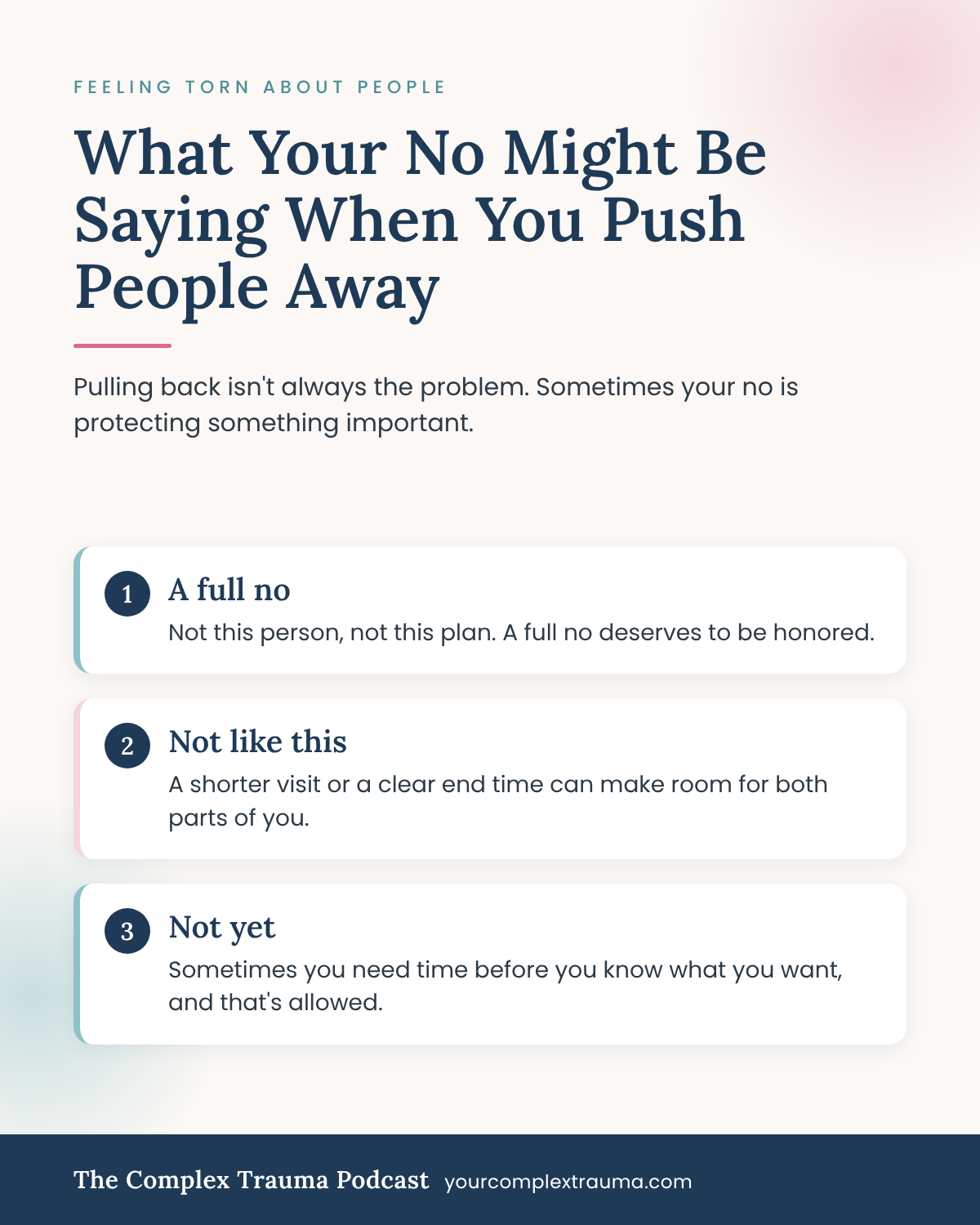
Pulling away isn't always the problem to fix. Sometimes your no is protecting something important, and it deserves to be honored.
A more useful question than "which one is the real me?" is "how much is right for me right now?" Zero is always one of the possible answers.
Why do I push people away when I want connection?
Many people push others away while wanting connection because closeness carries two meanings at once. It can mean comfort and belonging, and it can also carry old expectations of being judged, needed too much, or let down. When both meanings are active, part of you reaches and part of you retreats.
Maybe you've been hoping a certain person would finally make plans with you. They do, and for about a minute you feel giddy. Then you start drafting reasons you might be busy. You haven't changed your mind about liking them. Something else has joined the conversation.
That "something else" is usually trying to protect you. If closeness has ever come with criticism, unpredictability, or the feeling of losing yourself, it makes sense that a part of you would get nervous right when connection becomes real. The longing and the bracing can both be honest responses to your history.
Is pulling away always a trauma response?
Pulling away isn't always a trauma response. Sometimes you're tired, sometimes the plan doesn't fit, and sometimes a no is simply a no. Research on mixed emotions shows that people can feel positive and negative things at the same time, so being torn is a normal part of being human.
I think this matters, because trauma content online can make every hesitation sound like a symptom. If you grew up in a home where your no was ignored or overridden, the last thing you need is another voice telling you your no doesn't count. Complex trauma can turn up the volume on these conflicts, but it doesn't mean every boundary you set is something to heal your way out of.
What is your nervous system doing in a push-pull moment?
In a push-pull moment, your nervous system may be activating and braking at the same time. For decades, researchers have shown that the sympathetic and parasympathetic branches of the autonomic nervous system don't only work like a seesaw. They can move in opposite directions, move independently, or both increase together (Berntson, Cacioppo, and Quigley, 1991).
Freeze is one of the clearest examples. In threat research, anticipatory freezing involves a lot of activation in the body alongside a parasympathetic brake on movement. Researchers describe this state as active, because it helps the body take in information and prepare to act (Roelofs, 2017). So the stillness you feel when you're unsure about someone may be your body gathering information, which is a different picture than shutting down.
It also doesn't take much to set this off. In one study, women standing on a platform that measured tiny body movements swayed less and showed a slower heart rate while looking at angry faces (Roelofs, Hagenaars, and Stins, 2010). A picture was enough to nudge their bodies toward freeze. Imagine what an unreadable text, a tense silence, or a room full of new people can do.
One honest caveat matters here. You'll see posts claiming that the part of you that wants to go is your sympathetic nervous system and the part that wants to hide is your parasympathetic. Nobody can know that from the outside. What the research supports is that your body doesn't have to be in one clean state for you to feel pulled in two directions.
Why does my body react when I know I'm safe?
Your body can react when you know you're safe because new safety learning usually doesn't erase old threat learning. In fear learning research, the two tend to exist side by side, and context influences which one shows up (Bouton, 2004). That's why old reactions can return under stress, even after a lot of healing, and it doesn't mean the healing didn't count.
Is the push-pull a sign of disorganized attachment?
The push-pull can look like disorganized attachment, but you can't tell from your behavior alone. Disorganized attachment is a research concept that came from watching babies reunite with a parent after a short separation. Most babies had a strategy for getting comfort. Some didn't, and they would move toward the parent and then freeze or turn away.
Researchers describe the bind behind this as "fright without solution," which means the person you're wired to go to for safety is also someone who frightens you. Disorganized attachment isn't rare. In a large meta-analysis, about 15 percent of babies in low-risk, middle-class families showed it, with higher rates in families facing serious stress or maltreatment (van IJzendoorn, Schuengel, and Bakermans-Kranenburg, 1999). It also doesn't automatically mean a parent was abusive, since a parent who is frightened or overwhelmed can be part of the picture.
The attachment quiz you took online is measuring something different. Most quizzes ask how you feel in adult relationships, and that self-report approach doesn't line up neatly with the disorganization researchers observe in infants. A quiz can still give you useful language, and your story will always be bigger than any one label.
There's real hope in this research, too. Attachment patterns can shift over a lifetime, and researchers use the term earned security for adults who had very hard early relationships and developed secure ways of relating anyway (Roisman, Padrón, Sroufe, and Egeland, 2002).
Why does pulling back feel like relief, and then like rejection?
Pulling back often feels like relief first because the part of you that was bracing finally gets to rest. A few hours later, it can feel like rejection, because the part of you that wanted connection is still lonely. Both reactions can be true, and neither one proves you made the wrong choice.
Relief can be easy to misread. Sometimes relief tells you that you protected something you needed. Other times relief just means the tension stopped for a while. The ache afterward deserves the same respect. It's information about what you're hoping for, and it doesn't mean you have to say yes next time.
What tends to make this painful is the shame that shows up on top of both feelings. You might start telling yourself that you're too much, too flaky, or impossible to be close to. That story usually hurts more than the original conflict, and it gives you only one question to ask, which is what's wrong with you. A kinder and more useful approach is to get curious about what each part of you was trying to do.
What to do instead of forcing yourself to say yes
Instead of forcing yourself to say yes, try asking, "How much is right for me right now?" This question borrows from titration in Somatic Experiencing, which means approaching activation in small doses your system can take in. And zero is always one of the possible answers.
When you listen closely to the part of you that wants to pull back, it's often saying one of three things.
A full no. Not this person, not this plan, or not this relationship. A full no deserves to be honored, especially if your no was ignored when you were younger.
Not like this. You might want to see someone, just not for a whole evening with no way to leave. A shorter visit, a public place, or a clear end time can make room for both parts of you.
Not yet. Sometimes you need time before you know what you want. Asking for that time is a real answer, and you're allowed to take it.
None of these options is the more evolved answer. The point is that you get to choose with all the information in view, instead of letting the loudest or most frightened part decide on its own. Sometimes one part of you will be disappointed no matter what you choose, and that part deserves care instead of criticism.
Over time, small and chosen doses of connection with people who treat you well can give the guarded parts of you new experiences to take in. That's usually slower than forcing yourself into closeness, and it's much kinder.
I go deeper into this in the podcast episode Why Do I Want Two Opposite Things at the Same Time?, including how parts work and attachment research can help you make sense of feeling torn.
When the push-pull is telling you something about the other person
Sometimes the urge to pull away is responding to what's happening right now. If someone gives you the silent treatment when you say no, pushes until you give in, or makes you feel afraid, your distress is picking up on something real. A trauma-informed lens should never talk you out of noticing current harm.
You can also miss someone who hurt you and still know that contact isn't safe. Missing them tells you something about your attachment, and knowing it wasn't safe tells you something about the relationship. Some relationships call for no contact at all, and missing someone never means you owe them contact.
If you're experiencing abuse, threats, or stalking, please reach out for support and a concrete safety plan. In the US, you can contact the National Domestic Violence Hotline at 1-800-799-7233 or text START to 88788. If you're thinking about hurting yourself, call or text 988 to reach the 988 Suicide and Crisis Lifeline.
If you'd like support with this, I'd love for you to listen to more episodes of The Complex Trauma Podcast. And if you're in Pennsylvania and looking for a trauma therapist, my practice, Reclaim Therapy, offers therapy in person in Horsham, PA, and virtually throughout Pennsylvania.
Frequently Asked Questions
Why do I feel relieved when plans get canceled?
Feeling relieved when plans get canceled often means a part of you was bracing for the effort, exposure, or unpredictability of being around people. That relief can sit right next to real loneliness, and both feelings can be honest.
Is the push-pull a sign of disorganized attachment?
The push-pull isn't enough on its own to tell you that you have disorganized attachment. Disorganized attachment is a research concept based on observing babies with a caregiver, and online quizzes measure adult feelings about relationships, which is a different thing.
Can you want someone close and be afraid of them?
Yes, you can want someone close and be afraid of them at the same time. Attachment researchers call this bind fright without solution, when the person you turn to for safety is also someone who frightens you.
Why does my body react even when I know I'm safe?
Your body can react when you know you're safe because new safety learning usually doesn't erase old threat learning. The two can exist side by side, and stress or reminders can bring the older reaction back.
How do I stop pushing people away?
Instead of trying to stop pushing people away, try asking how much connection is right for you right now. A shorter visit, more time, or a clear no can all be valid answers, and choosing in small doses often helps more than forcing closeness.
Is it okay to say no when I'm lonely?
Yes, it's okay to say no when you're lonely. Loneliness tells you that you want connection, and it doesn't mean every invitation is the right one. You can honor your no and still look for connection that fits.
Everyday partsDissociative parts (alters)OwnershipFeel like you, even when they're intenseOften feel like "not me"InfluenceMoods and reactions you recognize as yoursThoughts, feelings, or urges that seem to come out of nowhereControlYou stay in charge of your choicesSome parts may take full control, especially in DIDMemoryOrdinary forgettingMay include memory gaps or time loss, though not alwaysSense of selfCan be painful without splitting your sense of who you areCan disrupt your sense of self, time, and daily functioningBetween partsShift and blend as situations changeOften avoid each other, especially early on
This comparison is meant for understanding, not diagnosis. Many people fall somewhere in between, and only a careful assessment can sort out what's true for you.
Does it feel like mine?
With everyday parts, even intense ones, there's a sense of "this is me." With dissociative parts, there's often a sense of "not me," meaning feelings, thoughts, memories, or body sensations you're aware of that don't feel like they belong to you. Clinicians describe this sense that something is happening without you choosing it as one of the major signs of dissociation. Some people describe feeling like more than one person, or having inner voices or parts with their own name or age.
Do parts influence you from the inside?
Imagine sitting in an ordinary work meeting when a wave of terror rises in your chest, along with an inner voice insisting that you're in trouble and need to hide, even though nothing in the room has changed. That feels very different from regular nerves before a presentation, which you recognize as your own and can make sense of. Those out-of-nowhere urges, feelings, sensations, or voices are called intrusions, or passive influence, and most dissociative parts influence a person this way without ever fully taking over. Hearing voices can come from many different places, which is one reason a careful assessment matters so much.
Do parts take over?
Sometimes, especially in DID, a part takes full control of a person's behavior, which is called switching. Some people lose time when that happens. Others stay aware but feel like they're watching themselves act with no control over it.
What about memory and time loss?
Everyone forgets things, and many people with complex trauma don't remember much of their childhood, which can have a lot of explanations. Dissociative amnesia goes further, like finding things you bought with no memory of buying them, or people greeting you as if they know you when you have no idea who they are. Time loss in the present is considered a hallmark of DID. Not losing time does not rule out a dissociative disorder, though, because amnesia isn't required for OSDD. For a full DID diagnosis, the DSM requires memory gaps, and the ICD-11 says amnesia is typically present.
How much does it get in the way of your life?
Janina Fisher describes a dissociative disorder as a more extreme degree of compartmentalization. It can affect your ability to know, moment to moment, who you are, to make a decision and carry it through, to manage impulses, to keep track of time, and to tell the past from the present. The diagnostic manuals also require that the symptoms cause real distress or real problems in daily life, relationships, or work.
How do parts relate to each other?
In dissociative systems, parts often avoid each other, especially early on, and some experts call this a phobia of dissociative parts. The daily-life part may want nothing to do with the parts stuck in trauma time, and those parts can feel abandoned. For many people with dissociative disorders, reaching the calm, curious center that IFS calls Self can be much harder, and a therapist's excitement about parts can feel more like danger than hope for a system that survived by hiding.
A couple of things matter less than you might think. The number of parts isn't important on its own, and a part's name, age, or appearance isn't meant to be taken literally. What matters is what the part does for you and what it has been carrying.