Parts vs Alters (How to Tell Everyday Parts From OSDD and DID)
Episode 151
Written by Sarah Herstich, LCSW, Certified EMDR Therapist, EMDRIA-Approved Consultant, Somatic Experiencing Practitioner, host of The Complex Trauma Podcast, and owner of Reclaim Therapy in Horsham, PA
Parts vs alters comes down to ownership. Everyday parts, like an anxious part or a people-pleasing part, are shifts in mood and role that still feel like you. Dissociative parts, which many people with DID and OSDD call alters, carry a "not me" quality and may push in from the inside or take over.
Key Takeaways
Everyone has parts, and ordinary parts still feel like they belong to you.
Dissociative parts, sometimes called alters, feel more like "not me" and can intrude on you or take over.
Dissociation exists on a spectrum that runs from PTSD through complex PTSD, OSDD, and DID.
Not losing time does not rule out OSDD, and being high-functioning doesn't answer the question either way.
Only a careful assessment with a clinician trained in dissociation can diagnose a dissociative disorder, and a diagnosis is a map, not an identity.
If you've been doing parts work for a while, you might know this exact moment. The language of parts helped so much. Your anxious part, your angry part, your part that wants to hide under a blanket for the weekend all suddenly made sense. And then you heard someone say "everyone has parts," and something in you wondered whether everyone's parts feel like yours.
This question came to me from a listener of The Complex Trauma Podcast. She's healing from CPTSD, and she had just learned she probably has OSDD too. She asked how common dissociative disorders are in trauma survivors, and how you know when a part is just a part of who you are and when it has crossed into a dissociative disorder. I answered her on the podcast, and I wanted to put the answer here too, because so many of you are carrying the same question and feeling a little scared to ask it out loud.
Before we go further, please hear this. This post is meant to help you understand, not to diagnose. If something here feels familiar, bring it to a therapist trained in trauma and dissociation.
Does everyone have parts?
Yes, everyone has parts. Having parts is a normal part of being human, and it doesn't mean anything is wrong with you.
Maybe there's a part of you that says yes to every invitation and a part that wants to cancel the minute you arrive. Maybe there's a part that feels about seven years old when your mom comments on your parenting, and a part that can calmly run a meeting an hour later. If you've listened to my podcast, you know mine include a very enthusiastic overfunctioning part.
Janina Fisher, a leading trauma clinician and author, draws a helpful distinction here. She describes Internal Family Systems, or IFS, as a parts theory that applies to all human beings, whether or not they've experienced trauma. Structural dissociation, which I'll explain below, is a trauma theory that describes what happens to the self when someone has to survive overwhelming experiences. So when your therapist says "a part of you" and a dissociation specialist says "a dissociative part," they may be using the same words to describe very different experiences.
What makes these everyday parts is that you can still recognize and claim all of them. You might feel like a completely different person at a family holiday than you do at work, and you still remember both, understand both, and know that both are you. Even when a part is loud, and even when it's a part you'd rather not have, it still feels like yours. "Part of me wants to scream" still means I want to scream.
What does dissociation actually mean?
Dissociation is a word that gets used for two different kinds of experiences, and even professionals don't always agree on where to draw the line between them.
The first kind is something almost everyone experiences, like driving home with no memory of the drive, getting so absorbed in a show that someone has to say your name three times, or spacing out in a meeting when you're exhausted. Some researchers place all of this on one big continuum of dissociation. Others, including the authors of Coping With Trauma-Related Dissociation, describe these as ordinary changes in awareness that show up when we're tired, stressed, or sick.
The second kind is more specific. In the trauma sense, dissociation is a division in the self, where one part of you owns an experience while another part of you holds it as not yours. Someone might say, "That scared little girl isn't me, and that fear isn't my fear." Dissociation experts describe that "not me" quality as the essence of dissociative disorders, and it's the meaning that matters most for the question of parts vs alters.
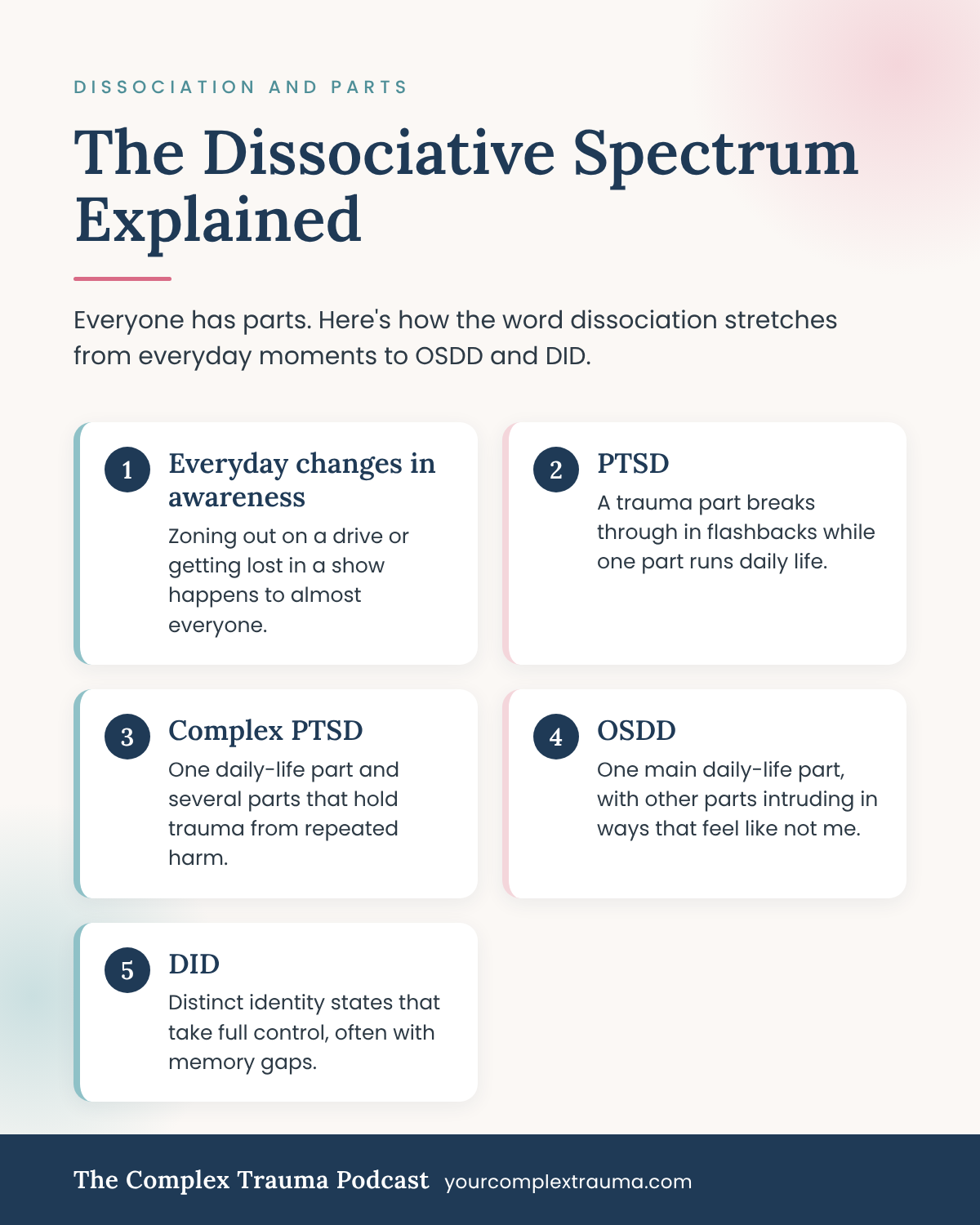
The dissociative spectrum explained, from everyday zoning out to OSDD and DID.
What is the dissociative spectrum?
The dissociative spectrum describes how trauma-related dissociation ranges from milder splits in the self, as in PTSD, to the more separate identity states of dissociative identity disorder. One of the most useful maps for this spectrum is the theory of structural dissociation, which Kathy Steele developed with two colleagues and which Janina Fisher builds much of her work on.
Structural dissociation is a clinical framework rather than a proven lab finding, but as maps go, it's a really good one. The basic idea is that when someone survives overwhelming experiences without enough support, the self tends to organize into at least two kinds of parts. One kind is focused on daily life, getting up, going to work, making the lunches, and keeping it together. The other kind stays stuck in what's called trauma time, experiencing the past as if it's still happening and holding the feelings and body sensations that were too much at the time.
PTSD and dissociation. In PTSD after a single traumatic event, this model describes one main part running daily life and a trauma part that breaks through in flashbacks or nightmares. Dissociation is common even here. A 2022 review that pooled 49 studies found that roughly 38 percent of people with PTSD met criteria for the dissociative subtype, which involves feeling detached from yourself or like the world isn't real, though that number varied widely depending on how studies measured it (White et al., 2022).
Complex PTSD and dissociation. Complex PTSD usually comes from repeated trauma, often in childhood and often in relationships. The World Health Organization recognizes CPTSD in its diagnostic manual, the ICD-11, although it is not yet its own diagnosis in the DSM, which most US clinicians use. In the structural dissociation model, people with complex trauma tend to have one main daily-life part and several trauma-holding parts. Janina Fisher describes clients who look like they have it all together on the outside while feeling deeply divided inside, which might sound a lot like you. If it does, my post on the hidden cost of high-functioning trauma may resonate too.
OSDD. OSDD stands for other specified dissociative disorder. In the ICD-11, the closest match for the kind of OSDD I'm describing here is called partial dissociative identity disorder, and older books call it DDNOS. The ICD-11 describes one main identity state that runs daily life while other identity states intrude on it through thoughts, feelings, perceptions, movements, or behavior that feel unwanted. Those other states don't typically take full control, though brief episodes can happen. Most people with OSDD have a single main part that functions in daily life, which is the same basic shape as complex trauma in this model. The difference is one of degree, meaning how separate the trauma parts are, how much they feel like "not me," and how much they act on their own.
DID. Dissociative identity disorder, or DID, sits at the far end of the spectrum. The ICD-11 describes two or more distinct identity states that recurrently take full control of a person's consciousness and functioning. In the structural dissociation model, people with DID usually have more than one part that functions in daily life, so one part might go to work while another parents, and they may have limited awareness of each other.
When Janina Fisher began explaining this model to her clients, she noticed something that has stayed with me. They didn't feel more stigmatized. They felt relieved, because the whole point of the model is that splitting happened for a reason. It's how they survived.
How common are dissociative disorders in people with CPTSD?
Dissociative disorders are more common than most people think, and they show up most often where trauma shows up. The numbers are messy, so I want to be honest about that.
Expert guidelines from the International Society for the Study of Trauma and Dissociation estimate DID at about 1 to 3 percent of the general population, and about 1 to 5 percent of people in inpatient psychiatric units, eating disorder programs, and substance use programs (ISSTD, 2011). Some researchers question these estimates, and they're still debated. One study at a New York City outpatient clinic interviewed 82 patients and found that 29 percent met criteria for some kind of dissociative disorder, yet only four had a dissociative diagnosis anywhere in their chart (Foote et al., 2006). That was one small study at one clinic, so the number shouldn't be stretched too far, but it points to two truths. Dissociative disorders are closely tied to trauma, and they get missed a lot.
The connection to trauma is strong. In that same study, people with dissociative disorders reported much higher rates of childhood abuse, and many studies find that close to everyone with DID also has PTSD, now or in the past. So it makes a lot of sense that OSDD would show up alongside CPTSD, the way it did for my listener.
What is the difference between parts and alters?
The difference between parts and alters is less about how loud a part is and more about whether it still feels like it belongs to you. Below are some of the things clinicians who specialize in dissociation pay attention to. I pulled them together from the work of Kathy Steele, Janina Fisher, and the diagnostic manuals, so this is my way of organizing them rather than an official list. Please use it to understand, not as a checklist to diagnose yourself.
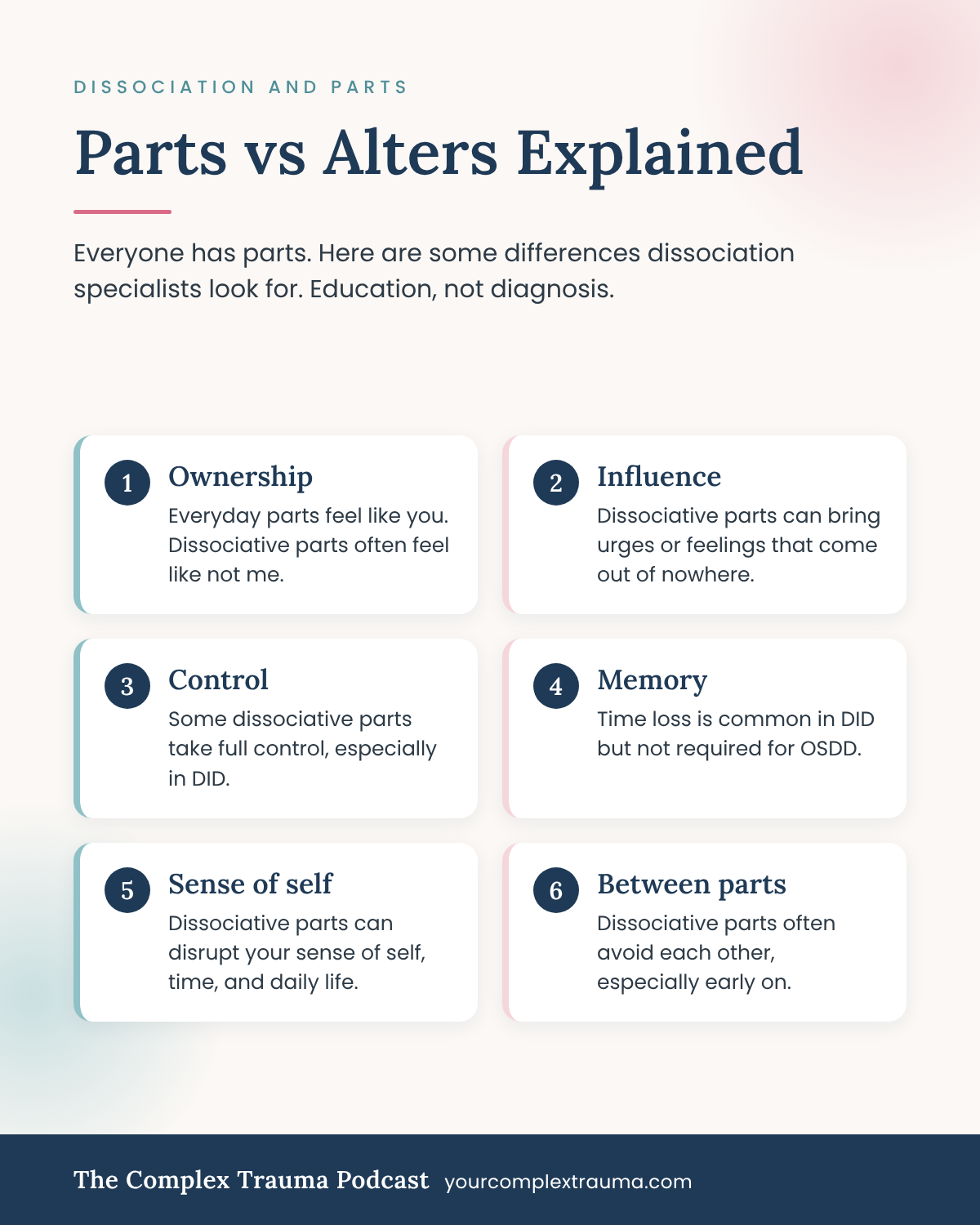
Parts vs alters explained, from everyday parts to the dissociative parts seen in OSDD and DID.
Everyday partsDissociative parts (alters)OwnershipFeel like you, even when they're intenseOften feel like "not me"InfluenceMoods and reactions you recognize as yoursThoughts, feelings, or urges that seem to come out of nowhereControlYou stay in charge of your choicesSome parts may take full control, especially in DIDMemoryOrdinary forgettingMay include memory gaps or time loss, though not alwaysSense of selfCan be painful without splitting your sense of who you areCan disrupt your sense of self, time, and daily functioningBetween partsShift and blend as situations changeOften avoid each other, especially early on
This comparison is meant for understanding, not diagnosis. Many people fall somewhere in between, and only a careful assessment can sort out what's true for you.
Does it feel like mine?
With everyday parts, even intense ones, there's a sense of "this is me." With dissociative parts, there's often a sense of "not me," meaning feelings, thoughts, memories, or body sensations you're aware of that don't feel like they belong to you. Clinicians describe this sense that something is happening without you choosing it as one of the major signs of dissociation. Some people describe feeling like more than one person, or having inner voices or parts with their own name or age.
Do parts influence you from the inside?
Imagine sitting in an ordinary work meeting when a wave of terror rises in your chest, along with an inner voice insisting that you're in trouble and need to hide, even though nothing in the room has changed. That feels very different from regular nerves before a presentation, which you recognize as your own and can make sense of. Those out-of-nowhere urges, feelings, sensations, or voices are called intrusions, or passive influence, and most dissociative parts influence a person this way without ever fully taking over. Hearing voices can come from many different places, which is one reason a careful assessment matters so much.
Do parts take over?
Sometimes, especially in DID, a part takes full control of a person's behavior, which is called switching. Some people lose time when that happens. Others stay aware but feel like they're watching themselves act with no control over it.
What about memory and time loss?
Everyone forgets things, and many people with complex trauma don't remember much of their childhood, which can have a lot of explanations. Dissociative amnesia goes further, like finding things you bought with no memory of buying them, or people greeting you as if they know you when you have no idea who they are. Time loss in the present is considered a hallmark of DID. Not losing time does not rule out a dissociative disorder, though, because amnesia isn't required for OSDD. For a full DID diagnosis, the DSM requires memory gaps, and the ICD-11 says amnesia is typically present.
How much does it get in the way of your life?
Janina Fisher describes a dissociative disorder as a more extreme degree of compartmentalization. It can affect your ability to know, moment to moment, who you are, to make a decision and carry it through, to manage impulses, to keep track of time, and to tell the past from the present. The diagnostic manuals also require that the symptoms cause real distress or real problems in daily life, relationships, or work.
How do parts relate to each other?
In dissociative systems, parts often avoid each other, especially early on, and some experts call this a phobia of dissociative parts. The daily-life part may want nothing to do with the parts stuck in trauma time, and those parts can feel abandoned. For many people with dissociative disorders, reaching the calm, curious center that IFS calls Self can be much harder, and a therapist's excitement about parts can feel more like danger than hope for a system that survived by hiding.
A couple of things matter less than you might think. The number of parts isn't important on its own, and a part's name, age, or appearance isn't meant to be taken literally. What matters is what the part does for you and what it has been carrying.
What if I'm making this up?
Doubting yourself is very common with dissociation, and that doubt can't settle the question in either direction. The part of you that runs daily life often has good reasons to insist everything is fine, and shame can make these experiences hard to say out loud, even to yourself. Some people spend years minimizing what happens inside, while others worry that naming it at all means they're exaggerating. Both reactions make sense, and neither one is proof of anything.
You might also be wondering about all the DID content online. I want to be careful here, because people with DID get accused of faking all the time, including by clinicians, and that does real harm. Some clinicians have reported seeing more young people self-identify with DID after watching content online, and nobody knows yet what that means. Some people may take on language from what they watch, and for others, seeing someone describe their inner world may be the first time they ever felt safe naming what was already there. Both concerns about overdiagnosis online and the reality of underdiagnosis in therapy offices can be true at once.
Being high-functioning doesn't rule anything out either. A part that keeps life running is part of how dissociation can work, so being able to hold down a job, parent, and show up for everyone doesn't answer the question either way. And OSDD isn't "almost DID." It has its own name for a reason, and it deserves to be taken seriously on its own terms.
How is OSDD or DID diagnosed?
OSDD and DID are diagnosed through a careful assessment with a clinician trained in dissociation, usually including structured interviews and time. Screening tools like the Dissociative Experiences Scale can flag experiences worth exploring, but they aren't diagnostic, and they include many experiences that people without dissociative disorders have, like getting absorbed in a movie. Dissociative systems don't always show everything right away, so an assessment can take a while, and that's okay.
A diagnosis is a map that helps you and your therapist figure out how to help, and you are so much bigger than the map. If you just found out you might have a dissociative disorder, you may feel relief, fear, doubt, and grief all in the same afternoon. You're still exactly who you were the day before you found out. The only new thing is a map for something your system has been doing for a long time to keep you safe.
What does healing look like for dissociative disorders?
Healing from a dissociative disorder usually follows a phase-oriented approach that starts with the present, meaning safety, stabilization, sleep, and daily life, before going near the hardest memories. You don't have to start with the painful past. A big part of the work is helping parts get to know each other and reach agreements, which is very different from forcing parts to go along with you or ignoring what they need.
The conversation about the goal of treatment has shifted over the years. Many clinicians and many people with lived experience now say the goal is whatever helps you live well, and you get a big say in what that looks like. For a lot of systems, that means parts that know each other, communicate, cooperate, and take care of each other. For some people, it means eventually blending into one. The expert guidelines describe integration as an ongoing process and recognize cooperation between parts as a realistic outcome, while still leaning toward blending, so this conversation is still happening (ISSTD, 2011). What matters most is that your system gets a say.
If your system already communicates and cooperates, I see you. The avoidance and walls between parts I described above are what it can look like before that kind of work happens, and they aren't everyone's story. The research on treating dissociative disorders is still young, but the studies we have are encouraging, and clinicians describe inner worlds that start out feeling like war zones and slowly become places that feel safe and warm.
How do you find a therapist who understands dissociation?
The most helpful therapist for dissociation is one with specific training in trauma and dissociative disorders, who goes slowly, puts safety first, and works with your whole system rather than around it. Plenty of wonderful therapists haven't had that training, and it's completely okay to ask about it directly.
When you're looking, you might ask a potential therapist whether they've been trained to assess and treat dissociation, how they approach parts work with someone whose parts feel very separate, and how they pace the work so you aren't pushed into hard memories before your system is ready. A good trauma therapist will welcome those questions. You might also notice how you feel in your body when you talk with them, because feeling even a little safer in the room is useful information too.
If you'd like to hear me walk through all of this out loud, listen to the full episode on The Complex Trauma Podcast, and follow the show so you don't miss the next one.
Have a question you'd love answered in a future episode? Send it my way, because some of my favorite episodes have come from your questions.
And if you happen to be in Pennsylvania, my group practice, Reclaim Therapy, offers trauma therapy in person in Horsham and virtually across the state.
If you'd like something to lean on in the meantime, my free Dysregulation Toolkit is a gentle place to start. It's a collection of small, body-based tools for the moments when your nervous system feels like too much, and you're welcome to go at your own pace and skip anything that doesn't feel right for your system.
What your system did made sense. It's how you survived, and there are people who know how to help you make it feel safer inside.
Take good care of yourself. 🧡
Frequently Asked Questions
What is the difference between parts and alters?
Parts are the different moods, roles, and reactions every person has, and they still feel like you. Alters is a word many people with DID or OSDD use for dissociative parts, which feel more separate, carry a "not me" quality, and may intrude on you or take over without your choice.
Can you have OSDD and CPTSD at the same time?
Yes. Dissociative disorders are strongly connected to trauma, and many people with OSDD or DID also have PTSD or complex PTSD. Having both is a common pairing, and a trauma therapist trained in dissociation can help you understand how they fit together for you.
Do you have to lose time to have OSDD?
No. Memory gaps are not required for an OSDD diagnosis. Time loss is considered a hallmark of DID, but many people with OSDD never lose time, so not losing time doesn't rule out a dissociative disorder.
Is IFS safe for people with DID or OSDD?
Parts work can be very helpful for people with dissociative disorders, as long as it is paced for their system. That usually means going slower, focusing on safety and the present first, and working with a therapist who understands dissociation.
How common is dissociative identity disorder?
Estimates usually place DID at about 1 to 3 percent of the general population, and higher among people already in mental health treatment. These numbers vary by study and are still debated, and dissociative disorders are often missed.
Can an online quiz tell me if I have a dissociative disorder?
No. Screening tools like the Dissociative Experiences Scale can flag experiences worth exploring, but they are not diagnostic. A diagnosis takes a careful assessment with a clinician trained in dissociation, and it often takes time.