Grieving the Childhood You Never Had
Episode 149
Written by Sarah Herstich, LCSW, Certified EMDR Therapist, EMDRIA-Approved Consultant, Somatic Experiencing Practitioner, host of The Complex Trauma Podcast and owner of Reclaim Therapy.
Childhood emotional neglect grief is the grief of what didn't happen. It's mourning the comfort, protection, interest, and affection that should have been there and wasn't. Because the loss is made of absences rather than events, many people don't recognize it until adulthood, often when someone finally offers them the care they went without.
Key Takeaways
You can grieve something you never had. The grief of childhood emotional neglect is organized around what kept not happening, which is why it can take decades to find.
Children take the home they grow up in as reality, so a kid who isn't comforted often concludes "I shouldn't need comfort" instead of "comfort is missing."
This grief often shows up as anger, envy, numbness, heaviness in the body, or disbelief, and it can appear when someone treats you well now.
Context and impact answer different questions. You can understand why a parent couldn't give you something and still grieve not receiving it.
Grieving doesn't require tears, blame, or cutting anyone off. Recognition counts, and the pace matters more than the intensity.
I say the word grief on my podcast almost every week. Grieve the childhood you didn't have. Grieve the parent you needed. Grieve the years you spent surviving. Then a listener wrote to me with a question I'd somehow never answered. She grew up without hugs, remembers wanting them, and came to believe that needing one meant she wasn't growing up properly. Her childhood was pretty good overall. Decades later, she wanted to know if she had anything to grieve at all, and whether being sad about it was selfish.
That question deserved a whole episode, and it deserves this post, because so many people with complex trauma are told to grieve and never told how. Here's what I'd want you to know.
Why is the grief of childhood emotional neglect so hard to recognize?
The grief of childhood emotional neglect is hard to recognize because there's usually no event to point to. The loss is made of things that repeatedly didn't happen, and a child has no other version of family life to compare theirs with.
When someone dies, there's a before and an after. Someone was here, and now they aren't. The loss may be unbearable, but you can name what changed.
Emotional neglect works differently. You were upset and nobody noticed. You accomplished something and there wasn't much interest. You needed help making sense of a friendship, a fear, or your own changing body, and you figured it out alone. You wanted affection and learned not to ask. There may be no single scene that captures it. You might remember a childhood that looked stable from the outside, with school and birthdays and clean clothes, and there may have been real love in your house alongside very little room for your emotional life.
Children generally take the environment they're raised in as reality. So instead of thinking "I need comfort and my parent can't offer it," a kid tends to land somewhere like "I shouldn't need comfort. I'm too sensitive. Hugs are for babies. If I'm easy and independent, everything will be okay." A seven-year-old isn't in a position to assess what the adults around her are capable of. She's trying to keep living inside the relationships she depends on.
This is why the grief often doesn't become recognizable until much later, when you finally gain a point of comparison. A partner responds to you with care and it feels strangely unfamiliar. You have your own child and notice how instinctively you want to comfort them. A therapist remembers something you said three weeks ago and an emotion shows up that seems far too big for the moment. The experience in front of you gives shape to the absence behind you.
What are you actually grieving if nothing "happened"?
If you grew up with emotional neglect, you may be grieving the developmental support that should have been available to you: comfort when you were overwhelmed, protection when something was wrong, an adult who was curious about who you were, and the freedom to be a kid instead of managing the adults around you.
For some people the loss is the comfort that didn't come. For others it's never having someone help them put words to feelings, or never being able to depend on anyone without feeling ashamed or indebted. Some people grieve the play and experimentation they missed because they were monitoring moods, keeping secrets, or working very hard not to need anything. Many grieve what those adaptations cost later, like the relationships they couldn't trust and the years they read their own responses as character defects.
And some people are grieving a parent who is still alive and still unable to meet them. That one has its own kind of pain, because the relationship exists, and so does the hope that one more conversation will finally produce the response they've been waiting for.
You don't have to agree with every item on that list. What matters is getting specific, because "I lost my childhood" can be completely true and still too broad to feel. "I wish someone had come into my room after I was upset" is specific. "I needed an adult to notice I was scared" is specific. Getting specific doesn't mean forcing a memory. You're identifying the care, protection, or interest that mattered to you.
One honest caveat about hugs in particular. Plenty of loving families aren't physically affectionate, for reasons that include culture, sensory preferences, and a child's own boundaries. The absence of hugs alone doesn't tell us much. What stood out in my listener's story was that she wanted them, watched other kids get them, and decided her wanting meant something was wrong with her. The longing is the part that matters.
Why does grieving your childhood feel like self-pity?
Grieving childhood emotional neglect often feels like self-pity because the moment you recognize a need, your mind starts building the case against you. Context and impact answer different questions, and you can hold a compassionate answer to one alongside a painful answer to the other.
You identify something you wanted. You let yourself consider that it mattered. And before you've had ten seconds with that, a voice shows up. Your parent was under enormous stress. They had their own trauma. They showed love by working and cooking and making sure you had opportunities they never had. Other kids had it so much worse. What right do you have to grieve?
Understanding context is important. It lets you see your caregiver as a whole person instead of reducing them to the ways they failed you. But context answers "why couldn't my parent offer this?" Impact answers "what was it like for me not to receive it?" You can have a compassionate answer to the first and a painful answer to the second, and grief doesn't require a verdict that your parent was bad. It doesn't require you to erase the birthday cakes and the rides to school, and it doesn't require those good things to stand as evidence against your pain.
When someone tells me their childhood was good overall, I get curious about what "overall" is being asked to do in that sentence. Sometimes it's an honest description. Sometimes it's doing protective work, rushing to the total score before you're allowed to look at one unmet need. You don't have to grade your whole childhood to have a feeling about part of it. You can say, my mother loved me and I was lonely with her. You can say, I understand why affection was hard for my parent, and I wish I had been held.
For some people, self-criticism keeps grief at a distance because grief carries information they haven't been ready to take in. If I decide I was too needy, I still have a problem I can fix. I can need less. If I recognize that I was a child with a reasonable need and the adult couldn't meet it, I come into contact with helplessness, and that can be heartbreaking. It may also be why shame tends to get louder right when self-compassion starts.
What does the grief of childhood emotional neglect feel like?
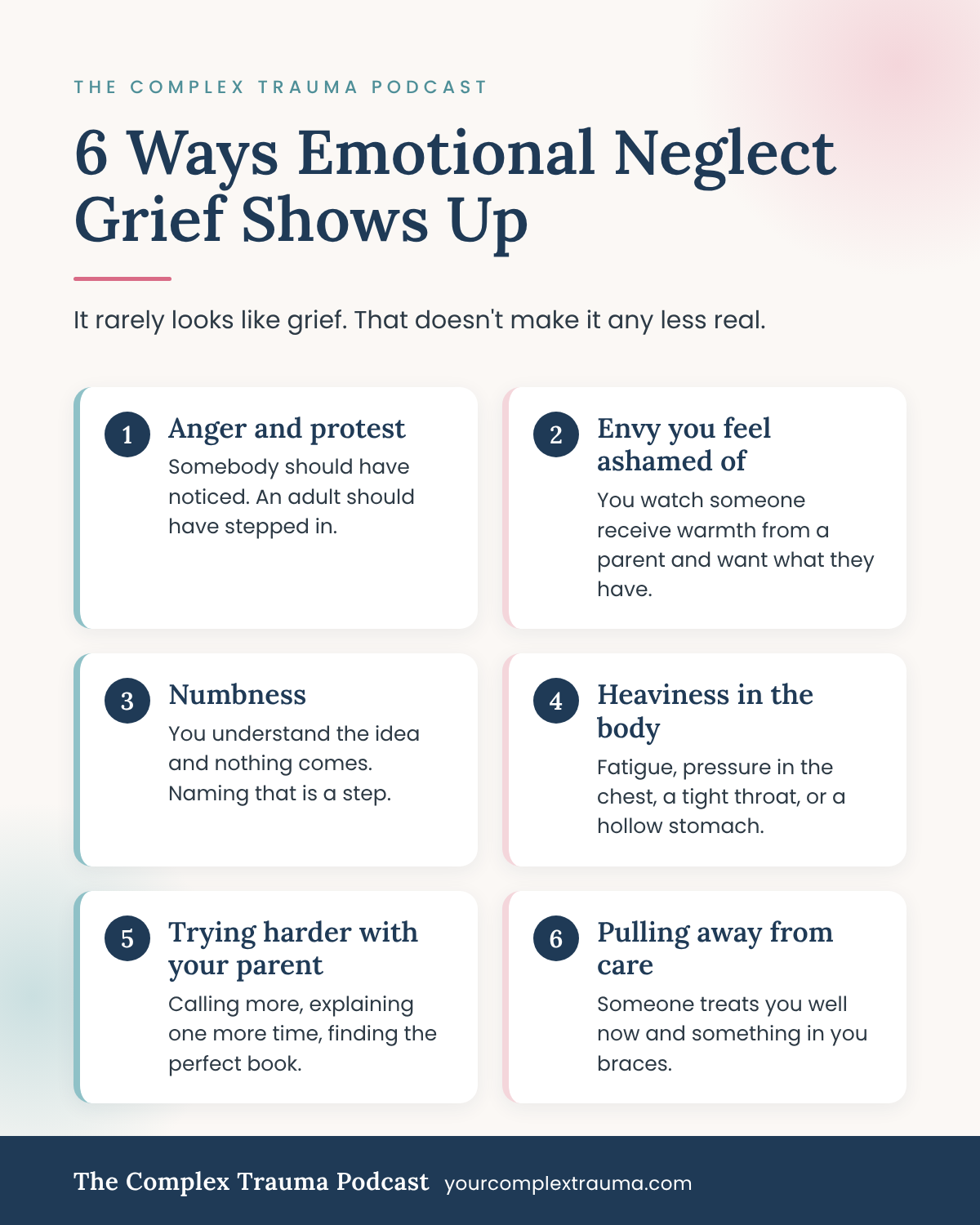
Six ways the grief of childhood emotional neglect shows up, most of which don't look like grief at all.
The grief of childhood emotional neglect rarely looks like textbook grief. It can show up as sadness, anger, envy, numbness, physical heaviness, disbelief, or trying harder with the parent you still have, and it can surface when something good happens.
Sometimes it looks the way you'd expect. You see an old school picture and notice, for the first time, how hard that kid was working to look okay.
It can also show up as anger, because loss can include protest. Somebody should have noticed. An adult should have stepped in. Envy is a big one, and people carry a lot of shame about it. You watch someone receive warmth from a parent, you want what they have, and then you judge yourself for being jealous. I'd read that envy as a longing that's pointing at something.
For some people it's numbness. You understand the idea and nothing comes. Numbness can have a lot of explanations, including stress, depression, dissociation, and medication, and being able to name it is itself a step. Grief can also be physical: fatigue, pressure in the chest, a tight throat, an ache behind the eyes, a hollow feeling in the stomach. There's a disbelief version, too. Wait, parents talk to their kids about feelings? And there's a version that looks like trying harder with the parent you still have, calling more, explaining yourself one more time, finding the perfect book that might finally make them understand.
Grief may also arrive when something good happens. You set a boundary and feel proud, then feel sad that nobody protected yours when you were young. You find a safe partner and realize how much you normalized before.
One caution. Grief can include low mood, sleep changes, trouble concentrating, and withdrawal, and so can depression. Persistent or worsening symptoms deserve care in their own right. Please don't assume a depressive episode is grief you simply need to feel harder.
Why does receiving care now make it hurt more?
For many people with complex trauma, present-day care can trigger grief because the body learned early what to expect from closeness. When someone finally offers warmth, the mismatch between expectation and experience can register as alarm, and once the body has a reference point for comfort, it can feel the distance of everything it went without.
This is the piece that confuses people most, because it doesn't show up when you're thinking about childhood. It shows up when someone treats you well now. A partner holds you and your body goes rigid. A therapist speaks with tenderness and you feel annoyed. A friend offers help and you hear yourself say "I'm fine, I've got it" before they've finished the sentence.
It's easy to read that as proof you don't want connection. Here's how I think about it as a somatic therapist. Long before you had words for any of this, your body may have been learning what to expect from closeness, and that kind of learning happens through repetition. If reaching for comfort mostly led to nothing, a child's body can organize around not reaching. For some people that looks like shoulders that live a little high and breath that stays shallow. You get very good at handling it.
Then, decades later, someone offers you the real thing, and what your body expects and what's happening don't match. For some people that mismatch registers as alarm before it registers as anything else. Unfamiliar can feel unsafe, even when unfamiliar is kind. So you stiffen, or crack a joke, or suddenly need to check on something in the other room. And if you can stay with the moment a few seconds longer, there's sometimes a sadness underneath the bracing that seems far too big for a hug in a hallway.
I think of present-day care as a measuring stick. The warmth in front of you gives your body a reference point it never had, and once you have the reference point, you can feel the distance. If this is what being comforted feels like, then I went without it for a very long time. So if being loved well sometimes makes you feel worse before it makes you feel better, you may be feeling the contrast. The care is landing, and some of what it lands on is the absence.
Two things I don't want lost here. Not every flinch is a childhood story. Sometimes you don't want to be touched by that person, or the moment is simply wrong, and your irritation is accurate information about right now. And if touch has been a source of harm for you, stiffening may be about that, and staying longer is never the assignment. When it is the contrast, and the person is safe, you don't have to white-knuckle through anything. You can let in a small amount, stay one breath longer than usual, notice one thing that feels okay, and step back. That counts as receiving.
Do you have to make yourself grieve?
No. Grieving childhood emotional neglect doesn't require crying, catharsis, or searching for the most painful version of your story. Grief can include emotion, and it can also be recognition: the moment you stop arguing that a need was unreasonable.
Trauma survivors are very good at turning healing language into a new standard to fail. You hear "grief is necessary" and start monitoring yourself. Am I sad enough? Did I cry enough? What if I feel nothing? No emotional display proves you've faced your past, and the absence of tears doesn't prove you haven't.
Pete Walker has shaped how CPTSD communities talk about grief, and many survivors find his language deeply useful. His model, which centers crying, angering, talking or writing feelings out, and staying with a feeling as it moves through, was built from his clinical work and his own lived experience, and I'd hold it that way. You don't need to manufacture an emotion because an expert told you it should be there.
Grieving can be the moment you stop arguing that a need was unreasonable. It can be updating what you expect a parent is able to give, even while you wish it were different. It can be noticing the cost of an old survival strategy without hating yourself for using it. And it tends to happen in pieces, with new layers showing up when you become a parent, enter a safe relationship, or realize an aging caregiver is unlikely to change. That doesn't mean grief is endless. Your understanding changes because your life changes.
Grief also doesn't have to be the focus every day. Researchers who study bereavement after a death describe a back-and-forth between contact with the loss and getting on with ordinary life. That work isn't about developmental grief, so I'm borrowing it only as a permission slip. We remember, and then we answer an email. We cry, and then we laugh at something. I wouldn't rush to call that avoidance. It may be the pace at which an experience becomes bearable.
If grief is present, the work is often less about producing it and more about noticing what interrupts it. Maybe you feel sadness for five seconds and hear "get over it." Maybe you become analytical, and you can explain attachment theory beautifully, and the sentence "I just wanted my mom" is the one that won't come out. Intellectual understanding isn't bad. The question is whether thinking gives you a way to approach your experience, or whether it's the only place you're allowed to go.
Can receiving care now actually change anything?
An adult relationship can't go back and provide a developmental experience at the age it was needed. Some clinicians and researchers think that receiving care now can still update old emotional learning, through a process called memory reconsolidation, in which an activated expectation meets an experience that contradicts it.
Somewhere in you there may be an old piece of emotional learning that goes something like "if I want closeness, it won't come, or it will come with a cost." When someone offers care now and you actually let a little of it land, that old prediction runs into evidence that contradicts it. You reached, and this time something arrived.
The theory is that the mismatch is what opens the door. The old learning has to be awake, meaning you're in the feeling of "if I reach, nothing comes" rather than describing it from a distance. Then, while it's alive in your system, you have an experience that contradicts it. Your body is expecting the absence and gets the presence instead, in the same few seconds. That's also why a single warm moment doesn't usually do it. The pairing tends to need repeating, at a dose you can actually take in. If the care floods you and you leave your body, the old learning was never really in the room to be updated.
I want to hold this carefully. The lab science on reconsolidation is real, and how much of it translates into what happens in a hug or a therapy session is still being worked out. What I can say is that for some people, receiving care now does more than fill a gap. It's the moment an old rule gets a second opinion.
What does grieving look like in real life?
Grieving childhood emotional neglect in practice can be as small as naming one specific absence, letting two true things sit side by side, being witnessed by someone who doesn't debate whether it counts, or asking for something different in a present-day relationship.
You might start with one sentence that names an experience rather than an entire childhood. I needed comfort when I was scared. I wanted someone to be interested in me. Then notice what answers. Maybe it's "that wasn't a big deal," or "my parents did their best," or "if I let myself want that now, I'll become needy." You don't have to argue with the response. It may be showing you how the need has been managed for a very long time.
You might write both sides down without deciding which one wins. My parent loved me, and their way of loving me didn't include the care I needed. I don't know exactly how the past affected me, and I know I learned to feel ashamed of wanting affection. You're looking for language that's accurate for you, and it doesn't have to sound therapeutic.
Grieving can involve being witnessed. You tell a therapist or a trusted person, "I know this sounds small, but I remember watching other kids get hugged," and instead of debating whether it qualifies as trauma, they stay with what the memory was like for you. Support doesn't have to mean touch. It can be someone listening without rushing you, or respecting that you're done talking.
Some people want a ritual, like a letter they don't send, or an object that represents what they needed. Rituals can give form to losses that never had a public event. They're optional. And grieving can involve changing something in the present, like asking a partner, "Could you ask before hugging me, and if I say yes, could you stay a few seconds instead of pulling away?" Or, "I don't want a hug, but would you sit with me?"
Naming the loss may change how you see the relationship with your parent now, and that can bring up a fear: if I accept they couldn't give me what I needed, am I giving up on them? It doesn't have to mean that. Recognizing a parent's limitations doesn't dictate one boundary for everyone. Some people stay close and stop bringing certain needs to that relationship. Some need distance. Deciding to go low or no contact is a big decision, and I'd encourage you to bring it to therapy. Grief isn't a covert instruction to cut anyone off. It may simply help you base decisions on the relationship in front of you instead of on the hope that the next attempt will finally rewrite the past.
What if the grief starts to feel too big?
If grieving childhood emotional neglect brings sleep changes, more nightmares, or daily life getting harder, that's a sign you may need more support or a slower pace, not proof the grief is working and not a failure.
Telling your therapist how you respond to this work is the work. A lot of people assume they have to get better at handling the overwhelm on their own before they've earned the right to keep going, and it's the opposite. "When we talk about what I didn't get, I leave feeling overwhelmed for days" is information a trauma-informed therapist needs, and a good one will use it to change the pace, the dose, or the approach.
If you don't have a therapist, you can still be selective about when and where you approach this. You can decide not to explore it late at night or when you're depleted. You can stop an exercise, call a supportive person, eat, rest, or just go back to your day. And if grief is accompanied by thoughts of harming yourself or a sense that you may not stay safe, please reach out to emergency or crisis services where you live. That deserves direct care, not an interpretation that it's a necessary stage of healing.
So, back to my listener. If you're decades into your life and only recently realized something may have been missing, do you have anything to grieve? You may. A need can matter even when you learned not to recognize it. Not knowing what you were missing may have helped you adapt, and it didn't necessarily remove the impact. You may also have gratitude, loyalty, and love, and protectiveness toward your mother in the same breath as anger with her. There's room for more than one response.
If all you can say today is "I remember wanting a hug, and I thought wanting one was wrong," that's a place to start. You don't have to turn it into the worst thing that ever happened. You also don't have to keep making it smaller so everyone else stays comfortable. You get to let it be the size it actually was for you.
I go deeper on all of this, including the listener's full question, in the episode above. If you're working through this kind of grief, a trauma-informed therapist who understands complex trauma can help you pace it. And if you have a question you'd like me to answer on the show, send me a message on Instagram. If you're wondering about it, thousands of other listeners probably are too.
Frequently Asked Questions
Can you grieve something you never had?
Yes. Grief can follow the absence of care, protection, or affection that should have been part of childhood, even if you didn't recognize it as missing at the time. This kind of loss has no clear before and after, which is why it often surfaces in adulthood when someone finally offers the care you went without.
What is childhood emotional neglect grief?
Childhood emotional neglect grief is mourning for the emotional support that repeatedly didn't happen in childhood, such as comfort when you were upset, protection when something was wrong, or an adult who was curious about you. It's a grief of absences rather than events, and it often shows up as anger, envy, numbness, or physical heaviness rather than tears.
Why do I feel worse when someone is kind to me?
For some people with complex trauma, present-day care creates a contrast with what their body learned to expect from closeness. The mismatch can register as alarm, and the warmth can make the old absence easier to feel. If being loved well makes you feel worse before it feels better, you may be feeling that contrast rather than rejecting connection.
Is this grief or depression?
They can overlap. Grief can include low mood, sleep changes, trouble concentrating, and withdrawal, and so can depression. Persistent or worsening symptoms deserve care in their own right, so talk with a therapist or doctor rather than assuming a depressive episode is grief you need to feel harder.
Does grieving my childhood mean blaming my parents?
No. Grief doesn't require a verdict that your parent was bad, and it doesn't require erasing the good things they did. Understanding why a parent couldn't offer something and grieving what it was like not to receive it are two different questions, and both answers can be true at once.
Does grieving mean I have to cut off my parent?
No. Recognizing a parent's limitations doesn't dictate one boundary for everyone. Some people stay close and stop bringing certain needs to the relationship, some renegotiate contact, and some need distance. Grief may help you base those decisions on the relationship you actually have rather than on hope that the next attempt will change the past. Decisions about low or no contact are worth bringing to therapy.