Why Do I Feel Worse After Therapy? (Complex Trauma, EMDR, and Dissociation in Session)
Episode 153
Written by Sarah Herstich, LCSW, a Certified EMDR Therapist, EMDRIA-Approved Consultant, and Somatic Experiencing Practitioner. Sarah hosts The Complex Trauma Podcast and owns Reclaim Therapy, a trauma-focused group practice in Horsham, PA.
Feeling worse after trauma therapy can be a normal part of the process, especially with complex trauma, where the therapy relationship itself can be activating and painful memories are tightly tangled together. What matters most is whether you can still mostly function, whether things settle over time, and whether sessions are getting easier or harder. Feeling flooded for days, or disappearing during sessions, is usually information that the pacing needs to change. It doesn't mean you're bad at therapy.
When I was getting ready for this week's episode, I spent some time reading what people say about therapy on Reddit and in trauma forums. One person called it a trauma therapy hangover. Another said every session leaves them feeling like they have the flu for a couple of days. Someone described therapy as throwing everything up in the air and then spending the rest of the week figuring out where it all lands. And over and over, in so many different words, people wrote some version of the same thing: I think something is wrong with me.
This post grew out of two listener questions. One came from someone in EMDR for complex trauma who leaves sessions dysregulated for days. She looks calm on the outside, but she's clenching her jaw, biting her nails, and getting triggered by everything. She wanted to know what an EMDR session for complex trauma should actually look like, and she said something I keep thinking about: "I can't help but feel like something is missing." The second listener is dissociating a lot in sessions and wants to know how to make it stop.
If either of those sounds like you, I want you to know that you're in good company, and that there are real reasons this happens.
Key Takeaways
Some stirring up after trauma therapy is expected. Being flooded for days on end is a sign the pacing may need to change.
With complex trauma, the therapy relationship itself can be activating, and looking fine in session is often a survival strategy you learned a long time ago.
EMDR for complex trauma usually works best with more preparation, smaller targets, and smaller pieces of a memory at a time.
Dissociating in session is protective, and it's often a sign that things got to be too much too fast.
Telling your therapist what's really happening is part of the healing work, especially if you learned early that needing things made life harder.
Is it normal to feel worse after trauma therapy?
Sometimes, yes. Trauma therapy asks you to get close to experiences your system has worked very hard to keep at a distance, so it makes sense that it can stir things up. The important distinction is between being stirred up and being flooded.
Your window of tolerance is the zone where your nervous system can feel things and still stay online. You can be sad, activated, or uncomfortable and still think clearly, still feel your body, and still make your kid a snack. When therapy pushes you outside that window, you can tip into hyperarousal (panic, irritability, poor sleep, feeling on edge) or hypoarousal (numbness, fog, shutting down, feeling far away from your own life).
How long it lasts isn't the best marker on its own. In one analysis of trauma-focused therapies, somewhere between about 15 and 30 percent of people had a real spike in symptoms partway through treatment. For most of them, symptoms came back down in about a week and a half, and most still improved meaningfully by the end (Larsen et al., 2016). A larger review found that, on average, people don't get worse in the middle of trauma-focused therapy (Purnell et al., 2024). I want to be honest about the limits here, though. Averages can hide the people who really struggled, and most of this research looks at PTSD rather than complex PTSD.
Why does therapy feel harder when you have complex trauma?
A car accident usually has a before and an after. Complex trauma tends to happen over and over, often for years, and so often it happens inside relationships with people who were supposed to keep you safe. Sometimes it happens with people who were there physically but weren't available to you emotionally.
Now think about what therapy is. It's a relationship with a person who is paying very close attention to you, asking how you feel, and noticing your face. For a lot of people with complex trauma, that alone can stir things up before you ever touch a memory. Being seen can feel wonderful and deeply unsafe at the same time.
Then there's the habit of looking fine. If you grew up as the easy kid, the responsible one, or the one nobody had to worry about, you probably learned early that having needs made things harder for everyone. Your nervous system figured out that calm on the outside kept you safe, so of course you bring that skill into the therapy room. It's the same reason so many people tell their therapist the week was fine when it really wasn't. I've been that client, too.
Finally, there's the sheer volume of what you're carrying. Thomas Zimmerman, author of EMDR With Complex Trauma, describes this with a metaphor I love. In EMDR and in a lot of trauma therapy, healing happens when a stuck memory links up with helpful things you already know now, like the fact that kids aren't responsible for what adults do to them. People who had fairly secure childhoods tend to have a boat the size of a cruise ship, with plenty of that helpful information on board. People with complex trauma often have something closer to a canoe, and an ocean full of whales. You can't land a whale in a canoe.
Why does it hit days after a session instead of in the room?
A few different things can be going on. Sometimes processing simply keeps going after you leave, because your brain doesn't stop working on something the moment a session ends. That can look like extra dreams, memories floating up, or feeling raw for a while, and it's expected.
Other times, a session pushes you too far outside your window. When that happens, the parts of you that hold the helpful information (the grown-up parts, the parts that know it wasn't your fault) go a little offline. The painful material gets stirred up but has a much harder time connecting to anything helpful, so it gets opened without getting resolved.
Complex trauma memories are also tangled together. If one memory pulls in five or ten others during a session, you go home with a whole drawer open instead of one thing. It makes sense that your body is still buzzing on Thursday.
What does EMDR for complex trauma look like?
EMDR stands for eye movement desensitization and reprocessing. The standard approach works beautifully for a lot of people, and preparation, closure, and checking in at the next session are already built into it. With complex trauma, I tend to spend a lot more time in those pieces and go a lot slower. This is how I work, and there are many skilled EMDR therapists who do things differently and do them well. Much of how I think about these adjustments has been shaped by Thomas Zimmerman's work.
Getting ready before processing
Before we touch a memory, I want to find things that help your body settle. I'm looking for resources you can actually feel, ones that work in session and that you've tried at home and noticed help, even a little. I won't take you anywhere in a car without brakes. I also want to get to know your parts, including the protective ones, the young ones, and the one that rolls its eyes at breathing exercises. Before we work on anything, I'll usually ask whether it feels okay to all of you today. Preparation shouldn't feel like a test you keep failing, though. The goal is to build what you need so you can start, and then actually start.
Starting with smaller memories
With complex trauma, I usually don't start with the earliest or worst memory. We catch smaller fish first. Each smaller memory that resolves puts more helpful information on board, so the boat gets bigger and the larger memories eventually have somewhere to land. Starting small isn't actually the slow road, because when one memory resolves, others with a similar shape can often resolve along with it.
Before working on a childhood memory, I'll often ask how much the most grown-up part of you, the part that pays the bills and puts gas in the car, actually feels that a child isn't responsible for what an adult did. Many people can say the right answer out loud while their body still insists it was their fault. That self-blame usually isn't random. For a lot of kids, believing it was their fault was protective, because if it was my fault, maybe I could fix it. That belief kept a sense of control and kept them attached to people they needed. If none of you believes it wasn't your fault yet, that's important information, and it tells us a part of you deserves attention before we go charging in.
Processing in smaller pieces
Instead of starting at the worst moment of a memory, I'll often have you come at it gently, a small piece at a time. The core ingredient in EMDR is noticing, and it's very hard to notice anything when you're on the edge of panic. Many people also believe they have to keep the memory playing the whole time while noticing their body. With complex trauma, I'll often tell you that you don't need to keep pulling the memory back up. Once a piece has been activated, just notice what's happening in your body, and when it settles, we go back for the next piece. Zimmerman compares the alternative to standing in an open barn door while every animal rushes out at once, so we put a gate on the door.
I also watch for the fact that people tend to do EMDR the way they do life. If your survival strategy was figuring everything out, you may try to figure it out mid-session. If it was pushing through, you may push. If you were the easy kid, you'll probably look fine in my office too.
Closing a session
To answer our listener's question about integration directly, yes, I protect time at the end of sessions, and the body is part of the work from start to finish. The bigger lever, though, is what happens in the middle. If you're completely flooded with ten minutes left, ten minutes of grounding can only do so much. When the pacing is right earlier on, the ending has something to stand on. With complex trauma, many sessions end with a memory still partly open, and that's common rather than a sign of failure.
As we close, I help people set aside whatever is still open using a container. A container is a way of setting something aside on purpose until you're in a better place to work with it. Some people imagine a box, a safe, or a jar with a strong lid, and some write a word on a slip of paper and put it in a real box. What goes in isn't gone. You're choosing not to carry it around all week, and you have a plan to come back to it.
Why do I dissociate in therapy?
Dissociation is protection. At some point, when you couldn't leave a situation with your body, part of you figured out how to leave with your mind. That was a brilliant adaptation, even if it has costs now. When dissociation happens in the middle of a session, it's often a sign that things got to be too much too fast and your system pulled the emergency brake.
"I dissociated in session" can also mean several different things, and each one needs something a little different.
Going numb, foggy, or shutting down. This is your system dropping into a low, protective state. Sometimes it follows getting too activated, and for many people with complex trauma it's where the system lives by default. Going slower and gently bringing your body back online tends to help more than pushing deeper.
Getting pulled so far into a memory that you leave the room. This is closer to a flashback, and it usually means the memory came in too big or too fast. Grounding and working in smaller pieces help.
Getting stuck in your head trying to figure it all out. This can look like being checked out too. Gently coming back to what your body is doing right now helps, because there's nothing to figure out today.
A different part of you showing up. That calls for slowing down, getting curious about the part, and making sure all of you is on board with the work.
Dissociating in a moment when things get to be too much is different from dissociation as an ongoing pattern woven through how your system is organized. If you're losing time, dissociating a lot outside of sessions, or feeling like different parts of you take over, talk with your therapist about it. When a dissociative disorder is present, EMDR needs to be adapted, and the type and severity of dissociation need to be carefully assessed first (Steele & Mosquera, 2024). I go much deeper into this in my post on parts vs alters.
What can I do when I start to dissociate in session?
The goal is to turn the dial down rather than to force yourself to stay present. These are ideas to try and talk through with your therapist.
Learn your early warning signs, like fog rolling in, sound getting far away, staring at one spot, or feeling floaty or heavy.
Agree on a signal ahead of time, like raising a hand or saying one word, so you don't need full sentences when your words are going offline.
Keep your eyes open and orient by looking around the room and naming a few things you see.
Feel your feet press into the floor, or hold something with texture, like a smooth stone, a soft blanket, or a warm mug.
Say it out loud, even if it's just "I'm going." That gives your therapist what they need to slow things down.
Ask to work on something smaller. Choosing where to start is part of the work.
How do I cope between sessions when I'm flooded?
Planning the 24 hours after a session can make a big difference. If you can, avoid scheduling therapy right before a big meeting or the school pickup line, and give yourself a few minutes in the car before you drive home. Have something easy to eat and something cozy waiting for you, and think of one person you can text who doesn't need the whole story.
It also helps to lower your demands on purpose on therapy days. Steady, repetitive movement like walking or rocking can help your nervous system settle, and so can sitting next to someone who feels safe. Use your container, and remember that setting something aside is a choice rather than avoidance. Try to notice what's happening in your body without digging back into the memory at 11 p.m., and jot down short notes to bring to your next session.
If things are getting harder instead of slowly settling, or you're struggling to function, reach out to your therapist before your next session. If you're having thoughts of hurting yourself or not wanting to be here, please reach out for support right away. In the U.S., you can call or text 988 at any time.
How do I know if therapy is working or hurting me?
There's no perfect checklist, but a few patterns are worth paying attention to.
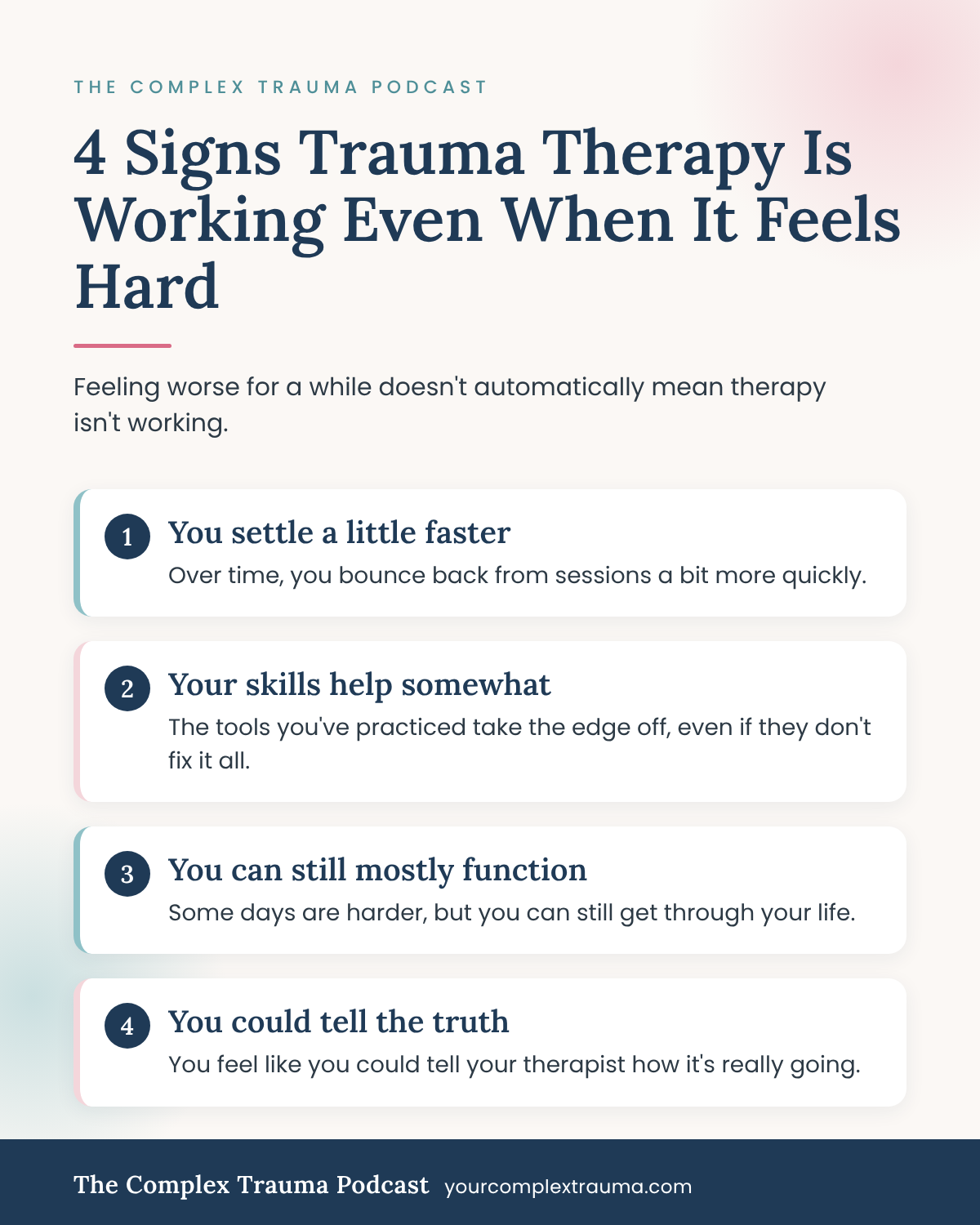
Signs it's probably working, even when it's hard: over time you settle a little faster after sessions, the skills you've practiced help at least somewhat, you can still mostly function, and you feel like you could tell your therapist the truth about how it's going.
Signs it's time to talk about pacing: it's getting harder from session to session, you leave most sessions flooded, you're struggling to function at work or at home, you notice new urges to hurt yourself, or you bring it up and it gets brushed off.
You're also allowed to say "not today." Before processing anything, it's okay to ask yourself whether you have the capacity to feel a little more raw today. If you walked in on the edge of panic or you're running on four hours of sleep, it's completely okay to use the session for something else. If you were the easy kid who shows up and performs no matter what, I know that can feel almost impossible. It's still allowed.
What should I say to my therapist?
Here are a few things you can say word for word if it helps.
"After last session, I was activated for about four days, and I didn't tell you."
"I look calm in here, but I'm usually a lot more stirred up than I seem."
"I notice I'm gone for part of the processing. Can we figure out a signal?"
"Can we try smaller pieces, or start somewhere that feels more manageable?"
"I'd like more time at the end to come back into my body before I leave."
"I don't think I have it in me to process today. Can we use this session differently?"
Good therapists want to know this, and when a client tells me something like this, I feel grateful. For a lot of people with complex trauma, saying these sentences is practicing the exact thing you learned not to do, which is letting someone know you need something and seeing what happens. If you've talked about it, given it time, and things keep getting harder without any shift, it's okay to ask about a consultation or a second opinion. That's a normal part of care.
And if your therapist works differently than I've described here, that doesn't mean they're doing it wrong. We all have different styles, and the relationship you have with your therapist matters most.
Frequently Asked Questions
Is it normal to feel worse after EMDR?
Feeling tired, tender, or more emotional after EMDR is common, and processing can continue for a few days after a session. Feeling flooded most of the time, or getting worse from session to session, is a sign to talk with your therapist about pacing.
How long does it take to feel better after a trauma therapy session?
It varies from person to person and session to session. Rather than focusing on a number of days, notice whether you can still mostly function, whether it's settling over time, and whether it's getting easier or harder across sessions.
Can you do EMDR if you dissociate?
Many people who dissociate do meaningful EMDR work, though it often needs to be paced differently. If dissociation is frequent or you may have a dissociative disorder, your therapist should assess that carefully and adapt the approach.
Why do I dissociate during therapy?
Dissociation is a protective response that often shows up when things become too much too fast. It can also look like shutting down, getting pulled into a memory, getting lost in your thoughts, or a different part of you showing up.
What is a container in EMDR?
A container is a resource for setting difficult material aside on purpose until you're ready to work with it again. People often imagine a box, a safe, or a jar, and it's best practiced first with something neutral, like a grocery list.
Should I tell my therapist if therapy is making me feel worse?
Yes. That information helps your therapist adjust the pace, and good therapists want to hear it. Tellin
If you love tuning in to the podcast, please take a second to leave a review! It truly helps other people find the show.
-
Sarah (00:40) Hey everybody, welcome back to the Complex Trauma Podcast. So today's episode, it started with questions from two of you. And I'll read through both of those questions in just a second. But first, I'll be honest, I fell down a little Reddit rabbit hole getting ready for this one. And I want to read you some of what people are saying about therapy because I think it's really interesting and so, so relatable. One person called it trauma therapy hangover. Another said, Every session leaves them feeling like they have the flu for a couple of days afterwards. Someone described therapy as throwing everything up in the air and then spending the rest of the week figuring out where it all lands. One person said they barely recover from one session before it's time for the next one. And over and over and over again, in lots of different words and variations, people wrote something along the lines of I think that something is wrong with me. So this one is for you if you're in therapy right now, or even if you have been in therapy, You're feeling worse and you don't know if that's actually okay. It's for you if you disappear in a session and you've been blaming yourself for it. It's for you if someone told you that you're not ready for trauma work and you walked away feeling like you failed at something else. And honestly, if you're a therapist listening, this one's for you too. This work is hard on our side of the room as well, and literally none of us get it perfect. We might try, but we definitely don't. Okay, so let me read you the first question. This listener wrote, I'm currently undergoing EMDR for complex trauma. I find that I'm leaving the sessions dysregulated, and it takes days to come out of a heightened nervous system response. On the surface, I seem calm, but I am easily triggered and find I'm doing things like clenching my jaw and biting my nails. My question to you is: what should an EMDR session for someone with complex trauma look like? More time for integration at the end. Perhaps somatic exercises. I can't help but feel like something's missing to assist with this integration. okay, so that last line, right? I can't help but feel like something's missing. Hang on to that. We're gonna come back to it. And the second question, it was a voice memo, so I'm not gonna replay the whole thing, but I will summarize it. And this person is dissociating a ton in sessions and wants to know how they can stop. And so in those same threads that I told you about a second ago in comment sections, a few other things came up over and over again. A lot of you describe feeling completely wiped out after sessions. A full day, sometimes more, where you're exhausted and cold and your body feels like it ran a marathon. A lot of you feel like looking fine, but not actually being fine. Calm on the outside, buzzing underneath, which, like, yeah, if you've listened to this show for any amount of time, That one's probably sounds pretty familiar. so many of you ask some version of how do I know if this is normal or if this is a red flag? How do I know if this is working or if it's actually hurting me? Some of you have admitted that you don't tell your therapist how bad the week actually was. You show up, you say it was fine, and you keep it moving. and a lot of you have been told that you can't do certain kinds of trauma work because you dissociate. And you walk out confused, Definitely a little ashamed, kind of like a promise of hope, right? That you're going to feel better got taken right away from you. And underneath all of it, I keep hearing a really similar fear. Is there something wrong with me? Am I doing this wrong? Am I just really bad at this somehow? Listen, I've also been a client on the other side of the room or the other side of the screen that said that everything was fine. Cause number one, I just didn't feel like doing it. I didn't feel like feeling all the things. And two, sometimes the aftermath of like diving into this stuff can be really hard, right? And you get a function. So I get it. So let's talk about why therapy can feel like this when you have complex trauma. So, recap real quick, here's the thing about complex trauma. When something happens once, like a car accident, there's usually a before and an after. There's a memory with a beginning, a middle, and an end. Complex trauma, it usually doesn't work like that. It happened over and over again, often for years. And so often it happened inside relationships with the people who were supposed to keep you safe or with people who were there physically but weren't there for you emotionally. So think about what therapy actually is. It's a relationship. You're sitting across from a person who's paying really, really close attention to you. They're asking how you feel, they're noticing your face. For a lot of people with complex trauma, that alone can stir things up before you've even touched a single memory. being seen can feel amazing and really, really unsafe at the very same time. And then there's that thing that you're like looking fine on the outside. If you grew up as the easy kid or the responsible one, or the one that no one had to worry about, you probably learned really early that having needs made things harder for everybody. so you got good at looking okay. your nervous system figured out pretty quickly that calm on the outside kept you really safe. So of course you bring that into the therapy room. These can be your most practiced skills. I mean, we spend years and years and years perfecting these skills that protect you. We're not just gonna drop them just because someone has a a nice office, a cozy couch, And a box of tissues next to you. same thing with not telling your therapist about a hard week. If needing something used to make things worse than walking in and saying, hey, I really fell apart after our last session and I need us to do this differently, that can feel completely impossible. So you say it was fine. And again, that makes a lot of sense. And then there's the overwhelming amount of stuff that you probably feel like you have to sift through. Thomas Zimmerman, who was on the show a while back, he wrote a book called EMDR with complex trauma. And he has this metaphor that I love. He talks about a boat and a whale. And here's the basic idea. In EMDR, and honestly, a lot of trauma therapy, a painful memory is kind of stuck. It's stored the way it felt back then. And when something stirs it up, your body reacts like it's still happening in the here and now. Healing happens when that stuck memory finally links up with things you already know now. Things like kids aren't responsible for what adults do to them. My needs matter. That's over, and I'm safe now. So let's say you have a memory of your dad screaming at you when you were seven. Every time it comes up, your stomach drops and it tells you, I am bad. But somewhere in you, the grown up you knows that a seven-year-old doesn't deserve to be screamed at. When the memory and that knowing finally meet, the memory starts to feel a little bit differently. It's still a sad thing that it happened. It just stops feeling like it's happening right now and it stops telling you that you're bad. So back to the boat and the whale metaphor. People who had a pretty secure childhood tend to have this boat that they live in that's like the size of a cruise ship, right? They have tons of helpful experiences on board to help them kind of disconfirm tough moments in their life. People with complex trauma often have something more like a canoe and an ocean full of whales. And you can't land a whale inside of a canoe, it would take it out in a second, right? So on top of that with complex trauma, the memories are all tangled together. It's like you pull on one thread and it tugs on 20 others. So it's like you start with one argument with your mom when you're 12 and suddenly your body is pulling up every single time you felt alone in that house. So here's what I want you to take from this part of the episode. Your trauma that's showing up in therapy, in the relationship with your therapist, in your body, in the week after therapy, means that your trauma is in the room. And that room is exactly where it needs to be to heal. But the question is how much shows up and how fast? So is it normal to feel worse after trauma therapy? Honestly, sometimes yes. But there's a difference between being stirred up and completely flooded. if you've been listening for a while, you've heard me talk about the window of tolerance. It's the zone where your nervous system can feel things and stay online. You can be sad, you can be activated, you can be uncomfortable. But still here when you're in your window of tolerance. You can still think, you can still feel your body, you can still make your kid a snack, right? Stirred up looks like being tired after a session. Maybe a little more emotional, maybe some dreams happen. Things can feel a bit tender, but you still function. And over the next few days, you start to settle a bit. Flooded is when you get pushed outside of that window. On the high side, that can look like panic, irritability, not being able to sleep, feeling on edge all of the time. And on the low side, it can look like numbness, fog, shutting down, and feeling far away from your own life. and really honestly, how long it lasts isn't the best marker. What matters more is whether you can still mostly function. Whether it's settling over time And whether it's getting easier or harder from one session to the next. So why does it so often hit a day or two after sessions instead of right there in the room? And a few different things can be going on. Because yes, I know a lot of people experience this. sometimes processing just keeps happening after you leave the therapy room. Your brain doesn't stop working on something the second the session ends. That's expected. and it can look like extra dreams, memories floating up to the surface, Or feeling a little bit raw for some time. And sometimes it's something else. When a session pushes you too far outside of your window, the parts of you that hold the helpful information, they go a little bit offline. Those grown-up parts that I know it wasn't my fault parts. so the painful material gets stirred up, but it has a much harder time connecting to anything that's helpful. It gets opened without getting resolved. And remember how complex trauma memories get really tangled together. If one memory pulls in five or ten others during a session, you go home with a whole drawer open instead of just one thing. So of course your body is still buzzing days later. Here's what the research actually tells us. When researchers have looked at trauma-focused therapies, they found that some people do have a real spike in symptoms partway through. In one analysis, it was somewhere between 15 and 30% of people depending on the therapy. For most of them, things came back down in about a week and a half. And most of the people who spiked got meaningfully better by the end of treatment. On average, across a bunch of studies, people don't get worse in the middle of trauma therapy. But I want to be honest about a couple of things. Averages can really hide the people who really struggled. And most of this research is on PTSD, not CPTSD. So we can't really stretch that too far. Again, there's not a lot of research on CPTSD. I want you to know that's really hard for me always looking at research on PTSD and not specifically complex trauma. It really lets us know where we are in the field and where research has to focus. but so research aside, let's bring this back to our listener who wrote in because there's another detail in her question I really don't want to skip. She said that on the surface, she seems calm, but underneath her jaw is clenched, she's biting her nails, and she's triggered for days. if you listen to my functional freeze episode, that might ring a bell. It can look like your system has one foot on the gas and on the brake at the very same time. Underneath, there's a ton of activation. On top, there's like a lid holding it all down so that you can keep going. So if that's you, want you to know that a rough week is information. It's a signal that something about the pacing might need to change. It has nothing to do with you. it also probably doesn't have a lot to do with the therapy either. Maybe just the pace of it. so what should an EMDR session look like for someone with complex trauma? I want to answer this in a way that I would if I were like sitting across from you in the therapy room. And I want to be clear that this is how I work. There are a ton of skilled EMDR therapists who do this differently and do it really, really well. But I'll walk you through how it looks in my office. And a quick background EMDR, it stands for eye movement, desensitization and reprocessing. The standard way it's taught works beautifully for a lot of people. And adjusting it for complex trauma is absolutely necessary. A lot of how I think about those adjustments have been shaped by Thomas Zimmerman's work. And so you'll hear a lot from what I've learned from him Sarah (13:11) I talk about EMDR for complex trauma. I'm going to use a lot of metaphors, and these metaphors are from Thomas Zimmerman and his book EMDR for Complex trauma So I want to give him credit. I think the metaphors are brilliant and they make this so much easier to understand. You'll hear them as I'm talking, but things like the boat and the whale, the barn. Cars having brakes. Like I said, you'll hear them when I talk about them. But I want to give him credit because the way that he teaches EMDR for complex trauma is brilliant. Sarah (13:40) For any EMDR therapist listening, none of this is tossing out the standard protocol that we all learn in our training. The prep, the closing, the checking in the next time I see you, that's already built into EMDR. But with complex trauma, we just maybe spend a lot more time in those pieces and go a lot slower. Okay, so let's say you come to my office to see me or my virtual office, whatever. Before we even touch a memory, we spend time getting you ready. And for me, what I want to do is find things that help your body settle, things you can actually feel in your body and that you've tried at home and noticed actually help even just a little bit. Because think of it this way, I'm not gonna take you anywhere in a car without brakes. So if we're moving towards trauma material, we have to have some way to slow it down. It's so easy to touch a little bit of something and get completely flooded. So the beginning parts of EMDR really you learn these strategies to be in your body, to slow things down, to come out of it when it starts to feel like too much. also want to get to know your parts, those really protective ones, the young ones, the one that rolls its eyes at breathing exercises, right? And before we work on anything, I'll usually ask, does this feel okay to all of you today? That said, getting ready shouldn't feel like something that you're like failing at, The goal is to build what you need so you can start and then actually start. and when we do start, it usually isn't the earliest or the worst memory. Remember from earlier, the boat and the whale, we catch smaller fish first. So in the beginning phases, we're starting to expand your boat, right? We're expanding your boat out and then we start to catch small fish. Every smaller memory that resolves puts a little more helpful stuff on board. So your boat gets bigger. And the big memories eventually have somewhere to land. and I want you to know that starting small isn't actually the slower way. Because when a memory fully resolves, other memories with a similar shape can often resolve right along with it. So those smaller fish, those smaller memories that you're working on can end up clearing a lot more than you think. Before we work on a specific memory, I'll often check one thing. If it's a memory from when you were a kid, I might ask, how much does the grown-up part of you, the part that pays bills and puts gas in the car? know that a child isn't responsible for what an adult did. And I'm not asking you what you know in your head. I'm asking what that part of you actually feels true when you're in touch with it, when you're in relationship with it. Because here's the nuance: a lot of people can say the right answer out loud, right? Of course it wasn't my fault. I was seven. And then you ask them to sit with the memory for a second, and their whole body says, Yeah, but it was my fault. Both of these things can be true at the same time. This is the complexity of complex trauma. And that self-blame, it isn't super random for most people. For a lot of kids, believing it was their fault was actually protective. If it was my fault, then maybe I can fix it. Maybe if I'm better, quieter, easier, it won't happen again. that feels a lot safer to a little kid than the truth, which is that the adults they depended on weren't safe and there was nothing they could do about it. so that belief, it kept a sense of control. And it kept them attached to people they needed, and that's a brilliant, brilliant survival strategy. so if your honest answer to that question is something like basically none of me believes it wasn't my fault. It doesn't mean you're failing at therapy. And it also doesn't mean we can never touch that memory. What it is is information. And it tells us there's a part of you holding that blame for a reason. And that part of you deserves some attention before we go charging through it. So we might get to know that part first and get curious about what it's protecting. we might start with a memory where you have a little more of that grown-up knowing on board and let the healing process kind of grow. Let your system trust what's actually happening. And this is the same thing with attachment wounds. A car accident has a beginning, a middle, and an end. An attachment wound is kind of about everything. So it's often one of the harder places to begin. And I want some really solid resources for people lean on, to feel, to use, to make a difference before we dive into all the attachment wounds. In EMDR for complex trauma, processing itself is where I make a lot of shifts. instead of jumping straight to the worst moment of a memory, I'll often have people come at it gently, a really small piece at a time. I want the distress to come in because we need that to reprocess trauma, but just in bites that are small enough that you can actually notice them and actually digest them. And here's why that matters so much. The main ingredient in EMDR is noticing. you notice what comes up and the healing tends to show up as a byproduct of that noticing. but it's really, really hard to notice anything that's on the edge of panic. And when you're flooded, the parts of you that the painful memory needs to connect with are exactly the parts that go offline, right? you know, a lot of people think that during EMDR, they're supposed to keep the memory playing in their mind the whole time while also noticing what's happening in their body. With complex trauma, I'll often tell you that you don't have to. Once a piece of the memory has been activated, just notice what's happening in your body right now. You don't need to keep pulling the memory back up. And when that piece settles, I'll invite you to maybe go back for the next one. Otherwise, it's kind of like standing in an open barn door while every animal inside of that barn rushes out at you all at one time. So we need to kind of put a gate on the door. Sarah (19:21) I'll be right back after a quick word from this episode's sponsor. So I want to take a quick pause and just remind you that I own a group therapy practice called Reclaim Therapy, and we're a team of trauma therapists who work with exactly what we're talking about today: complex trauma, EMDR, somatic work, dissociation, and disordered eating, all of it. And we take pacing really, really seriously in our work. We're not gonna rush you into the deep end of anything until you're ready. We see clients in person in Horsham, Pennsylvania, right outside of Philadelphia, and we offer telehealth across Pennsylvania and Florida. So if you've been thinking about starting therapy or you're looking for someone who really gets complex trauma, head to www.reclaimtherapy.org to book a consultation with me. I'll tell you, we'd love to meet you. Okay, let's get back to the episode. Sarah (20:18) Something else that we tend to look out for is that people tend to do EMDR the way that they do life outside of EMDR. So if your survival strategy was figuring everything out, You'll probably try to figure things out mid session. if it was pushing through, maybe you'll push. And if you were the easy kid, you'll probably look fine in the office too. so part of my job is really trying to notice that with you. And part of yours is letting me see a little bit more than like, I've got this, I'm fine, I wanna keep going. And I don't say that lightly because what matters is the trust that you have with your therapist. towards the end of that question, our listener asks about somatic exercises. And for me, the body is part of the whole session from start to finish. We track sensation, we go slowly, and we move back and forth between what's hard and what feels steady. So your body learns it can touch something difficult and come back. So when we're talking about somatic exercises, it's often built into the work with complex trauma. Somatically, we're trying to build capacity. We're trying to help you feel more without getting blown out of the water, right? You can do that in session, you can do that outside of session, you can do that just by orienting to your space And noticing fun, pleasure, goodness, not just pain. And then there's the end of your therapy sessions, right? And this is where the integration question kind of comes into play. I personally do protect a lot of time at the end of sessions. But honestly, I think the biggest lever is what happens in the middle. If you're completely flooded with 10 minutes left, 10 minutes of grounding can only do so much. so when the pacing of therapy, of trauma therapy, of EMDR is right earlier on, the ending of therapy, the integration of all that you've experienced, it actually has like a leg to stand on. When we're doing EMDR, I also pay a lot of attention to the body when we're closing out a session Because sometimes there's a response that got started and didn't finish, like a push that wants to happen, a shake, a deep breath, tears that are right at the edge. If we can give your body some room to finish that gently and in small doses, things often settle in a way that stick much better than just calming down on top of it. Other times it's really just kind of noticing what feels a little bit steadier. and letting your attention rest there for a little while so that your body remembers what settled actually feels like before you walk out the door. And when we're done with the session, I'm usually helping people set aside whatever's still open. And I frame that as more of like a choice, like you're deciding on purpose what you take home and give your attention tonight. Because you don't have to carry everything every single minute. I know that's really hard because a lot of you, a lot of us, carry a lot every single minute. But then we come back into the room, into the therapy room, we check in with your body and we make a plan for next week. A lot of EMDR therapists use a resource called a container. And I'll give you a really quick version of that. It's a way of setting something aside on purpose until you're in a different place to work with it. A lot of people imagine like a box or a safe, a vault, or a jar with a really strong lid or a really strong lock. Some people use something like writing a word on a slip of paper and putting it in an actual box. What goes into the container, it isn't gone. You're not pretending something didn't happen. What you're just choosing is not to carry it around all week. I personally usually practice it at first with something kind of boring like a list of groceries or something like that. So that you can put a the list into the container, have some distance from the list, right? Send it back if it pops its head out, Then we come back and we finish what we started. But I think the point is, is that if you're experiencing too much, if you're feeling flooded. If you feel like memories and body sensations are coming at you left and right and there's no break to slow them down, it really does deserve a conversation with your therapist. Okay, so now to the second question, the dissociation that's happening a ton in sessions. And this listener wants to know, how do I stop? So what I'm gonna do is I'm gonna kind of like push back on that question just a little bit, because I don't think the goal is to force your dissociation to stop. I know that it can be really frustrating. But dissociation is protection. At some point when you couldn't leave a situation with your body, some part of you figured out how to leave with your mind. And that simply was brilliant. Yes, it absolutely has cost now. but the part of you that does it has been working really hard to keep you safe for a really long time, probably. You know, dissociation is kind of a word like I talked about in our last episode that gets related to a lot, right? Like I dissociated in session can mean a lot of different things. And each of those different things might need something different. So if you go numb or foggy or you shut down, that's your system dropping into a low protective state. Sometimes that happens after things got too activated. And for a lot of people with complex trauma, it's also kind of where the system lives by default sometimes. what helps there is going slower and smaller and gently bringing your body back online rather than pushing to go deeper. if you get pulled so far into the memory that you're not in the room anymore, that's closer to a flashback. It usually means the memory came in too big or too fast. Grounding helps, and so does working in much smaller pieces with both of your feet in the present moment. If you're stuck in your head and you're trying to figure it all out, that can look like being checked out too. And that makes sense because figuring things out was probably how you survived at some point. What helps is gently coming back to what your body is doing right now. That there's actually nothing to figure out today. And if it feels like a different part of you shows up, maybe a younger part or a part that takes over, that's a parts conversation. Slowing down, getting curious about the part, and making sure all of you is on board with the work is part of this work. There's also a difference between dissociating in a moment when something gets to be too much, and dissociating that's more of an ongoing pattern woven into how your whole system is organized. Both experiences are of course real, but they call for a different pacing. And here's the big one. When it happens in the middle of a session, a lot of the time it's a sign that things got to be too much too fast. Your system hit its limit and pulled that emergency break, which really honestly means that your body did its job. so instead of trying harder to stay present, the fix is usually trying to turn the dial down a little bit. Smaller pieces, slower pace, sometimes a more tolerable memory for now. You know, some people aren't in their bodies much to begin with when they've experienced complex trauma. Not just in session, kind of like all the time. And when you can't feel much in your body, emotions can stay stuck up in your head as ideas about feelings instead of something you actually feel in your body. And I get this one, When I started training in somatic experiencing, the bottom half of my body, it basically like didn't exist. And I'd been a therapist for about a decade at that point. It took a lot of work with my own practitioner to get to know that part of me. And it was slow. So if that's you, you're not behind. You're at the beginning of getting to know your body again. Now, if you're dissociating a lot in and out of sessions, losing time, feeling like different parts of you take over, something to definitely talk about with your therapist. Some people are living with a dissociative disorder, and that's important to know. Kathy Steele, who I've talked about on other episodes, she's one of the leading voices on dissociation, has written that when dissociation is the core issue. EMDR needs to be adapted, and the type and severity of dissociation really needs to be addressed first. I'll link to that episode that I just did in the show notes where I talk all about that. So, what can you actually do in session? A few things to try and talk about with your therapist. Learn the early warning signs, like when the fog starts to roll in, when sound is getting further away, maybe you're even staring at one spot or feeling floaty or heavy. The earlier you catch it, the easier it is to come back. Maybe agree on a signal ahead of time, like a hand up, a word, a tap, Something that doesn't require a full explanation when your words are going offline. Keep your eyes open and orient. Look around the room. Name a few things you can see. Let your eyes land on something. feel your feet press on the floor or hold something with texture in your hands. A smooth stone or a soft blanket or a warm cup of coffee or tea. Some people actually bring a scent that they like into the therapy room. Because the more of the present moment you can have with you, the better. And also say it out loud, even just like I'm going, I'm floating away. Saying that out loud is part of the therapy. It gives your therapist the information they need in order to slow things down. And I want you to know that you're allowed to ask to work on something smaller, even if parts of you are like, No, I wanna go through all the hard stuff. I wanna bang it out. I wanna get it done. Being in conversation with your therapist about this stuff is so important so that together you can choose where to start. I wanna remind you that it's a marathon, not a sprint, right? Which socks I know. But I'm willing to guess that your therapist Really want you to hang in there for the marathon. Okay, so you've had a big session and now it's Tuesday night and you're flooded. What actually helps? Again, these are things to try and things to bring to your therapist. Take what fits and definitely leave the rest. The first thing, plan the 24 hours after. If you can, don't schedule therapy right before a big meeting or the school pickup line, stuff like that. Give yourself 20 minutes in the car before you drive home. And set yourself up ahead of time. Have something easy to eat, something cozy waiting for you, a person you can text who doesn't need an entire story about what's going on. The future you will be really grateful that you've set yourself up. For ease, not heading back into chaos. Next, lower the demands on purpose. Therapy days and the days after are not the days to deep clean the fridge or have a really hard talk with your mom. So order takeout if you need to. Let the laundry wait. Something else to try. Use rhythm and movement, like walking, bouncing your knee to the rhythm. A lot of nervous systems settle with steady repetitive rhythm. Next, lean on co-regulation. A person who feels safe, like you actually in your body feel safe with, or a pet, a voice you trust. Sometimes just sitting next to someone you love while you're both watching TV, like something meaningless, does more than any type of regulation exercise actually could. Next, use your container and know why you're doing it. Setting something aside for now is a choice. you're choosing what gets your attention tonight because you've got a plan to come back to it in therapy. That's agency And your ability to choose what feels holdable in the here and now. Next, notice but don't dig. This one can come up quite a bit. It's like 11 o'clock at night and you're journaling and you're trying to figure it all out. And now you're deeper into the memory than you were in your session. I want you to remember: you don't have to solve your trauma tonight. Notice what's happening in your body, name it. That can be enough. Bring that back into your session the next time you sit down with your therapist. Next, jot what you notice. Just short notes, maybe even just words. Like maybe your jaw was clenched all week, you couldn't sleep on Wednesday, you felt numb at work. Bring all of that into your therapist. It's really, really helpful information to have. not least, know when to reach out sooner. If things are getting harder instead of slowly settling, or if you're struggling to function, reach out to your therapist before your next session. And if you're having thoughts of hurting yourself or not wanting to be here, please reach out for support right away. If you're in the US, You can call or text 988 at any time. And if you're somewhere else, your local crisis line is there for you too. Okay, I want to try to do something together real quick. If you don't feel like doing a little exercise together, skip ahead a minute. This will be here if you ever want to come back. If you're driving, do not do this. With your eyes open, let them slowly wander around the space that you're in. You're not actually looking for anything in particular. Give yourself permission to let your eyes land on just a few things. Maybe it's a color that you like, something with an interesting shape, something that's been there a long time. Maybe even something new or novel that you've never noticed before. and notice what it's like to let your head turn a little bit as you look. Let your neck move if it wants to move. If it feels okay, notice where your body is being supported right now. Maybe by the chair, the floor, under your feet. And just notice if anything shifts even a little bit. Maybe a breath gets a little bit deeper. Maybe nothing changes at all. That's okay too. And that's it. That's what we call orienting. It's really small on purpose. When you're flooded, the thinking part of your brain isn't fully online. So a long, complicated practice is really, really hard to do. And for a lot of people with complex trauma, the big inward stuff like closing your eyes, a full body scan, or really focusing on your breath, it can make things worse in the moment, right? You're getting pulled into the trauma vortex. Because turning inward can bring you right up close to the very sensations that feel so incredibly overwhelming. So orienting, it goes the other direction. Its eyes open outward in this present moment. You're letting your nervous system take in some information that you're here now in this room, and the thing your body is bracing for isn't happening right now. That's a message that your system can actually hear when it's activated. And you know what? Small is something that you can actually do on a hard Tuesday night. You can do it in the car, at your desk, in the bathroom, at a party. The more you do it when things are only a little bit hard, the easier it is to reach for when things are a lot hard. Okay, so let's get back to the question that so many people on the forums asked. And I know that a lot of you out there probably have a similar question. How do I know if this is normal or it's a red flag? There's no checklist for this, but here's what I'd pay attention to. Some signs it's probably working, even when it's hard. Over time you settle a little bit faster after sessions. the skills you've practiced help at least somewhat, even if they don't make it all go away. You can still mostly function in your life. And you feel like you could tell your therapist the truth about how it's going, even if that's a little bit scary. And some signs that it might be time to talk about pacing with your therapist. If it's getting harder session after session instead of slowly getting easier, maybe you leave most sessions flooded, not just once in a while. You're struggling to function at work or at home, or you notice new urges to hurt yourself. Or you bring things like this up and get brushed off. So these things are information and good therapy can hold that information and adjust. And something that I really want you to hear is that you're allowed to say, I don't want to do this today. Before you process anything, it's okay to check in with yourself and ask, do I have the capacity to feel a little bit more raw today? If you walked in on the edge of panic or it's just been like a brutal week, or you're running on four hours of sleep, it's completely okay and probably necessary to use that session for something else. For those of you that were the easy kid who show up and perform no matter what, I know that can feel almost impossible. But it's still allowed. I wanna give you a few scripts to say to your therapist if you need them. last session, I was activated for about four days and I didn't tell you. I look calm in here, but I'm usually a lot more stirred up than I seem. I've been noticing that I'm gone for part of the processing. Can we figure out a signal to let you know when that happens? Can we try smaller pieces or start somewhere that feels more manageable? I'd like more time at the end to come back into my body before I leave. I don't think I have it in me to process today. Can we use this session for something else today? And here's the thing: good therapists, they want to know this stuff. When you tell us, it helps us do our jobs better. And I promise you, when a client tells me something like this, I feel really, really grateful. And I know for a lot of you, saying these things is practicing the exact thing that complex trauma taught you not to. letting someone know you need something and seeing what happens. Again, this relationship and therapy with your therapist, this is part of the work of healing from complex trauma. So to close this episode out, let's talk about what it looks like when trauma therapy is landing. Usually it looks a lot smaller than one big breakthrough moment. It's like you bounce back faster after sessions. What used to maybe knock you down for a couple of days now takes just one. You catch yourself starting to float away a little bit sooner and you come back a little bit easier. a memory that used to feel like was happening right now starts to feel like something that happened in the past that's actually over. And maybe one day you walk into session and say, hey, last week was really hard and I didn't love how I left. And nothing bad happens. Your therapist leans in and you figure it out together. For a lot of you, that moment right there is healing, being honest about what you need and finding out you're still welcome in the room. Slow is fast. Thousands of tiny moments like that, they add up big time. So if this episode stirred up questions about dissociation, go back and listen to my episode on the dissociative spectrum. It walks through the differences between parts, OSD, DID, and it actually does pair really well with this one. And if you want more of how Thomas Zimmerman thinks about complex trauma, our conversation together is gonna be linked in the show notes. And to those two listeners who sent these questions, thank you. You are definitely not the only ones with these questions. And remember, this is from my perspective, how I practice in my therapy space. If your therapist does something differently, it doesn't mean that they're doing it wrong. We all have our different styles, we all have our different personalities. What's most important is your relationship with your therapist. As always, my hope is that you're walking away from this episode feeling a little bit more seen. Maybe you have a little bit more information and maybe a lot less alone. Always the goal. Keep sending in your questions. I love hearing them. I love hearing from you and answering things on the show. I'll be back next week for another episode and until then, take good care of yourself.