Why You Keep Repeating the Same Painful Patterns and What Greek Myths Know About It
Episode 152
Written by Sarah Herstich, LCSW, a Certified EMDR Therapist, EMDRIA-Approved Consultant, and Somatic Experiencing Practitioner. Sarah hosts The Complex Trauma Podcast and owns Reclaim Therapy, a trauma-focused group practice in Horsham, PA.
If you keep ending up in the same painful patterns, nothing is wrong with you. For many people with complex trauma, repeating old relational dynamics is the nervous system reaching for what feels familiar, even when familiar hurts. In this post, I'm looking at trauma reenactment through the lens of Greek myth, inspired by my conversation with psychotherapist Dr. Gillian O'Shea Brown, and sharing why healing these loops usually has to happen in the body, too.
Key Takeaways
Trauma reenactment is the tendency to recreate painful relational dynamics from early life, often without realizing it.
What feels like intense chemistry can sometimes be your nervous system recognizing something it already knows.
Many of these patterns started as survival strategies that kept you connected to the people you depended on.
Understanding a pattern is an important start, and lasting change often requires new experiences in the body.
Patterns that formed in relationship often heal in relationship, slowly and with support.
You promised yourself you'd never end up here again. And then, somehow, there you are. It's a different person, maybe a different city or even a different decade, and it's the same sinking feeling in your stomach.
For a lot of people with complex trauma, this is one of the most painful parts. You can see the pattern. You can probably explain it better than most people could. And you still find yourself right back in it, wondering what is wrong with you.
I've been thinking about this a lot since my conversation with psychotherapist Dr. Gillian O'Shea Brown on The Complex Trauma Podcast. Gillian wrote a whole book, Psyche's Awakening, about how Greek myths map the patterns so many of us carry. And honestly, a guy pushing a boulder up a hill for all eternity has never felt so relatable.
This post is meant to help you understand your patterns with more compassion. It isn't a substitute for therapy or a way to diagnose yourself, and if something here stirs a lot up for you, please go gently and reach out for support.
What is trauma reenactment?
Trauma reenactment is the tendency to recreate, often without realizing it, relational dynamics that echo early painful experiences. In psychology, the older term for this is repetition compulsion. It can show up as being drawn to partners who feel emotionally unavailable, overgiving in friendships that never give back, or working for bosses who feel a lot like a critical parent.
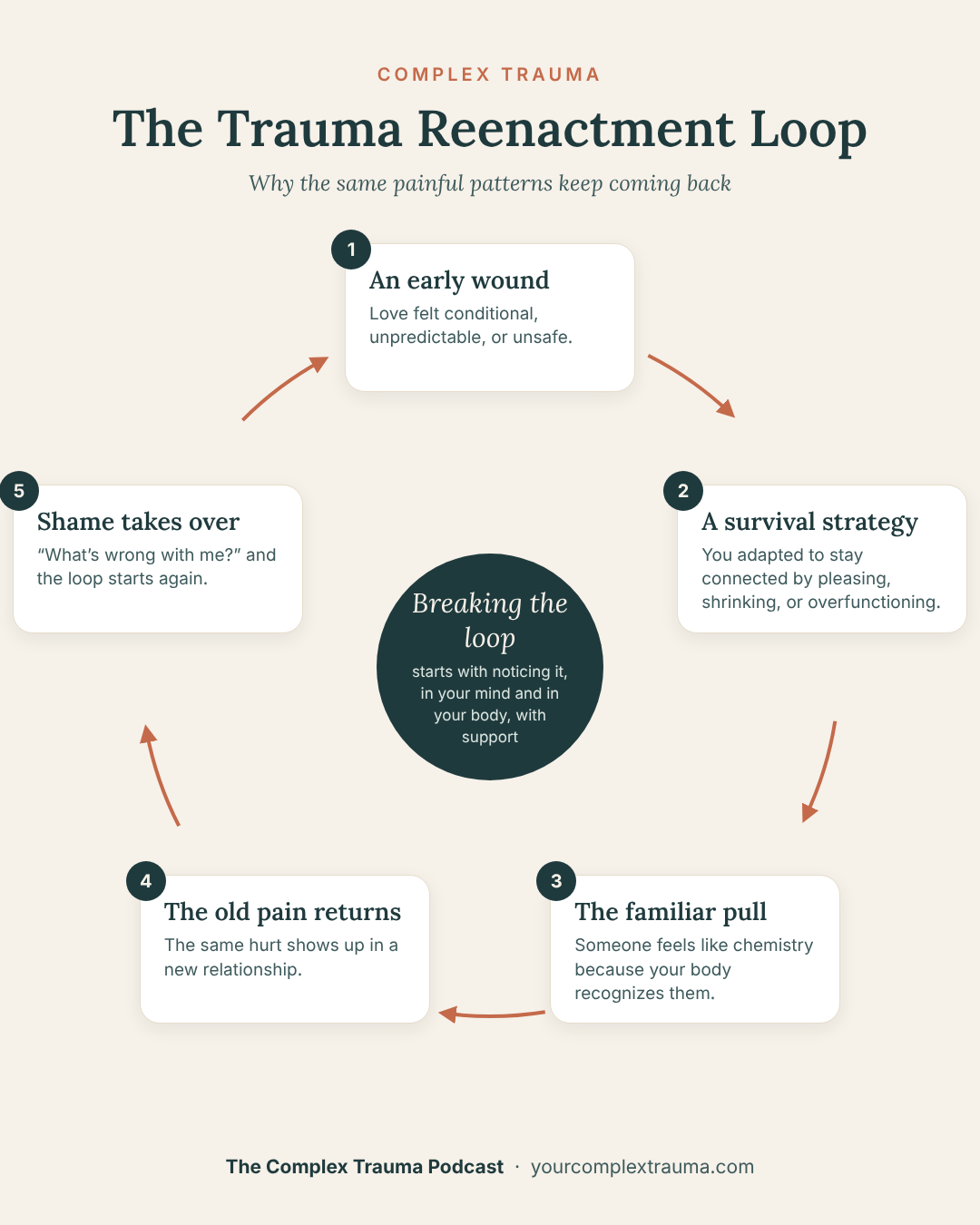
The loop of trauma reentactment
It's easy to read this as self-sabotage.
I see it differently.
These patterns usually started as survival strategies.
If love felt conditional growing up, part of you may still be trying to earn it. If a parent was hot and cold, part of you may still be waiting for the warm moment to come back and stay. Many clinicians describe this as an unconscious hope for a different ending, a chance to finally get what you needed the first time around.
Why does the wrong person feel like chemistry?
Here's the part that makes this so confusing. The pull toward a familiar pattern often feels really, really good at first. It can feel like butterflies, electricity, and that can't-eat, can't-sleep feeling all at once.
Your nervous system recognizes patterns long before your thinking brain catches up. When someone's way of relating matches what you grew up with, your body can light up with recognition. That activation (the racing heart, the stomach flips, the constant checking of your phone) can feel a lot like attraction. Sometimes it is attraction. And sometimes it's your system bracing for something it already knows.
Gillian put this so well in our conversation. When people map out their patterns, the "crazy chemistry" can start to look a lot more like stress hormones and an old story. That's a hard realization. It can also be a relieving one.
What can Sisyphus teach us about trauma loops?
In Greek myth, Sisyphus is punished by the gods to push a massive boulder up a hill, only to watch it roll back down, over and over, forever. Gillian uses his story to describe what she calls "the bite that fits the wound," the way new experiences keep pressing on the same old pain.
What strikes me about Sisyphus is how exhausting it is. Many of the people I work with have no shortage of effort. They're working incredibly hard. They read the books, they listen to the podcasts, they can explain their attachment patterns in impressive detail, and they still end up at the bottom of the hill again. When that happens, it usually means the pattern lives somewhere deeper than willpower can reach.
Where do these patterns start?
For many complex trauma survivors, the roots go back to early relationships with caregivers. Gillian connects this to Medea, one of the darkest figures in Greek myth, and to what she calls the primary parent wound.
In real life, that wound is rarely obvious. It can look like years of walking on eggshells. It can look like love that came with conditions, or a parent who was your source of comfort and your source of fear at the same time. A child in that position can't leave and can't make sense of it, so they adapt. They get small, or helpful, or perfect. Many decide the problem must be them.
Those adaptations made sense. They kept you connected to the people you depended on. The tricky part is that the same strategies that protected you as a kid can keep you circling the same hill as an adult.
Why isn't understanding the pattern enough?
This is the part I care about most as an EMDR therapist and Somatic Experiencing Practitioner. Insight matters. Being able to say "oh, I keep choosing people who feel like my dad" is a big deal. But a lot of us know the moment where we can name the pattern perfectly and still feel our body pull us toward it anyway.
These patterns live in your body as much as your mind. They show up as a tightening in your chest when someone takes too long to text back, or a strange sense of calm when someone is a little unavailable, because that's the kind of distance you learned to live with. Healing often means helping your nervous system have new experiences, in small doses, until something different starts to feel safe enough. In my experience, slow really is fast here.
How can you start stepping out of the loop?
There's no five-step fix for a pattern that took years to form, and I'd be suspicious of anyone who promises one. These are a few gentle places to begin.
Notice the pattern with curiosity
Gillian's book includes an exercise she calls the erotic emotional map, where you look at your relationships with your parents growing up and then at the people you've been drawn to as an adult, and notice the echoes. She's offering the chapter and a mini course for free on her website, which I've linked below. You don't need a formal exercise to start, though. Simply noticing "oh, this feels familiar" is a real beginning.
Check in with your body
The next time you feel that magnetic pull toward someone, pause for a breath. Where do you feel it? Does it feel like warmth and ease, or more like bracing? There's no right answer. You're just gathering information about what your nervous system recognizes.
Go slowly, and get support
Patterns that formed in relationship often heal in relationship. Working with a trauma-informed therapist, especially one trained in approaches like EMDR or somatic therapy, can give you a safe enough place to feel what's underneath the loop without getting swept back into it.
How do you find a therapist who understands trauma patterns?
Look for someone who specializes in complex trauma or relational trauma and who works with the body as well as the mind.
Approaches like EMDR, Somatic Experiencing, and parts work can all help with patterns that insight alone hasn't shifted. It's also okay to ask a potential therapist how they think about repeating relationship patterns and see whether their answer feels shaming or curious.
If you're in Pennsylvania or Florida, my team at Reclaim Therapy works with exactly this. You can reach out for a consultation here.
In my episode with Dr. Gillian O'Shea Brown, she tells the stories of Sisyphus, Medea, Medusa, and Chiron, and what each one reveals about complex trauma. She is such a good storyteller, and I think you'll hear yourself somewhere in there. Listen to the full episode here, and grab Gillian's free chapter and mini course on the erotic emotional map at her website.
Content note: the episode includes a discussion of sexual assault in Medusa's story.
Have a question you'd love me to answer on the podcast? Send it my way. And if you want something to help your nervous system in the harder moments, my free Dysregulation Toolkit is there for you.
If you've rolled that boulder up the hill more times than you can count, I want you to know that the rolling itself shows how hard you've been trying. You learned these patterns for good reasons, and you can learn new ones too.
It takes time, it gets messy, and it's possible. 🧡
Frequently Asked Questions
Is repeating unhealthy relationship patterns a trauma response?
It can be. For many people with complex trauma or CPTSD, repeating familiar relational dynamics is one way the nervous system seeks out what it knows. It isn't the only explanation, and a therapist can help you sort out what's going on for you.
What is the difference between trauma reenactment and self-sabotage?
Self-sabotage suggests you're working against yourself. Trauma reenactment frames the same behavior as a survival strategy that once protected you and hasn't yet caught up to your present life. Many trauma therapists find the second framing more accurate and a lot less shaming.
What does "the bite that fits the wound" mean?
It's a phrase psychotherapist Dr. Gillian O'Shea Brown uses for new experiences that land right on old pain and reactivate it. She connects it to the myth of Sisyphus, who is forced to push the same boulder up the same hill forever.
What is the primary parent wound?
Dr. Gillian O'Shea Brown uses this term for the pain that comes from depending on a caregiver for love and safety while that same caregiver is also a source of fear, criticism, or unpredictability. It often shows up in adulthood as shame, difficulty trusting, and survival strategies like people pleasing or hyperindependence.
Why do so many trauma survivors relate to Medusa?
In older versions of the myth, Medusa is assaulted, then blamed and punished for what happened to her. Many survivors see their own experience in that story, especially the experience of being treated as the problem after speaking up about harm.
Can you break a trauma pattern?
Many people do. It usually happens gradually, through awareness, support, and new experiences that help your nervous system learn that something different can be safe. Healing is rarely linear, and slipping back into an old pattern doesn't erase the progress you've made.
If you love tuning in to the podcast, please take a second to leave a review! It truly helps other people find the show.
-
Sarah (00:40)
Hey everybody, today we're talking about complex trauma through the lens of Greek mythology. And I know 10th grade English, but stay with me because there's something about hearing a story that helps us make sense of our own. Sometimes it's really hard to look straight at what's happened to us, but when you hear about someone else living out the exact pattern you keep living, sometimes something clicks, like, wait, that's me.
And that's exactly what my guest today does so incredibly well. Dr. Gillian O'Shea Brown is an Irish-born, New York-based psychotherapist, an adjunct professor at NYU, and an Mdria approved consultant
Who is passionate about whole living for all people? Her work on healing complex trauma has been featured in Vogue, Forbes, Marie Claire, Huff Post, and more. And her new book, Psyche's Awakening, uses Greek myths as mirrors, as cautionary tales, and as a way back to the resilience and wisdom we already carry inside of us.
Also, I have to tell you, you'll hear it, but Jillian is such a good storyteller. I kind of forgot I was hosting a podcast when we were doing this. I
was sort of just sitting here getting lost in the stories. Like, wait, then what happened? She takes us through four different myths. Sisyphus and why so many of us keep rolling the same boulder up the same hill in our relationships, Medea and the parent wound, which goes deep, Medusa, who you'll never look at the same way again, and Chiron, the wounded healer, and what it can look like to make meaning out of pain. Just so you know, around the 16 minute mark.
Jillian tells Medusa's story and it includes sexual assault. Please take care of yourself while you're listening. She does give a trigger warning, but pause, skip ahead, come back later. Of course you always get to choose.
and be sure to stay until the end because she's giving away a free chapter and a mini course on her erotic emotional map. and I imagine that you're gonna want it. okay, let's dive into my conversation with Dr. Gillian O'Shea Brown.
Sarah (02:37)
Hey everybody, welcome back to the Complex Trauma Podcast. I am so excited to have Dr. Gillian O'Shea Brown on the podcast today. And we're of course gonna talk all about complex trauma and we're also gonna talk about Greek mythology and the connection between them. So welcome to the show.
Gillian O Shea Brown (02:53)
Thank you so much for having me. I'm very excited to be here because my whole career has centered on the treatment and healing of complex trauma. So it feels like a very special place to be here, you know, in a podcast exclusively for complex trauma.
Sarah (03:09)
I'm so excited to have you here. And we were just chatting before we hit record about how the the book that Gillian just wrote is a complex trauma book. And give us like a little teaser if you can about the the book and connections to complex trauma and then we can dive into all of the other stuff.
Gillian O Shea Brown (03:28)
Yeah, absolutely. So I've been I've been a therapist working with trauma survivors for about fifteen years. And in working with people, I kind of realized that the deepest pain that people endure is their experiences and close relationships. What happened too much, what didn't happen at all, what they needed, what they ached for. And this led to me
writing a textbook for NYU in 2021, Healing Complex PTSD, a clinician's guide. And I wanted to condense, you know, all these years of practice wisdom, of blending different modalities like EMDR and ego state work and you know, somatic work all into one book. And when I wrote the textbook, I thought I would be really happy. But after I had my children and I wrote the textbook,
It was actually quite sad because I felt like my children, my clients, my students at MYU, a lot of them weren't actually going to read the book or benefit from the wisdom inside. And I thought back to my own childhood because I was born and raised in Ireland and I learned a lot of my lessons on life through myth, folklore, and fairy tales. And a story is never just a story.
like the principle the philosophy stays with you long after. And as I was, you know, taking care of my own kids after food and nurturance, the next thing we all universally ask for is stories. As humans we crave and we need stories, we understand ourselves and the world through stories. And I thought it would be an interesting maternity leave project to translate my textbook into a book for everyone.
And I kind of sat down, because my first baby was a baby that slept seven to seven, and my second one absolutely did not sleep at all.
Sarah (05:26)
that's a dream. I feel that deeply.
Gillian O Shea Brown (05:33)
So I was like, hmm, how can I translate this textbook into something that everyone would love? You know, everyone would read it, people could pick it up, they it would be depathologizing, welcoming. And the first chapter of the textbook was attachment, who we are in love and relationships.
And I thought, okay, the simplest way I could put this would be what's the difference between narcissism versus self-love? Because people are so afraid if I love myself, I'll become a narcissist. But we all
Sarah (06:00)
Right.
Gillian O Shea Brown (06:01)
know that's not true. Narcissists have a deep cavernous hole inside that can't be filled. So I wanted to use a different myth for each story for like 11 core psychological principles that build on each other with 11 mythological stories.
And of course, you know, narcissism as we know it today, as a diagnosis, Freud got that from Greek mythology. He got it from the story of narcissism echo thousands of years ago. It's basically a story of a narcissist and an empath and a codependent dynamic. But I wanted to open up each chapter with a Greek myth, introduce a psychological principle, and then a self-healing technique. And then from there
The book seemed to write itself, you know, the psychological Achilles heel, the loop that many trauma survivors live over and over again, the bite that fits the wound, I use Sisyphus who rolls the boulder up the hill over and over again. Medea who murdered her children became the mother wound, although it's never it's usually more covert and hidden. It's rather than an actual murder, it can be many years of walking eggshells.
feeling too much or not good enough. And the book was a translation of the textbook using Greek mythological stories as a framing because I believe that we all know the myths in our unconscious. Even if you feel like you don't know Greek myth, you read the story and you're like, it's familiar. I remember it. I saw it in a movie. I read it in a book. It's in my unconscious. And then from a place of familiarity to teach someone something new.
It embeds into your thought process very easy. It makes
Sarah (07:48)
Yeah.
Gillian O Shea Brown (07:48)
it more digestible. And that was my hope for the book was that it could be a soft but informative companion.
Sarah (07:54)
Hmm,
I love that. I mean, you already mentioned some of the some of the myths, some of the stories that I'd love to kind of get into. would it feel okay to to start with Sisyphus? Yeah.
Gillian O Shea Brown (08:06)
Yeah, absolutely. Well, before I go into Sisyphus
I used the chapter the Achilles Heel because a lot of complex trauma survivors will know that you know we all have these emotional maps of the world in terms of who we are and how we'll survive. And everybody has core negative beliefs, and you don't come out of the womb with these beliefs, you learn them through painful and invalidating life experiences. It could be I'm not good enough, it could be I'm too much, and in this psychological Achilles Heel chapter
I used Matthew Perry's memoir as as a case study. And anyone that has read that memoir, and he has a documentary coming out later this month, he repeatedly said in his memoir, I'm broken. And it was something he started telling himself early on when he felt very unseen in a stressed-out family system. And it's emblematic of what happens in complex trauma where you have an early formative memory.
Where you know, when a parent looks through you with despondent eyes, you don't stop loving them, you stop loving yourself. And you start telling yourself a story about yourself, that core negative belief. And then what happens is that anything that serves as the bite that fits the wound that aggravates that pain, it's the cumulative pain of all of the times that you felt that way. So in I guess
The Achilles chapter, what I do is I have people map out their core negative belief and there's a technique to do this. And then what we do, and I always do this in complex trauma treatment, is they write it on the top of a page, they do a timeline, and they write down three to five times in their life when they felt this way. And almost like the headline of a newspaper, just enough to take the memory from your internal cabinet.
And then you start to see, I started to feel not good enough at five and seven and twelve and at nineteen. And i the corrective experience I needed the most would have been to be seen, to be held, to be believed. You know, you start to see yourself to compassionate eyes. But after identifying your psychological Achilles heel, the next chapter is Sisyphus.
Which is the bite that fits the wound. It's the old pain that we keep reliving over and over again. And this is tied to an old Freudian theory. It's over a hundred years old. It's called repetition compulsion. And we tend to unconsciously reenact the past because the unexamined history is doomed to repetition. And there's a quote from Carl Jung that I love, and he says, Until you make the unconscious conscious, it continues to rule your life, and you call it fate.
But the simplest way that I can explain repetition compulsion is that if we were all in a circle and we all threw our problems in the circle, and you could pick anyone's problems, you would probably choose your own again. It's a pain, you know how it goes, you know to tolerate it, you have an unconscious desire to solve the puzzle, you have a reparation fantasy, and you believe that if you could
seduce that unavailable partner, you will deem
their earlier childhood neglect null and void. So
we are unconsciously reenacting the past all the time. And a small way that I can explain this very simply is my four-year-old was in my bedroom and she was playing with my dresser and she caught her fingers in the drawer and she cried and I comforted her and then I knew what she was gonna do.
She went back and she repeated it from the point of power so that she could understand the overwhelming experience on her own terms from the point of power. That's
Sarah (12:00)
Yeah.
Gillian O Shea Brown (12:01)
a very benign example, but then you think about forensic psychology and how you know the survivor can become the perpetrator, people can try to seduce the abuser. This is so hardwired into our psychology that when you
Unearth the blueprints of your psychological Achilles heel and the pain that you keep reliving. Initially there's a profound grief, but then there's an accountability and then there's a source of power. And those two chapters are quite illuminating because I feel like you're starting to really excavate your psyche and what is it that you keep reliving. And in the end we have to ask ourselves one question Do I want to repeat or evolve?
Sarah (12:47)
Can you share a little bit more about like Sisyphus's I don't know, is that a plural Sisyphus story? I'm like Sisyphus's
Gillian O Shea Brown (12:53)
Yeah, that is so I had a I had so
much trouble with that when I recorded the audiobook. I remember they made me repeat they were like again, again, again. That saying plur that name plurally is impossible. Yeah. I I said it
Sarah (13:04)
Yeah. It is. I'm like, is that even a plerable thing? I don't even know, whatever.
Gillian O Shea Brown (13:09)
so I said it wrong so many times I started calling him syphilis.
Sarah (13:13)
So
Gillian O Shea Brown (13:15)
Which is a totally different thing.
Sarah (13:17)
Totally different thing.
Gillian O Shea Brown (13:20)
but do you want me to tell the story of Sisyphus?
Sarah (13:22)
Yeah, can you tell us like a little bit or whatever feels important from from that story?
Gillian O Shea Brown (13:24)
Yeah, yeah.
absolutely. So, you know, it's interesting when I was writing these stories, I had to really embody the archetypes and I believe that the archetypal energy of each of these mythical heroes lives within us or we encounter them in the outside world. And Sisyphus is a very cruel scheming character. He's kind of known to bend in, talk to you like you're the only person in the room, seduce you.
But then also sabotage you, smear campaigns. He's very cruel to his guests. And ultimately what happens with him is that he spills one of Zeus's secrets. And he they want to punish him. And basically he actually manages to go to the dark underworld and outsmart Hades, the god of the underworld, and he returns back to the land of the living.
With his wife, they have this elaborate ruse. But when he does eventually die, Zeus wants to punish him. And the way he punishes that him is that he has to forever after push a boulder up a hill, only for it to fall down again. Every time
Sarah (14:39)
Mm.
Gillian O Shea Brown (14:40)
for all of eternity. And this repetitious loop of pain, of reliving the same pain over and over again, is something that
is very emblematic of the experience of complex trauma. you escape the painful situation, you try to create a new life, but you're still re-encountering the trauma time and time again. And Albert Camus actually wrote about Sisphus and he said the myth is only tragic if the hero is conscious. I think a lot of people are not aware of their loops. They're not aware of the pain that they keep reliving and
That's why I think podcasts like this are very illuminating, because people will go, me too. And that's that's putting words to my experience and it's creating a kind of a shared resonance and an awareness, which is very helpful. But the point of power is in knowing, in not operating out of not operating out of classic conditioning, but out of deep self-awareness. And identifying your psychological Achilles heel and the pain that you keep reliving is very important. And
This self-healing technique that is in the Sisyphus chapter, the bite that fits the wound chapter, is called the erotic emotional map. And any therapist listening to your podcast will go, okay, you know, when people come in, I often ask them to give me three to five adjectives to describe the relationship they had with each parent from the ages of five to twelve, not the parent, the relationship. And we want it to be stable, predictable, reliable, and trustworthy.
But relationships are a complicated blend of vices and virtues. And sometimes you have a parent that was maybe very coercive and another that was very absent. And the childlike meaning you made of it is that you were pining for the love or the approval of the parent who you crave the most. And we tend to meet people in our adult romantic lives that are at the same level of our unresolved childhood wounds. And when people do the erotic emotional map,
And they look at first their experiences of being parented, and then you look at objects of desire, whether it's a crush, a one-way idealization or a relationship, doesn't need to be everyone you tender matched with or kissed on a dance, or just like people that left footprints in your heart, but you start to notice archetypal echoes, and then you go, I'm pendulating between two different archetypes, or I keep trying to seduce.
Person that is representative of the parent who broke my heart.
Sarah (17:13)
Right.
Gillian O Shea Brown (17:14)
And this is so out of alignment with what I want. I feel like I'm unconsciously reenacting a familiar dynamic because we crave familiarity, we crave the reparation fantasy. we're hardwired to do the same thing again. This and it's much more seductive to go for the devil you know than the devil you don't.
And then we layer it into the psychology of love and we look at, you know, the erotic equation, attraction plus obstacle equals romance. We start to think that the candle of the carrot in front of her nose, the hot cold, hot cold that this is a challenge and you're a hero looking
Sarah (17:52)
Yeah.
Gillian O Shea Brown (17:53)
for the challenge. But actually when we map it out and you do your er erotic emotional map, you're kind of going, Okay, look, I
This is not so sexy anymore. This is just a
Sarah (18:03)
Mm-hmm.
Gillian O Shea Brown (18:04)
lot of cortisol and adrenaline and I'm reenacting my childhood trauma. It's actually it's this is not crazy chemistry. This is
Sarah (18:07)
Right, I'm just reenacting, reliving, right? Yeah. Yeah.
Gillian O Shea Brown (18:12)
like unconscious trauma reenactment. And any therapists that listen to the post podcast will go, this is like the adult attachment interview, like the beginning part, but it has a modern twist when we add objects of desire and it has a sexy new title.
Sarah (18:28)
Mm.
Gillian O Shea Brown (18:31)
'Cause I wish I wish these measures had better titles because you
Sarah (18:34)
I know.
Gillian O Shea Brown (18:34)
it would make it so much easier to learn. You'd be like, Okay, I wanna learn 'cause it's got a job. Yeah, yeah, yeah. Yeah. So
Sarah (18:38)
Like I'm gonna keep that.
Gillian O Shea Brown (18:41)
it is it is an homage to the gold standard in like qualitative research, which is the adult attachment interview, but with a much cooler title and more succinct, and I think much more helpful.
Sarah (18:52)
I love it. I love it. my gosh. I love this so much. Let's move
to let's do Medea's story. Yeah. Yeah, I know. I know. I always go in like go in right there.
Gillian O Shea Brown (18:59)
wow, okay. Straight to the mother wound. Straight to Yeah. Let's go right there. Okay. Yeah.
I mean, okay, so Medea is a chilling character in Greek mythology. she is a maiden helper and she wants to help Jason you know, get the golden fleece and she betrays her family.
To the extent that she actually murders her brother to help him get the golden fleece. But the marriage, which kind of started from a place of deceit and betrayal, was not a happy marriage. They become social pariahs, they become exiled. He somehow seduces a princess and then moves his children into the castle with his new young beautiful wife. And Medea is furious. She's a sorceress, she's powerful, she gave everything.
everything to him. She self-abandoned so much that she murdered her little brother, sprinkled him on the road as a decoy to her father so that her and Jason could get away. She is so angry that what she actually does is that she goes into the castle under the pretense of well wishes, offers beautiful clothes to Glaus, the princess bride, and to her children. They're all soaked in poison.
The gift, the gift is poisonous. Their goodwill and their trust in their mother is weaponized against them. And she just kind of looks at Jason with a smirk on her face and walks away. I won. And it's
Sarah (20:40)
Mm.
Gillian O Shea Brown (20:40)
basically the coldness of the mother wound. But the median wound, it's not just the mother wound, it's the primary parent wound. And when a complex trauma survivor is in a paradox of
relying on someone for protection, nurturance and guidance, but the person is also terrifying. The person is also abusive. The person is also making you walk on eggshells, it puts you in un in an unresolvable paradox. because in order to maintain proximity to them, you have to develop a whole host of defense mechanisms in order to survive. And it takes years to
To understand and dissolve these defense mechanisms. but the primary parent wound is so painful because you're hardwired for love, attachment, and trust, and the very essence of your heart is used against you. And I needed a whole chapter dedicated to the parent wound because it's the deepest pain that anyone can ever go through if the person that brought you into this world.
is also the one that planted all those core negative beliefs, the one that made you stop trusting yourself, loving yourself. And when the parent is abusing the child, the child for a very long time does not stop loving the parent. They stop loving themselves. And it's a very heart wrenching chapter, but it's one that I hope puts words to people's pain.
Sarah (22:09)
I'll be right back after a quick word from this episode's sponsor.
Okay, I wanna pause here for a second because the Medea story it can hit pretty hard. If you grew up needing love and safety from the same person who scared you, take a breath. That's a lot to carry, and you don't have to carry it alone. like you know, I'm the owner of Reclaim Therapy,
A group therapy practice of trauma therapists who get complex trauma from the inside out. The parent wound is a lot of what we work with every single day. We use EMDR, somatic therapy and parts work,
And we also support people healing from eating disorders and attachment wounds. We see clients in person at our Horsham, Pennsylvania offices and through telehealth anywhere in Pennsylvania and Florida with daytime and evening appointments. If something inside of you is saying, Okay, I think I'm ready, head to reclaimtherapy.org or email info at reclaim therapy.org And I'll personally help you find the right fit.
let's get back to Gillian.
Gillian O Shea Brown (23:14)
it's also not as clear as your mother murdering you. It's like it's it's like a debt by a thousand cuts.
Sarah (23:20)
Right.
Gillian O Shea Brown (23:20)
And I think that gifts being weaponized or loyalty binds being used, or saying one thing, doing another, and this subtle sinister acts where the trust and the reliance is weaponized, this is the mother wound. And
it makes you feel shameful for being vulnerable.
and trusting and open hearted. It makes you want to close your heart.
Sarah (23:47)
And feel like something's wrong with you, right?
Gillian O Shea Brown (23:50)
So something's
wrong with you for being trusting. And
Sarah (23:52)
Yeah.
Gillian O Shea Brown (23:53)
then all of the defence mechanisms that you develop in order to maintain proximity to abuse of caregiver, what helped you to survive in childhood can go against you in adulthood. I like to think of defense mechanisms like inflammation. You know, if you got injured and you became inflamed, initially it's a great thing. It enhances blood flow, reduces the risk of infection, it's a good thing. But chronic inflammation
Is really bad for pretty much every part of your body. Defense mechanisms are the same. In the moment, that was the most sophisticated, elegant, adaptive thing that you could do in order to survive. But long term, these unconscious scripts that rule your mind without revisiting them, what helped you to survive in the moment can go against you in adulthood. So if you learn to mute your emotions and your needs to maintain proximity to an overwhelmed caregiver.
Then that's gonna go against you later on. If you learn to be very hyperbolic very fast because you grew up in an environment where subtlety went unnoticed, that's gonna go against you in adulthood. If you learn to be self reliant to a fault, to have zero needs, and to be incredibly helpful so you wouldn't be discarded, that will go against you in adulthood. And these kind of mother wound symptoms, it's important to look at them, the origin of the wound and where they came from.
Because it helps you to rewrite your story. And my philosophy as a therapist has always been similar to when Michelangelo carved the David and he saw a big block of marble and he said, I saw the angel in the marble and I carved until I set it free. And I think that human beings are like that. Complex trauma survivors are like that. Underneath
Sarah (25:35)
Yes.
Gillian O Shea Brown (25:36)
the fear, the defence mechanisms, the unresolved memories, the authentic self is always there.
ready to be unveiled. And the deeper work, people are so frightened of the deeper work. You're going to meet your wounded inner child. You're going to meet the parts of you that tried to keep you safe. You're going to meet the part of you that is still carrying shame. But that is how you perform inner alchemy. That's how you transform shame into self-forgiveness, wounds into wisdom, pain into purpose is taking a moment to really go within.
Sarah (26:09)
I feel like we could just end the podcast there. The end. Call it. Like yes. Yeah. no,
Gillian O Shea Brown (26:12)
The end, the end, the end, bye That's it. The end, short podcast.
Sarah (26:22)
that's so good. I agree completely. So
What
about what about Medusa? Because I think
Gillian O Shea Brown (26:28)
Well, okay.
Sarah (26:29)
like we were even chatting before we hit record and I like forget Medusa's whole story. I just remember
Gillian O Shea Brown (26:34)
Yeah, yeah.
Sarah (26:35)
pieces of it and like what like I told you what I read about with my son in a in a story about Medusa and the head and all of that kind
Gillian O Shea Brown (26:39)
Yeah, yeah, yeah.
Sarah (26:41)
of stuff. But yeah, let's let's talk about Medusa.
Gillian O Shea Brown (26:45)
Well, I mean, a lot of people hear Medusa and they think about a cool Halloween costume or
Sarah (26:49)
Yes.
Gillian O Shea Brown (26:49)
or an iconic fem fatale that embodies both beauty and danger in one mythical creature.
Sarah (26:55)
Yeah.
Gillian O Shea Brown (26:56)
but a lot of survivors of sexual abuse, body-based intrusion trauma tattoo Medusa on their bodies all around the world as a silent kind of Me Too. And the story of Medusa has been so mischaracterized, everyone thinks she's a monster whose head was beheaded.
But what actually happened to Medusa was that she was studying under Athena, the goddess of wisdom. Any of your listeners that watched the Odyssey this summer will go, yeah, Athena, she's like moral compass personified goddess of wisdom, like she's so good. But wait till you hear this story. So basically, she's studying under Athena. Athena wants all of her priestesses and training to be celibate. So then Athena's uncle.
Poseidon, god of the sea, he sees Medusa and this beautiful fair maiden, and he's like, She's so beautiful, and he tries to woo her, but she's so dedicated to her her identity as a priestess and her her celibacy that she turns him down. So, trigger warning for any of your listeners that are survivors of body-based intrusion trauma, he assaults her in Athena's temple, rapes her, and she is just so petrified.
And then Athena finds out that her uncle assaulted one of her students. And what she does is she doesn't hold him accountable.
Sarah (28:22)
Mm.
Gillian O Shea Brown (28:22)
The more vulnerable party gets punished, which is often the way even in modern society today.
Sarah (28:27)
Hm. I was gonna say Yeah.
Gillian O Shea Brown (28:30)
So what she does is that she's so angry that her sacred temple has been contaminated by a sexual assault.
That she actually blames Medusa, she curses her twice. She turns her golden hair into writhing, venomous snakes. And then that's not enough. Anyone that looks into the eyes of Medusa will turn to stone. Now that's an interesting defense mechanism for a survivor of sexual assault, because usually they feel like they're the ones turned to stone.
So she
Is exiled off to an island with her two Gorgon sisters. They're the only ones that are unaffected by her gaze, and she's alienated and exiled. Now that's not enough. They're not done with her. The witch hunt isn't done. A group of the gods, including Athena, bestow a young warrior with all of the armory, and they say, Hey, bring us her head.
Sarah (29:32)
Mm.
Gillian O Shea Brown (29:33)
He goes to her island.
He goes to her home when she's sleeping. He beheads her. Death won't even quell the power of Medusa. So he puts her head in a sack. And he uses it against his enemies. And once again her body is used, violated, dehumanized, weaponized. And it's a deeply tragic story. And I don't know how it happened in history that Athena is this.
I get so upset when I go into these
Sarah (30:04)
Yeah.
Gillian O Shea Brown (30:05)
like jewelry stores and it's like an Athena pendant and I'm like, no,
Sarah (30:09)
Like wait a minute.
Gillian O Shea Brown (30:10)
like she's not wise. She's polarized black and white thinking. She's a misogynist. She's an enabler of abuse. Like, why
Sarah (30:19)
Yeah.
Gillian O Shea Brown (30:19)
are we worshipping her? and I think Medusa is the monster, and for so many survivors of abuse.
Especially people that have the courage to come to voice, especially people that are whistleblowers for institutional abuse, they're vilified. And I want to tell a story where I reimagined Medusa and gave some depth and humanity to her character because I think that she's truly an emblem of complex trauma. Because so many people feel like it's the one in a household that comes to voice and tries to shine a light on things, they're vilified because they're shattering the illusion.
And they're a scapegoat. And I
bet there's so many of your listeners that are scapegoats. And this is this this podcast is a safe space for brave conversations. And it's a safe space for scapegoats. And it's a place where you're not alone. And I just wanted to reimagine Medusa because I just it's so funny when I was writing the book, I kind of
felt such powerful emotions towards all of these characters and she broke my heart so much. And I just wanted
Sarah (31:25)
Yeah.
Gillian O Shea Brown (31:26)
to give her justice.
Sarah (31:27)
Mm-hmm. Yeah, absolutely. And it's like we're seeing we're seeing this play out in real time, like right now. Yeah.
Gillian O Shea Brown (31:33)
absolut absolutely. Like I i in the
chapter there's a conversation afterwards where I talk about, you know, trauma on the body, but I also talk about the Me Too movement and how it tried to dilute this, you know, alienation and violation of the weaker party, the whistleblower. But actually, no, a lot of survivors of abuse, they feel like they're abused once in private and then over and over and over again publicly.
Sarah (32:01)
Mm. in in Medusa's story, I'm thinking about the idea of power.
Yeah.
Gillian O Shea Brown (32:05)
Well she was very powerful. Like even
in death, like when he beheaded her, he's still using her power, but she's not sitting in the seat of her own power. And I think that so many of us we are intrinsically powerful beings, especially when we're aligned with the right people, places and experiences. But if you don't sit in your own power, someone else will use it. Like it could be a parasitic relationship, a narcissistic abusive relationship, power.
And self sovereignty and owning yourself is so important. And she's absolutely powerful. You're so right. But her own power is kind of taken from her. It's used against her. And I think the self reclamation is so important of of coming back to owning yourself. And sometimes that's a messy process. Sometimes it's
like a social debt where you lose ten to twenty relationships or you have to quit a job or you have to
Be the truth teller and be vilified.
Sarah (33:05)
Right.
Gillian O Shea Brown (33:05)
But it's kind of like a public service. You're helping the people underneath you. You're breaking the illusion. it's it's no longer, you know, this airy fairy illusion that everything is fine. You're you're doing a public service by coming to voice. And Medusa is certainly powerful, but even the way we tell stories, because you know, myths are passed down from one generation to the next through storytelling.
So many people would if we were to say what's your first thoughts on Medusa, they'd go, Cute Halloween costume, monster but like she's a survivor.
Sarah (33:38)
Yeah, yeah, she's a survivor. Wow, so cool, so cool. what about Chiron?
Talk to us about Chiron.
Gillian O Shea Brown (33:45)
Okay.
So Chiron Carl Jung talked about Chiron and he called Chiron the wounded healer. He also said that the initiation into being a healer is to basically have a broken heart. And that we in psychology we call this post traumatic growth. It's the wisdom and the attunement and the compassion that you gain through navigating painful life experiences. And
Trauma and painful wounds have they do have some secondary gifts. you never really know yourself or the quality of your relationships until you've been tested by adversity. When you go through a dark night of the soul, it's like pain is the circuit breaker and you start to see some people lean in and some people are very busy and unavailable. And it can actually be a bit of a cleansing moment.
Because you never really know yourself or those relationships until you've been tested by adversity. The story of Chiron is very close to my heart. Chiron was a centaur, so half horse, half man. He was born as a product of assault. His mother and father abandoned him at birth, and he was essentially orphaned. And then Apollo, the god of the sun and medicine, found him and nurtured him.
And taught and became his teacher and his mentor. And Chiron basically, you know, because of his abandonment wound, he was so grateful to be mentored and he became a very gifted healer. However, later in life, he was hit with a poison arrow. And because he was a mortal being, it was an incurable wound, it could not be healed. And he lived with intense pain all the time. Incurable.
But he wouldn't die. He was kind of stuck in this liminal space of not being able to die but living in intense pain every day. But the pain made him an even more gifted healer. It made him a kinder, more resonant, attuned, compassionate healer. It made him even more attentive and sincere with his patience. And in the end, he basically.
I won't ruin the end of the story because I think it's wonderful. But but he
Sarah (36:07)
Yeah, don't worry about the end.
Gillian O Shea Brown (36:10)
makes a deal with the gods and he is immortalized in the night sky as the constellation Sagittarius. And we as humans were made up of the same atoms as the stars, and the essence of Chiron lives within us. And we all have this wounded healer energy within us. And in the midst of your own pain, five, ten years later, twenty years later.
You start to make meaning of it. If you had the childhood you would have wanted, would you be the person you are today? If you had not endured that struggle, would you have ever gone into healing? Would you have begun a healing journey? Would you serve as a healer? perhaps the pain that you endured molded you into being a kind, compassionate, curious, creative being. And it's how we start to make meaning of our pain. And
The theory I tie to this chapter is sublimation. Sublimation i is the art of transmutation. It's how you turn your psychological Achilles heel into your superpower. There's so many examples of this. Like I guess you think about Oprah Winfrey, a survivor of child sexual abuse and incest. And her whole career was, you know, in the nineties creating safe spaces for brave conversations, taking people out of the silence, the secrecy, and the shame.
Or we think of let's say Arnold Schatznader, he had an abusive alcoholic father and he f he felt small, weak, and powerless. But then the obsession to have a corrective experience, he brought that into wrestling and politics and acting and real estate and it kind of in out of balance your your sublimation can be an insatiable thirst for a corrective experience.
that is looks like ambition, but it's almost like moral masochism, like you're almost like,
Sarah (38:01)
Mm-hmm.
Gillian O Shea Brown (38:02)
are you living or are you just surviving?
Sarah (38:04)
Yeah.
Gillian O Shea Brown (38:04)
But in balance you'll feel energized, you'll feel good, you'll feel aligned, you'll feel a soft hum within that I'm in the right place, doing the right thing. It almost feels like play. And it's an invitation to go within and to look at, you know, making meaning of the pain and I bring people to
a series of questions to go deeper and deeper and deeper into not just the pain, but the wisdom that they abstracted from navigating life's most painful experiences.
Sarah (38:37)
Yeah. Wow. Really cool. I'm
curious how or if you, I mean I imagine that you do, but in your in your clinical work with clients and in
Gillian O Shea Brown (38:45)
Yeah.
Sarah (38:46)
EMDR and in treatment in treatment settings, I guess.
Gillian O Shea Brown (38:50)
Yeah.
Sarah (38:51)
do you incorporate some of this into, you know, how you're working with folks? Because it feels so cool and like it could fit so well.
Gillian O Shea Brown (38:57)
Yeah. Thank you. Thank you.
Well, you know, the whole book, the the eleven chapters, the eleven core psychological principles, the self healing techniques, it's exactly how I do the work. It's exactly how I do the work in the therapy room. It's literally step by step by step. And not everyone is gonna go into a therapy room and I wanted a way of people having a guide to doing it with themselves.
and being able to do the deeper work, you know, with themselves in a kind, compassionate way and it exactly mirrors the healing process as I've designed it in the therapy room.
Sarah (39:36)
Mm-hmm. Yeah, there's that translation from the first book that you wrote into this in a more kind of like creative and maybe resonant type of way for the for the masses, not just the clinicians.
Gillian O Shea Brown (39:45)
Well I wanna I wanted
to humanize it because it's so anticlimactic to write a textbook and it's so
Sarah (39:50)
Yeah.
Gillian O Shea Brown (39:51)
what you really wanna say is mask behind all this jargon and I wanted something real and resonant and something that felt like a warm hug. And the opening sequence of the book i it's a short story of me going to a rag tree. And in Ireland, rag trees or hawthorn trees are the gateway to the realm of fairies.
So you go to the rag tree and you tie a rag in a tree and you make a wish. And the opening sequence of the book, I go to the rag tree at eight years old and I make a wish to write a book that felt like a warm hug. Now you might be saying, host of Complex Trauma Podcast, what eight year old wants to write a self help book? What was going on there? And you know, you would be right. Like that's
Sarah (40:35)
You would be right.
Gillian O Shea Brown (40:37)
concerning.
But when I wrote the textbook in twenty twenty one, I was like, this was not the book that I wanted to write in my eight-year-old heart. But
Sarah (40:46)
Yeah.
Gillian O Shea Brown (40:46)
I know that Psyche's Awakening it was the book I was meant to write. Like at that was the book I was foreshadowing, I was hoping for. And the interesting thing too about I guess complex trauma healing is regardless of the modality that you're using, whether it's, you know, internal family systems or EMDR or even the somatic based work.
you know, you've one foot in the present, you've one foot in the past, and you're compassionately witnessing yourself through a painful moment of the past where you got stuck. And often people are giving themselves loving messages and guidance from the present, but then they're like, no, I had this this happened before. I had this conversation. And it's very kind of quantum healing esque because it's almost like time doesn't feel linear. It's like, no, I I did I did this before. I remember this. And I feel like
I connect my Wish at the Rag Tree to the textbook I wrote when I was in my super academic phase for like ten years. Yeah, my academic era, which is now
Sarah (41:47)
Your academic era. Yeah. Yeah.
Gillian O Shea Brown (41:50)
done. well, no, I still teach, but but to this book which it came from my heart and it felt like it was me coming home to my heart and taking everything and just coming back to being eight years old. And I think that when you're doing complex trauma work.
whether you're on your own healing journey or you're helping others, a lot of our defense mechanisms and a lot of our neurosis as adults, we're working for our inner child. And we're kind of looking back at our wounded inner child and saying, hey, did I do it? Are we good? And this to me was a moment of kind of doing something for my inner child that felt like it felt like an homage to the wish in the rag tree, which is just such a vivid memory from eight years old.
Sarah (42:32)
Amazing, really incredible. I'm I'm curious, you know, for the complex trauma survivors that are listening,
what's
Gillian O Shea Brown (42:39)
Yeah.
Sarah (42:40)
what's a message that you want them to take home from
Gillian O Shea Brown (42:44)
Yeah.
Sarah (42:44)
from your work, academically, clinically, in the book? Yeah, what's the what's the take home that you want them to just carry with them?
Gillian O Shea Brown (42:53)
It's a beautiful question. I will say that doing this work for like fifteen years, the greatest joy that I have is seeing the light come back into someone's eyes after they've been lost in the darkness for so long. And the modalities that I use or the techniques in this book, they're always tapping into your inner wisdom. And I really believe that the words and the corrective experiences and the things you needed at that time when you got stuck.
It's always within you. And I think trauma survivors underestimate their power. they underestimate their compassion, their creativity, their curiosity, and even if you've lost years of your life to pain, trauma, self-loathing, numbing, reenactments, there's always a journey back to yourself. The point of power is in the present moment, and your core essence.
is that you are a good and lovable and kind person that is worthy. And even if you're not proud of yourself today, every day is a new day to start again. And it's it's a new opportunity. And what I didn't put in this book and I really regret it, is, you know, the Greek myth story about looking back, don't look back. You know,
And I feel like so much of trauma is looking back into the past and feeling paralyzed in the present. And the point of power is in the present moment. you're not your past. It helped to inform you, it helped to shape you as the person you are today, but you are so much more than your past.
Sarah (44:32)
Yes, helped you survive and there's more.
Gillian O Shea Brown (44:35)
Yeah.
Sarah (44:36)
Well tell everyone where they can find you online.
Gillian O Shea Brown (44:39)
so I'm pretty much everywhere. I'm very active on Instagram. my handle is Dr. Jillian O'Shea Brown. I'm on Substack2. I like to share a lot of the techniques from the book. And if anyone goes on my website, I'm giving away a free chapter, the Sisyphus chapter, that's the erotic emotional map chapter, and a mini course on how to do your erotic emotional map.
Sarah (45:01)
Ooh, amazing.
Gillian O Shea Brown (45:02)
So that can be a nice little sampler and I also think anyone that's doing the work like complex trauma work, relational trauma, this is a nice way of you kind of understanding your patterns. And it can be very illuminating and it could be something you do with a friend or with yourself or you might bring it to your therapist and go, Hey, I did this. Can we explore it? so that's a little free gift if anyone has, you know, a curiosity to dive deeper.
Sarah (45:28)
Amazing. I will link to that and I'll link to your website and your Instagram, your Substack, all the places so that people
Gillian O Shea Brown (45:34)
Thank you.
Sarah (45:34)
can follow along and learn all of this goodness and practices. I mean, the book is just jam-packed. So yeah, I'll link to everything and just thank you so much for the work that you do in the world and the warm hug that you're offering all of these survivors. yeah, thank you so much.
Gillian O Shea Brown (45:52)
Thank you. I loved this conversation and what you're doing and it's been a real pleasure. Thank you so much.
Sarah (45:57)
Okay, everybody. We will be back next week for another episode. So until then, take good care.