Narcissistic Abuse and Complex Trauma (and Why You Still Doubt Yourself)
Episode 148
Written by Sarah Herstich, LCSW, Certified EMDR Therapist, EMDRIA-Approved Consultant, Somatic Experiencing Practitioner, and host of The Complex Trauma Podcast
Narcissistic abuse can lead to complex trauma when the relationships you depended on for safety and belonging were organized around one person's needs. Over time, it can shape how much you trust your own perception, how safe it feels to have needs, and how quickly you blame yourself when someone is upset.
Key Takeaways
Narcissistic abuse describes a relational system built around one person's importance, where everyone else's value depends on what they provide.
Someone can have strong narcissistic traits without meeting criteria for narcissistic personality disorder, and the harm can still be real.
One of the most lasting effects is internalized gaslighting, when you start doubting your own reality even after the relationship has changed.
A boundary is about what you will do to protect yourself, and you can't make another person change their behavior.
Low contact and no contact are personal decisions, and most people who make them are grieving.
What is narcissistic abuse?
Narcissistic abuse is a pattern of harm that happens inside a relationship or family organized around one person's importance. That person's needs come first, their wishes function like rules, and the people around them are valued mostly for what they provide. If you weren't the person at the center, your job was usually to support their sense of being special.
I recently talked about this with Amy Marlow-Macoy, a clinician and trainer who specializes in gaslighting and adult children of narcissists. She described it as two lanes of definition. One is the clinical definition tied to a diagnosis, and the other is the everyday way people use the word. They overlap, and they aren't always the same thing.
That distinction matters, because you don't need someone to carry a diagnosis to name what happened to you. What matters most for healing is the pattern you lived inside and what it taught you about yourself.
How does narcissistic abuse cause complex trauma?
Narcissistic abuse can cause complex trauma because the harm is chronic and relational, and it often happens in the relationships you needed most. Complex trauma tends to grow out of repeated experiences where the people you depended on for safety were also a source of fear, confusion, or emotional harm.
When you grow up needing a parent's approval to feel secure, you adapt to whatever keeps the connection intact. Maybe you learned to read moods before anyone spoke. Maybe you learned that your feelings were inconvenient, or that being impressive was the safest way to be seen. Those adaptations made sense. They also tend to follow you into friendships, partnerships, and jobs long after you've left home.
Why siblings can have such different experiences
Siblings raised by the same narcissistic parent can have very different experiences, because favoritism is often part of the system. People sometimes describe these roles as the golden child, the scapegoat, and the invisible child. These are informal terms rather than research categories, but many adults recognize themselves in them.
The golden child reflects well on the parent and is often praised, though the pedestal is narrow and easy to fall from. The scapegoat is treated as the source of the family's problems. The invisible child mostly fades into the background. Every role carries a cost, and each one can shape how you show up in relationships later.
What's the difference between narcissistic traits and narcissistic personality disorder?
Narcissistic personality disorder, or NPD, is a formal diagnosis, while narcissistic traits exist on a spectrum. In the DSM, a person must show at least five of nine criteria, in a pervasive and lasting pattern across different contexts, to be diagnosed with NPD. Many people with strong narcissistic traits don't meet that threshold.
Amy pointed out that the diagnostic criteria lean toward the loud, grandiose version of narcissism. Some people with strong narcissistic traits are much harder to spot. They might use guilt, illness, or helplessness to regain control when they hear no. From the outside, that can look like anxiety or too much love. From the inside, it often feels like you're never allowed to have a life of your own.
She also described narcissism as one part of a broader category of emotional immaturity. Not every emotionally immature parent is narcissistic, but people high in narcissistic traits tend to be emotionally immature. If you've found language for your family in either place, you're not doing it wrong.
What is internalized gaslighting?
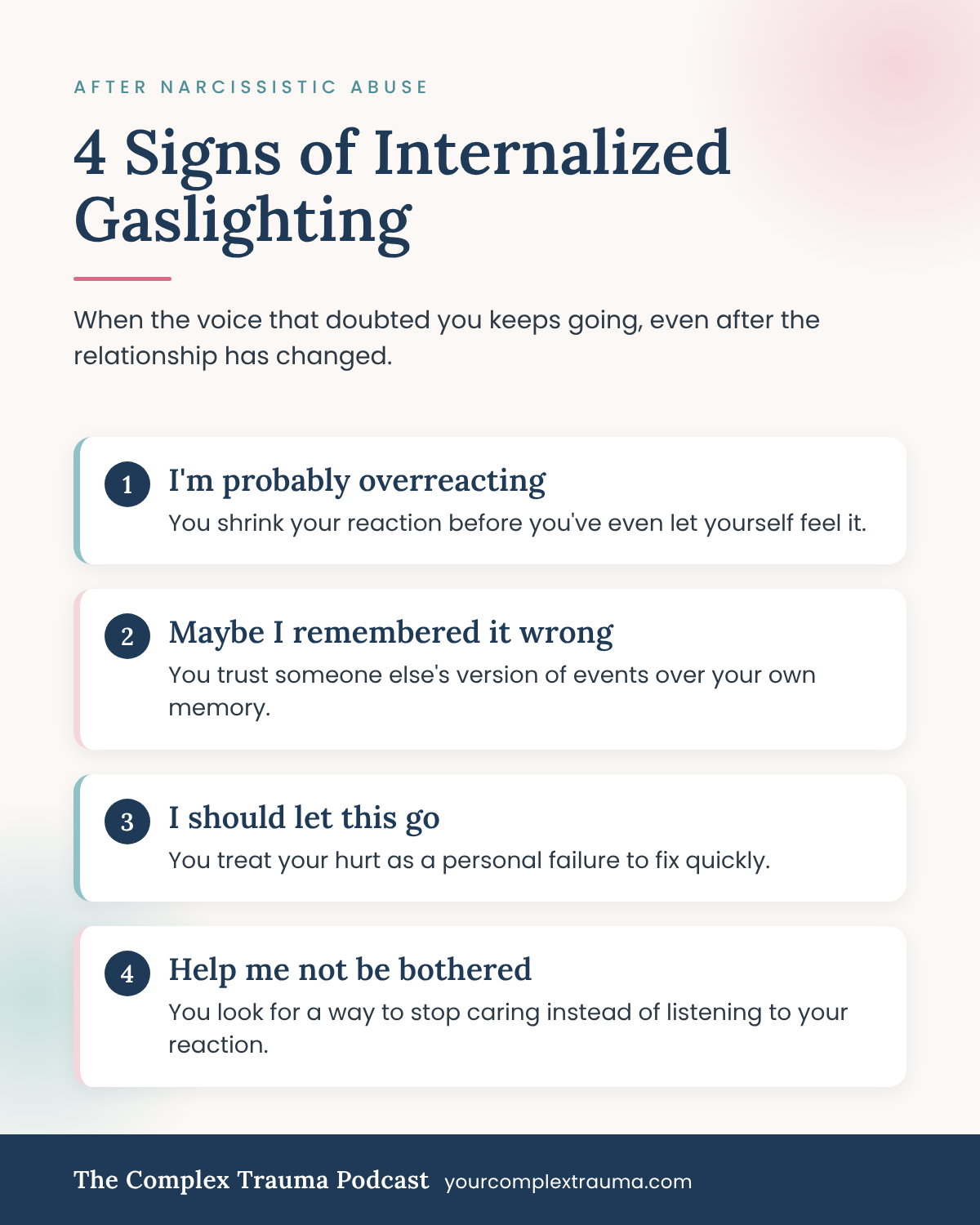
Four signs of internalized gaslighting that can linger after narcissistic abuse and complex trauma.
Internalized gaslighting happens when you start doubting your own perception in the same way someone once taught you to. Gaslighting is when one person repeatedly tries to make another person question their memory, feelings, or sense of reality. Over time, many people take that voice inside, and it keeps going even when the person who started it isn't around.
Amy called internalized gaslighting one of the stickiest parts of complex PTSD, and I see why. You might notice it in thoughts like these.
"I'm probably overreacting." You shrink your reaction before you've even let yourself feel it.
"Maybe I remembered it wrong." You trust someone else's version of events over your own memory.
"I should be able to let this go." You treat your hurt as a personal failure to fix quickly.
"Can you help me not be bothered?" You look for a way to stop caring instead of listening to your reaction.
That last one stopped me when Amy said it. So many people come to therapy hoping to become unbothered, when being bothered is often the healthiest response they have. Learning to let something bother you can be a big part of recovery.
Your body often notices before your mind is willing to. A clenched jaw, a twist in your stomach, or a wave of nausea around a certain person can be worth getting curious about, especially when your thoughts keep insisting that everything is fine. The goal is to notice where your body and your story don't match, without forcing yourself to pick one right away.
What is DARVO?
DARVO is a pattern that often shows up alongside gaslighting. The term, coined by psychologist Jennifer Freyd, stands for deny, attack, and reverse victim and offender. When you raise a concern, the other person denies it, criticizes you for bringing it up, and then positions themselves as the one who was hurt.
Imagine telling a friend that a comment hurt you, and twenty minutes later you're the one apologizing. That reversal is what makes DARVO so disorienting. Knowing the pattern exists can help you recognize it while it's happening, so you don't have to talk yourself out of the original concern.
What are the red flags of narcissistic abuse in relationships?
Common red flags of narcissistic abuse include always being the one who's wrong, having your memory or feelings regularly dismissed, and getting guilt-tripped for basic self-care. Every relationship has conflict. The difference is whether both people's perspectives get respected.
You almost always end up apologizing, even when you raised the concern.
Your opinions are treated as silly or not real.
You feel less confident and less sure of yourself the longer you're in the relationship.
You're the one doing most of the caretaking, adjusting, and inconveniencing yourself.
Saying you need rest leads to guilt, sulking, or punishment.
Many adults who grew up in narcissistic families also notice these patterns showing up with partners, friends, and bosses. Familiar can feel safe even when it isn't good for you, and noticing the pattern is a meaningful first step.
How do you set boundaries with a narcissistic parent?
A boundary with a narcissistic parent is what you will do to protect yourself if a hurtful behavior continues. Asking someone to stop is a request. The boundary is your plan if they don't, like leaving the room, ending the call, or skipping the next gathering.
This shift is freeing for a lot of people, because it puts the boundary back in your hands. You can't make another person change. You can decide how much access they get to you when they won't.
It also helps to expect pushback. When you set a limit with someone high in narcissistic traits, they may ignore it, get angry, or recruit other family members to pressure you. People sometimes call those recruits flying monkeys. If you know backlash is likely, it's easier to stay steady when it shows up, and to remember that their reaction doesn't mean you did something wrong.
What's the difference between low contact and no contact?
Low contact means reducing how often and how deeply you engage with someone, while no contact means not seeing or talking to them at all for a period of time. Low contact might look like shorter calls, fewer visits, or showing up for holidays without weekly dinners. No contact doesn't always mean forever, though it does mean stepping away fully for now.
Only you can decide what's right for your life. What I want you to know is that people rarely make these choices lightly. Amy said that every client she's seen who went no contact was grieving, and that matches what I see too. Most people would love a closer relationship with their parent if that parent could see them as a whole person. Grief is often part of the decision, even when the decision is right.
What does healing from narcissistic abuse look like?
Healing from narcissistic abuse often starts with noticing the messages you absorbed about your worth, like "people only keep me around because I'm useful." Those messages usually weren't said out loud. They were taught through how love worked in your family, and they got repeated until they felt like truth.
From there, healing tends to include three things. It includes getting curious about where those beliefs came from, building compassion for the younger parts of you who believed them, and practicing new ways of relating so you don't land in the same patterns again. Trauma-focused approaches like EMDR, somatic therapy, and parts work can help with all three.
The heart of it is coming to know that you deserve respect simply because you're a person. You don't have to earn it by overfunctioning, staying small, or keeping everyone happy. Amy ended our conversation by saying that people who grew up in these systems are some of the most courageous people she knows, because they keep hoping for something better. I couldn't agree more.
If this resonated, I'd love for you to listen to my full conversation with Amy on The Complex Trauma Podcast. You can learn more about her work at amymarlowmacoy.com. And if you're in Pennsylvania and looking for a trauma therapist, my practice, Reclaim Therapy, offers therapy in person in Horsham, PA, and virtually throughout Pennsylvania.
Frequently Asked Questions
Can narcissistic abuse cause complex PTSD?
Yes, narcissistic abuse can contribute to complex PTSD when the harm is repeated and happens in relationships you depended on. It can affect how you see yourself, how you trust your perception, and how you relate to other people.
Does my parent need to have NPD for it to be narcissistic abuse?
No, your parent doesn't need a diagnosis of narcissistic personality disorder for the harm to be real. Many people with strong narcissistic traits never meet the full criteria, and what matters most for healing is the pattern you lived inside.
What is internalized gaslighting?
Internalized gaslighting is when you start doubting your own memory, feelings, or reactions in the same way someone once taught you to. It can sound like telling yourself you're overreacting or that you should just let it go.
What does DARVO stand for?
DARVO stands for deny, attack, and reverse victim and offender. It describes a pattern where someone denies a concern, criticizes the person who raised it, and then acts as though they were the one who was harmed.
What is a boundary with a narcissistic parent?
A boundary with a narcissistic parent is what you will do to protect yourself if a hurtful behavior continues. It might mean leaving the room, ending a call, or skipping an event, since you can't control the other person's behavior.
Is it normal to grieve after going no contact?
Yes, grief is very common after going no contact with a parent. Many people grieve the relationship they hoped for, even when stepping away is the right decision for them.