Is Functional Freeze Real?
Episode 147
Written by Sarah Herstich, LCSW, Certified EMDR Therapist, EMDRIA-Approved Consultant, Somatic Experiencing Practitioner, and host of The Complex Trauma Podcast
Functional freeze is a descriptive term, not a diagnosis, for a pattern in which you keep working and parenting while feeling numb, stuck, or cut off from yourself. Many somatic clinicians describe it as a blended nervous system state, with mobilizing energy held underneath shutdown, which can make small personal tasks feel impossible while urgent ones feel easy.
Key Takeaways
Functional freeze is a recognizable pattern that many clinicians and listeners find useful, and it is a descriptive term and not a formal diagnosis.
Many somatic clinicians describe it as a blended state, with activation held underneath shutdown, so the body is often bracing instead of resting.
It is not another word for dissociation, and a systematic review of 28 studies found no clear physiological pattern for dissociation in people with PTSD.
ADHD, depression, burnout, sleep loss, and medical conditions can look similar and can exist alongside a trauma history.
Small choices, gentler transitions, and pleasure can help rebuild access to your own wants, and a no to any of it is a complete answer.
What does functional freeze feel like?
You scheduled your mother's dentist visit, your kid's checkup, and a team offsite in one afternoon. Your own appointment has been an open browser tab for six weeks.
If you are the person other people describe as together, this may sound familiar. You answer messages, remember birthdays, and know where everyone needs to be, and somewhere inside all of that capability sits a task so small it should take five minutes that you cannot seem to begin. When someone you love has an actual emergency, you become fast, clear, and calm. When nobody needs anything from you, an open afternoon can leave you with no idea what you want to do with it.
The word functional describes how things look from the outside. It does not tell you how things feel on the inside, and it does not mean you are doing well. It means enough of your life keeps moving that the struggle is easy for other people, and sometimes for you, to miss. In my work with people who carry complex trauma, I hear some version of the same question constantly. Why can I handle the hard thing and still stall on the easy one?
What are common signs of functional freeze?
People describe it in different ways, and these are some of the patterns I hear most often. Not everyone recognizes all of them, and some people only see one or two.
Handling emergencies easily while stalling on small personal tasks
Struggling to know what you want, feel, or need
Taking care of everyone else while your own meals, rest, and appointments slide
A lag between knowing what you want to say and getting the words out
Feeling far away or on autopilot while still getting things done
Feeling tense, wired, or restless even when nothing is moving
Is functional freeze a real diagnosis?
No. Functional freeze does not appear in the DSM-5-TR or the ICD-11, and no standardized test measures it. It is a descriptive term, which means different clinicians use it to point at slightly different things. Kathy Kain and Stephen Terrell, who work with developmental trauma from a somatic perspective, use it for chronic patterns that can include low energy, numbness, dissociation, inhibition, and limited capacity in someone who is still able to function.
Online, freeze, shutdown, collapse, dissociation, hypoarousal, and tonic immobility often get used as if they were interchangeable, and clinically they are not the same thing. Researchers who study human freezing are usually looking at something shorter and more specific, which is an acute defensive response to threat, often marked by reduced movement and a slowing heart rate. Some researchers describe it as a preparatory state, with action held for a moment while the brain gathers information. A pattern that has built up over years of adapting to a stressful environment is a different thing, which is why I think of functional freeze as a useful clinical description and not a settled scientific category.
What is happening in the body during functional freeze?
Many trauma clinicians use polyvagal theory, developed by Stephen Porges, as a map for talking about nervous system states. It describes three broad states. The ventral vagal state is the settled, connected one, where you can think clearly and be with other people. The sympathetic state is mobilization, the fight or flight energy. The dorsal vagal state is the shutdown end, where the body conserves energy and output drops.
I use this map the way I use any clinical model, as something helpful and not as settled fact. Researchers who study the autonomic nervous system, including a large group led by Paul Grossman, have challenged some of the theory's specific physiological and evolutionary claims, and Porges has responded to that critique. The debate is ongoing, which is a good reason to hold the three states loosely.
Within that map, many somatic clinicians describe functional freeze as a blend. Sympathetic charge, the mobilizing energy, is held underneath a dorsal leaning presentation of conservation and reduced output. In plain language, the outside slows down while the inside stays braced. People describe held breath, tight shoulders, a clenched jaw, or a low hum of tension, even while they look flat or checked out. If you want more background on how your nervous system responds to stress, the Reclaim Therapy blog covers it in Nervous System Dysregulation Is Not the Enemy You Think It Is.
The blend may help explain why the experience varies so much from person to person. For some people the shutdown end is louder, and they feel numb and slowed down. For others the activation is louder, and they feel anxious and wired while still unable to act, as if one foot were pressing the gas and the brake at the same time. These may be two views of the same pattern more than two different conditions, although that is a clinical formulation and not something researchers have measured directly.
Is functional freeze the same as dissociation?
No. Dissociation can be part of what someone experiences in functional freeze, but the two are different ideas. Dissociation is a disconnection from your thoughts, feelings, body, surroundings, or sense of self, and it runs along a spectrum from everyday zoning out to dissociative disorders.
A common online claim says dissociation always means the body has dropped into shutdown. A systematic review in the European Journal of Psychotraumatology looked at 28 studies with about 1,300 participants with PTSD and found no clear trend across physiological measures such as heart rate and blood pressure. The authors concluded that they could not find robust evidence linking dissociation to hypoarousal.
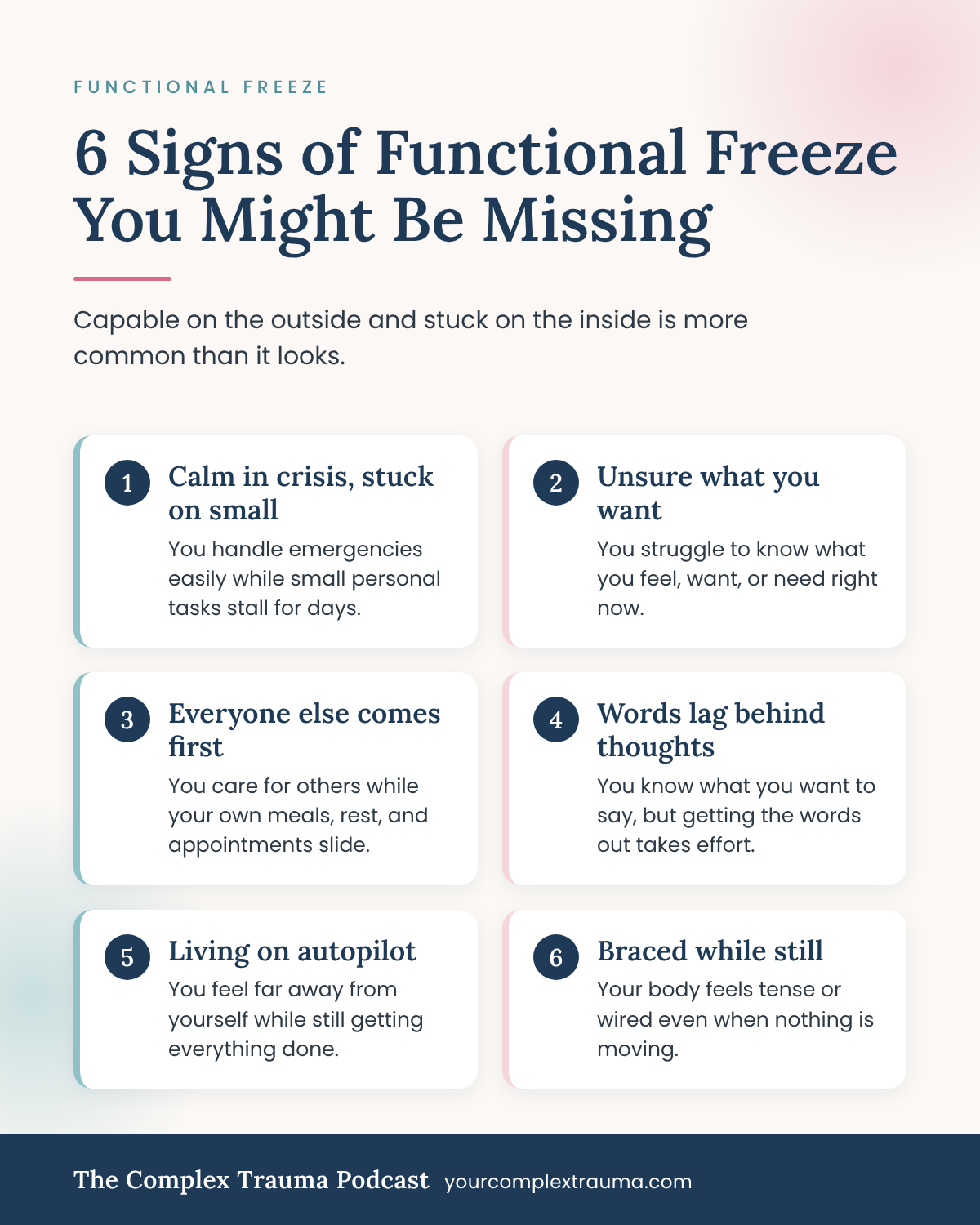
Six signs of functional freeze that are easy to miss when you are still getting everything done.
In everyday terms, there is no dependable body signature you can check yourself against to confirm which state you are in. That is why I am cautious about online checklists that promise to tell you whether you are in freeze, collapse, or something else, and why nervous system detective work can turn into another way of trying to control an experience. Noticing what gets harder, what gets easier, what helps you move, and what makes you disappear usually gives you more to work with than naming a state.
What is the difference between functioning and flexibility?
Functioning describes what you are able to produce. Flexibility describes how many responses your nervous system has available, such as mobilizing when you need to, stopping when you need to, moving toward something, moving away from it, and receiving help.
Dan Siegel's concept of the window of tolerance is a helpful way to picture this. It describes the range of arousal in which you can feel activated or calm and still stay present and think clearly. Past one edge you may flood, and past the other you may shut down. A person can function impressively inside a very narrow window, which is part of what makes functional freeze so easy to miss.
When I think about nervous system health, I ask whether you can notice you are tired before you are depleted, feel an impulse and act on it, change your mind, and rest and then return to activity. Those questions tell me more than whether you are getting things done.
Why can I handle a crisis but not a simple task?
A crisis supplies urgency, a clear next step, and often another person who needs you, and many people with developmental trauma learned early to mobilize around exactly those conditions. A personal want rarely supplies any of them, so the nervous system may not treat it as worth moving for. That is a clinical way of understanding the pattern and not a universal biological rule.
Neuroception is the term Stephen Porges uses for the way your nervous system scans for safety and threat below conscious awareness, before you have decided anything. A crying child or a looming deadline registers there almost instantly. Wanting to take a walk usually does not carry the same charge.
Practice may matter here too. If you grew up in a stressful, unpredictable, or emotionally complicated home, you may have spent years responding, which meant reading someone's mood, meeting an expectation, preventing the next problem, and keeping the connection intact. Initiating, which means noticing a want from the inside and acting on it, may have had far less room. This is my clinical formulation and no research has shown that functional freeze is caused by it, but it offers one explanation for why urgency can work when wanting something does not.
Janina Fisher, who writes about trauma and structural dissociation, describes a going on with normal life part of a person, the part oriented toward work, parenting, relationships, and getting through the day. Other survival responses, including fear, freeze, numbing, and attachment responses, can continue underneath it. This is a clinical framework for describing how experience can be organized into parts and not a literal map of compartments in the brain, and it is a different idea from the disconnection described in the dissociation section above. It does help explain how one part of you can handle a crisis beautifully while another part of your experience is carrying something very different.
The Reclaim Therapy blog explores the cost of overfunctioning in The Hidden Cost of High-Functioning Trauma.
How is functional freeze different from ADHD, depression, and burnout?
These patterns can look alike from the outside, and they are not mutually exclusive, so telling them apart usually takes a conversation with a professional and not a self-test. What tends to differ is the pattern around the stuckness, including how long it has been there, where it shows up, and what else comes with it. Because urgency can help a person with ADHD get started too, a pattern like only moving under pressure does not separate these on its own.
PatternWhat it often looks likeA question worth askingFunctional freeze (a descriptive term, not a diagnosis)Capable on the outside, disconnected or stuck on the inside, often alongside a history of chronic stress or developmental traumaDo I mobilize easily for urgency and for other people but struggle to act on my own wants?ADHDDifficulty starting and sustaining tasks that is usually traceable to childhood and shows up across settings, with urgency or interest often helping a person get movingHas this followed me since I was young, even during calm and safe periods of my life?DepressionPersistent low mood or loss of interest or pleasure, usually with changes in sleep, appetite, energy, or concentration, lasting at least two weeksHave I stopped enjoying things I used to enjoy, most days, for weeks?BurnoutExhaustion, cynicism, and reduced effectiveness linked to chronic workplace stress, which the World Health Organization describes as an occupational phenomenonDoes it ease when I am away from work?
Trauma exposure is also associated with differences in thinking skills. A 2015 meta-analysis of studies of people with PTSD found effects on areas like attention, working memory, and processing speed, with sizes that varied widely. Sleep deprivation, hormonal changes, medications, and medical conditions can affect energy and cognition as well, and it is possible to have a trauma history and ADHD or depression at the same time.
Because so many things can overlap, I would rather you not self-diagnose from a blog post, including this one. If the pattern has been around for a while, an evaluation with a licensed professional can help sort out what is contributing. If you ever have thoughts of harming yourself, you can call or text 988 in the United States at any hour.
What helps with functional freeze?
There is no research on treatments for functional freeze specifically, since it is not a formal diagnosis, so what helps is drawn from approaches used for developmental and complex trauma. The common thread in what I describe below is building access to your own choices and signals rather than forcing movement.
Can small choices help with functional freeze?
Often they can, because small choices give information from inside you a chance to matter again. The questions can be very ordinary. Do I want the window open or closed? Tea or coffee? Do I want to sit on the porch or stay at my desk? The point is to notice whether an answer is available at all, and what happens in your body when you let it count.
For some trauma survivors, tuning into the body can feel confusing or overwhelming at first, so this does not require scanning yourself all day. Choosing between two options is enough.
How can noticing small impulses help?
In Somatic Experiencing, we pay attention to small impulses, like a pull to stand, turn your head, stretch, push your feet into the floor, or create more distance. Instead of deciding right away what the sensation means, you get curious about what happens if you let a little of that movement happen. The experience that matters is noticing an impulse, having enough choice to act on it, and seeing what follows. Often nothing big happens, and that is fine. For developmental trauma especially, a sense of agency may need to be built through very ordinary moments, like wanting space and taking it, or wanting help and asking for it.
Why doesn't rest always help with functional freeze?
Because of the blend described earlier, the sympathetic charge underneath does not necessarily switch off the moment you stop moving. Many people notice that when they finally slow down, they start scrolling, feel numb or restless, hear their mind list everything they should be doing, or meet feelings that were easy to outrun while they were busy. That does not mean you are bad at resting. It may mean your system needs a gentler path between going and stopping.
Transitions can help, such as changing clothes, taking a short walk, eating something, putting on a song, or looking around the room and naming what you see. Anything that helps your system register that one part of the day is over can work. Treat these as experiments and not as a prescribed ritual.
Does pleasure belong in recovery from functional freeze?
I think it does. If recovery turns into a daily list of tracking, regulating, grounding, and orienting, it becomes one more job to perform well. The opposite of a constricted life is often aliveness more than calm. That can look like laughing, tasting something good, getting curious, feeling annoyed, having an opinion, or getting interested in something with no productive purpose at all. Those moments are evidence that more of you is available.
Any of this can be tried as an experiment, and a no to any of it is a complete answer. Choice is the point.
What kind of therapy helps with functional freeze?
Therapists generally draw on approaches used for complex trauma, such as Somatic Experiencing, EMDR with careful preparation, and parts-based work. These approaches are commonly used for developmental and complex trauma, although none of them has been tested on functional freeze itself. Look for a therapist trained in complex trauma who goes at your pace and is comfortable letting the work begin with very small things.
So is functional freeze actually real?
Yes, with some precision. The experience people describe is real, it has a recognizable shape, and it tends to develop for understandable reasons, often out of what a person had to get good at while growing up. It is also a descriptive term and not a diagnosis, and it will not explain every hard afternoon. Treating it as the answer to everything can get in the way of noticing what else may be contributing. Both of those things can be true at once.
If you recognized yourself here, you do not need to become less capable. What you may be building is a life where functioning does not require so much distance from yourself, where urgency is not the only thing that gets you moving, and where what you want gets a vote too. Your nervous system can learn that slowly, through very ordinary moments, and you get to choose the pace.
If you would like support with this, I own Reclaim Therapy, a trauma-focused group practice in Horsham, Pennsylvania, with in-person and virtual sessions across the state. You can learn more about how we approach complex PTSD treatment on our practice site.
Frequently Asked Questions
What is functional freeze?
Functional freeze is a descriptive term, not a diagnosis, for a pattern in which a person keeps functioning on the outside while feeling numb, stuck, or disconnected on the inside. Many somatic clinicians describe it as a blended nervous system state, with mobilizing energy held underneath shutdown. Different clinicians use the term in slightly different ways.
Is functional freeze a real thing?
The experience people describe is real and recognizable, although functional freeze is not a formal diagnosis and does not appear in the DSM-5-TR or the ICD-11. It is best understood as a useful clinical description and not a measured scientific category.
What does functional freeze feel like?
It often feels like being capable and stuck at the same time. People describe stalling on small personal tasks while handling emergencies easily, losing touch with what they feel or want, or feeling like they are watching their own life from a distance. Some people feel flat and slowed down, and others feel tense and wired.
Is functional freeze the same as dissociation?
No. Dissociation can be part of someone's experience of functional freeze, but the two are different ideas. A systematic review of 28 studies found no clear physiological pattern for dissociation in people with PTSD, which is one reason I avoid treating dissociation and shutdown as the same thing.
What causes functional freeze?
No single cause has been established. Clinicians often connect it to chronic stress, developmental trauma, and early environments where a child had to keep functioning and stay attuned to other people while there was little room for their own needs. ADHD, depression, burnout, sleep loss, and medical conditions can create similar patterns.
How is functional freeze different from depression or ADHD?
They can look similar from the outside, and they can occur together. Depression usually involves persistent low mood or loss of interest lasting at least two weeks, ADHD typically shows up since childhood across settings, and functional freeze describes capable functioning alongside disconnection from your own wants and feelings. A licensed professional can help sort out which of these apply to you.
How do you get out of functional freeze?
There is no single fix, and forcing yourself to move is often the habit you are already practicing. Many people find it helpful to start with very small choices, notice tiny impulses to move, build gentler transitions between activity and rest, and make room for pleasure. Therapy for complex trauma can support this work at a pace that feels safe.