Episode 154
Rumination can be a trauma response. For many people with complex trauma, replaying conversations and rehearsing worst-case scenarios started as a way to stay safe in a childhood that felt unpredictable. The loop is often a protective part of you still doing an old job, and it tends to ease through felt safety more than through thinking harder.
Key Takeaways
Rumination is repetitive, looping thinking that goes over the past and judges it, and for many people with complex trauma it began as a survival strategy.
A child who couldn't control what happened at home could at least try to predict it, and replaying events was one way the brain studied for danger.
Research with trauma survivors suggests that "why" and "what if" rumination can help keep trauma symptoms going, and repetitive thinking can keep the stress response switched on in the body.
Understanding where rumination comes from rarely makes it stop, because what the nervous system is looking for is a felt sense of safety.
Small body-based practices, moments of agency, repair with safe people, and therapies like EMDR and Somatic Experiencing can help the loop soften over time.
What does rumination feel like when you have complex trauma?
Rumination after complex trauma often feels like a mind that won't clock out. You might reread an email five times before you hit send, then reread it again after it's gone. You might replay a performance review for a week, fixating on the one comment that wasn't glowing. Maybe you rehearse an appointment with your doctor in the car on the way there, or lie awake drafting a text you know you'll never send.
A lot of people tell me they're completely fine during the day. They're productive, capable, and on top of everything, which is often part of high-functioning trauma. Then they lie down at night, or they finally get a slow Saturday afternoon, and the loop starts. By the time it winds down, they feel wrung out, as if they ran a marathon without ever getting off the couch.
There's often a layer of shame on top of all of it. You might know the loop isn't helping. You might have done years of therapy and understand exactly where it comes from, and it still happens. That can leave you feeling like you're failing at healing, which gives the loop one more thing to chew on.
Is rumination a trauma response?
Rumination can be a trauma response, especially for people who grew up with complex trauma or childhood emotional neglect. It often starts as a survival strategy that made a lot of sense at the time.
Picture a child in a home where things felt unpredictable. Maybe a parent's mood could shift without warning. Maybe the rules kept changing, or nobody seemed to notice when the child was sad or scared. A child in that environment has no way to leave and no way to make the adults change. What the child's nervous system can do is study. It replays what happened to figure out what went wrong, and it rehearses what might come next, so maybe next time it can see trouble coming.
For a kid, that's a brilliant strategy. If you can't control what happens, at least you can try to predict it. The hard part is that the part of you who learned to do this may still be on the job decades later. A vague email from your boss, a short reply from your partner, or a pause in a conversation can send that old protector straight back to work.
Thomas Zimmerman describes the brain as a prediction machine. It uses past experience to guess what's about to happen so it can prepare the body before anything actually occurs, and much of that runs below conscious awareness. If your early experience taught your brain that danger was likely and hard to see coming, it makes sense that it would keep scanning, replaying, and preparing.
As a Somatic Experiencing practitioner, I also think about rumination through the body. Peter Levine, who developed Somatic Experiencing, describes how our bodies mobilize to protect us when something overwhelming happens, getting ready to fight, run, push away, or yell stop. When a situation doesn't allow that, especially when you're small and the danger is a caregiver, that protective energy can stay in the system. The way I understand it as a clinician, for some people the replay is that energy still looking for somewhere to go. If you couldn't speak up back then, your mind may still be trying, rewriting the conversation over and over.
How is rumination different from worry and intrusive memories?
Rumination is repetitive thinking that goes over something again and again, usually by questioning and judging it. It tends to look backward, asking why something happened and what it says about you. Worry is a close cousin that tends to look forward, asking what might go wrong next. Many people do both, sometimes in the same breath.
Intrusive memories and flashbacks work differently. They tend to arrive on their own, as an image, a sensation in your chest, or a sudden wave of panic, often with no warning at all. Rumination is more like something your mind does with the memory after it shows up.
The two often feed each other. In a study of assault survivors, Michael and colleagues (2007) found that people used rumination to cope with intrusive memories, and that rumination also triggered more of them. The memory shows up, you try to think your way through it, the thinking stirs up more memories, and the cycle keeps going. Being able to name which one is happening can give you a little distance from it.
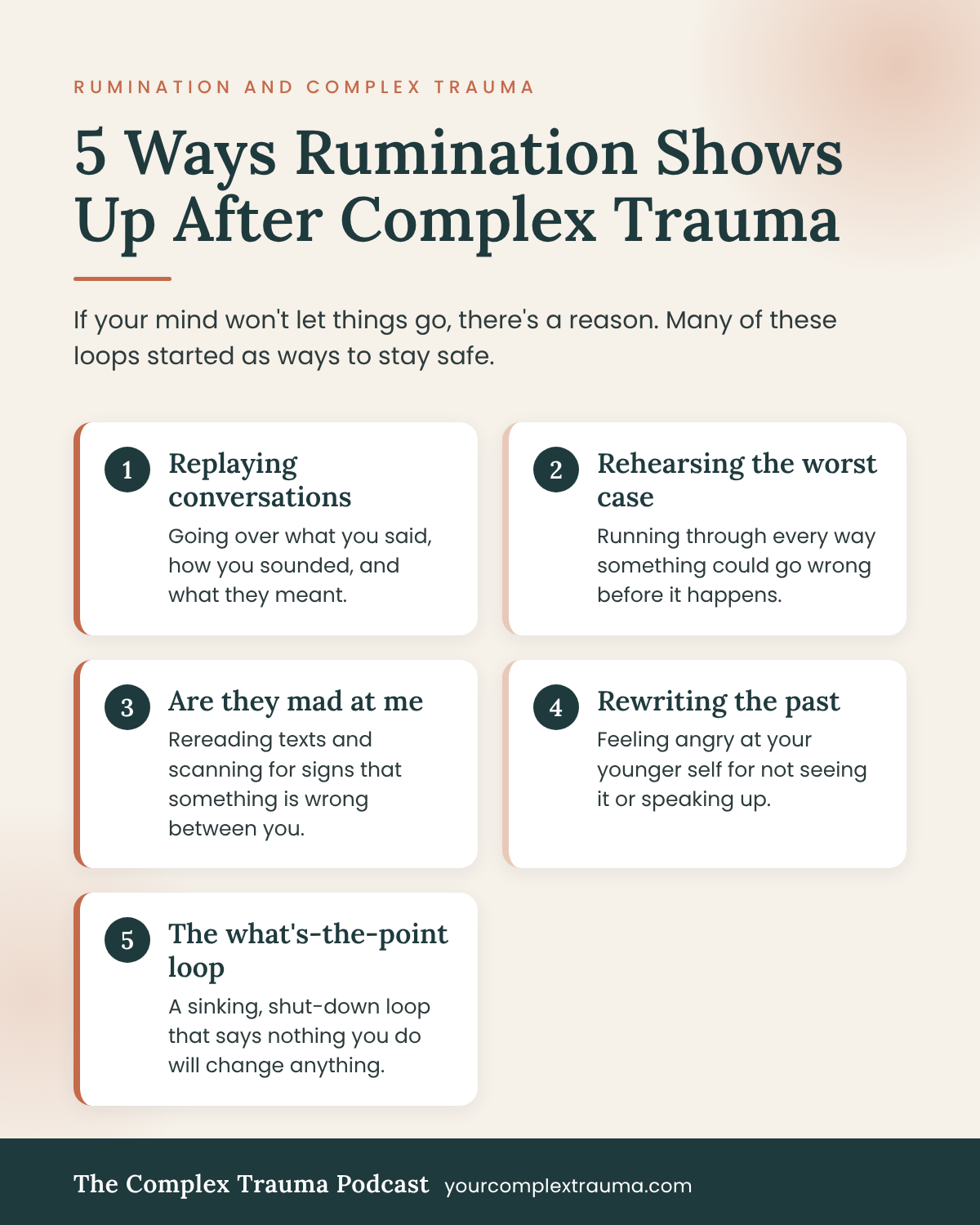
Five ways rumination can show up as a trauma response, from replaying conversations to the heavy what’s-the-point loop.
5 ways rumination shows up after complex trauma
Rumination after complex trauma can take a few different shapes. You might recognize one of these, or all of them.
Replaying conversations
You go over what you said, how you sounded, and what the other person might have meant. You rewrite your lines, sometimes dozens of times, searching for the version that would have protected you from judgment or rejection.
Rehearsing the worst case
Your mind runs through every way an upcoming event could go wrong, from the hard conversation you're dreading to the trip you're about to take. It can feel like preparation, and it usually leaves you more anxious than when you started.
The "are they mad at me" loop
A delayed text, a short reply, or a change in someone's tone sends you searching for signs that something is wrong between you. You might reread messages, replay someone's facial expression from memory, or draft an apology for something you aren't sure happened.
Rewriting the past
Many people with complex trauma replay old moments and feel furious at their younger selves for not seeing the danger or speaking up. That anger may be the protective impulse that never got the chance to happen, still trying to show up for you.
The what's-the-point loop
Some rumination feels frantic and revved up. Some feels heavy, like a weight on your chest that says nothing you do will change anything. This heavier kind can look like the body's shutdown response, where everything slows down and goes far away. Many people swing between the two, wired at 2 a.m. and flattened by the afternoon.
Why can't I just stop thinking about it?
Rumination is hard to stop with willpower because the loop often starts before you've decided anything, and because it lives in your body as much as your mind. Telling a protective part to stop is a bit like telling a smoke alarm to calm down while it still smells smoke. It might go quiet for a moment, and then it gets louder.
Repetition plays a role too. Every time the loop runs, it's a kind of rehearsal, and well-practiced pathways become easier for the brain to take. Research with trauma survivors lines up with this. Rumination predicted PTSD symptoms six months later in studies of assault and accident survivors, and the "why" and "what if" questions, the compulsive pull to keep going, and feeling worse before and after were the features most linked to staying stuck (Michael et al., 2007; Frank and Ehlers, 2008). Most of that research looked at people after a single traumatic event, and the pattern fits much of what I see in people with complex trauma too.
If your mind just jumped to "so I'm making my trauma worse," please pause there. Your brain usually launches the loop on its own, running on old data and trying to protect you. Rumination is a symptom, and it's something that happens to you.
Your body is part of the loop as well. Research on what's called perseverative cognition, meaning repetitive worry and replaying of stress, suggests it can keep the stress response switched on even when nothing threatening is happening in the room (Clancy et al., 2016). Your heart rate stays up, your muscles stay braced, and your breath gets shallow. That's a big part of why a spiral can leave you so exhausted, and if you want to understand more about what's happening there, I've written about nervous system dysregulation too.
In Somatic Experiencing, we also talk about coupling, which is when a thought and a body state get linked together. The memory of a conversation and a tight chest start to arrive as a package. You think about it and your chest tightens, then your chest tightens and your mind goes looking for what's wrong, landing right back on the conversation.
All of this explains why insight alone rarely ends rumination. You can understand exactly where the loop comes from and still find yourself in it, because what your nervous system is looking for is a felt sense of safety, and safety has to be experienced in the body.
Is rumination the same as processing?
Rumination and processing can feel almost identical from the inside, since both involve thinking about something hard and feeling a lot. The difference usually shows up in where you end up.
When you're processing, something moves. You notice something new, you feel sad or angry and then your body settles a little, or the memory feels slightly lighter and you don't need to go over it the same way again. When you're ruminating, you land right back where you started, with the same questions, the same knot in your stomach, and usually a worse feeling than before. If you've been over something fifty times and you're still at square one, that's a sign your system needs something other than more thinking.
What helps trauma-related rumination?
What tends to help trauma-related rumination is giving your nervous system new experiences of safety, choice, and connection, one small moment at a time. Here are a few places to start.
Name the loop
Saying "there's the replay" out loud or in your head can create a sliver of space between you and the loop. You don't have to stop it or fix it. Noticing it makes you the person watching the loop instead of the person swallowed by it.
Get more concrete
Research on repetitive thinking suggests that abstract, big-picture questions like "why did this happen" and "what does this say about me" tend to keep people spinning, while concrete, specific thinking tends to be more helpful (Watkins, 2008). Try shifting to questions like "what am I noticing in my body right now," "what do I need right now," or "what's one small next step." The why can be important to explore in therapy, with support. Alone at 2 a.m., it usually just keeps the loop going.
Give the energy somewhere to go
If rumination is mobilized energy with nowhere to land, small movements can help. Press your feet into the floor as if you're pushing it away, then let go. Squeeze your hands into fists and slowly open them. Stretch, walk to another room, or step outside for a minute. If you're in the heavier, shut-down version, try gentler movement, like wiggling your fingers and toes, to remind your body that a little aliveness is available too. Afterward, notice whether anything shifted, even slightly, and know that it counts even if nothing did.
Get curious about the feeling underneath
For many people, rumination keeps them busy in their heads and away from a feeling that was too big to feel when it first showed up, like shame, grief, or loneliness. Pete Walker writes about how the inner critic in complex trauma often grew out of trying to stay safe and acceptable, and a lot of rumination runs in that critic's voice. If a loop keeps coming back no matter how well you understand it, you might gently ask, "What would I be feeling right now if I weren't thinking about this?" This is tender work that tends to go best in small doses, ideally with a therapist beside you.
Practice tiny moments of agency
The heavier loop that says nothing will help often reflects a history where nothing you did made a difference. In a revisit of the original learned helplessness research, Maier and Seligman (2016) proposed that passivity may be the brain's default response to prolonged, uncontrollable stress, and that a sense of control is what gets learned. If control is learned, your brain can keep learning it now. Saying no and noticing you're okay, choosing where to sit, or asking for what you need are small experiences of agency that add up over time.
Let repair happen between people
So much rumination is relational. If you grew up in a home where ruptures were rarely repaired, your system may have learned to try to fix every disconnection alone, in your own head. Repair happens between people, which is part of why the loop never feels finished. Every time you name something with a safe person and they stay, or a friend tells you they weren't upset at all, your system gets new information that connection can come back.
How can therapy help with rumination and complex trauma?
Trauma-focused therapy can help with rumination by working with the memories and nervous system patterns that keep the loop going. EMDR, which stands for eye movement desensitization and reprocessing, is designed to help memories that feel stuck get processed so they carry less charge in the present. When a memory has less charge, the loop often has less to grab onto.
Somatic Experiencing works with the body directly, using approaches like titration, which means touching hard things in small doses, and pendulation, which means moving between activation and something that feels more okay. Parts work can help you get to know the protective part that keeps replaying, so it can feel safe enough to rest.
If you're in Pennsylvania and looking for this kind of support, my practice, Reclaim Therapy, offers complex PTSD treatment, EMDR therapy, Somatic Experiencing, and parts work in person in Horsham, PA, and through virtual therapy across Pennsylvania. Wherever you live, look for a therapist who specializes in complex trauma and goes at a pace your nervous system can handle.
Listen to the episode on rumination
I talk about all of this in more depth, including a conversation I replayed for way longer than I'd like to admit, in episode 154 of The Complex Trauma Podcast, "Why Do I Keep Replaying Conversations? Rumination and CPTSD."
If you want support for the moments when the loop is running and your whole system feels revved up, you can grab my free Dysregulation Toolkit. It's interactive, you can save it to your phone's home screen, and it walks you through tools for whatever kind of hard moment you're in.
If you're in Pennsylvania and want to talk with a trauma therapist about what you're experiencing, you can schedule a free consultation with Reclaim Therapy. Wherever you are, I hope you'll remember that the part of you that keeps replaying has been trying to protect you all along, and that it can learn, slowly, that it's allowed to rest.
Frequently Asked Questions
Is overthinking a sign of trauma?
Overthinking can be a sign of trauma, though it isn't always. For many people with complex trauma, constant replaying and analyzing began as a way to predict and prevent danger in an unpredictable childhood, and the habit kept going long after the danger passed.
Can rumination be a symptom of CPTSD?
Rumination can be one way complex PTSD, or CPTSD, shows up. People with CPTSD often replay conversations, rehearse worst-case scenarios, and judge themselves harshly, and research with trauma survivors suggests rumination can help keep trauma symptoms going.
Why do I replay conversations in my head?
Replaying conversations is often your brain trying to keep you safe by checking for anything you missed or anything that could lead to rejection. If you grew up needing to read people closely to stay safe, that checking may still run on autopilot today.
Why do I always think people are mad at me?
Worrying that people are mad at you often comes from growing up without repair after conflict. When ruptures were never mended, a child learns to scan for disconnection and try to fix it alone, and that pattern can carry into adult relationships.
How do I stop ruminating at night?
Trying to force the thoughts away at night usually backfires. It can help to name the loop, shift your attention to what you notice in your body right now, and give your body a little movement, like pressing your feet into the mattress and letting go a few times.
What kind of therapy helps with rumination?
Trauma-focused therapies like EMDR, Somatic Experiencing, and parts work can help with rumination rooted in complex trauma. They work with the memories and nervous system patterns underneath the loop, so that safety becomes something you can feel over time.
If you love tuning in to the podcast, please take a second to leave a review! It truly helps other people find the show.
-
Sarah (00:40) Okay, so it's two o'clock in the morning, you're lying in bed, and you're on take like forty-seven of a conversation that happened three days ago. You've rewritten your lines, you've analyzed their face, their tone, that little pause before they say, yeah, totally. And you've come up with the perfect thing that you should have said, and you've gotten mad at yourself for not saying it. and now you're wondering if that one word text they sent this afternoon means that they're just done with you. You're exhausted. You know this isn't actually helping. And you've literally told yourself to stop like 12 times. And it just keeps going. If that's you, I want you to stay with me today because even when it feels like torture, I think your brain is really trying hard to keep you safe. So let's dive into that. Hey everybody, welcome back to the Complex Trauma Podcast. Today we're talking about rumination, that replaying, the rewriting, the looping, the what if and why did I spiral that so many of us live with, especially at night. So this one is for the people who've been told to just stop overthinking it and wanted to throw their phone across the room. For the ones who've done years of work on themselves and still find themselves replaying the conversation from Tuesday or like Tuesday seventeen years ago. For the cycle breakers, the overthinkers, the people whose brains never seem to clock out. Essentially, I know this is a lot of you listening. we're gonna talk about where this comes from, why it gets so sticky, what's happening in your body while it's happening, and what might actually help. So I don't actually have one specific listener question this week. But when I was getting ready for this episode, like I do, I spent some time reading what people are saying about this online. And the same question kept showing up over and over and over again. Similar versions to I've done so much work on myself. I've been in therapy for years. I understand my patterns. I know where they come from, and I still can't stop replaying things. A conversation from three days ago, something I said at work, something that happened when I was eight. I lie in bed rewriting it and I get so angry at myself for not seeing it sooner and not saying what I should have said. It's exhausting. And honestly, it makes me feel like I'm failing at healing. Why does my brain keep doing this? And is it ever going to stop? So many people on Reddit on trauma forums described the replay lasting for days, sometimes weeks. Some people said it starts in their head and then spills out loud when they're alone in the car or the shower, and they catch themselves literally arguing with someone who isn't there. Some people said that they're fine all day, totally functional. And then the second their head hits the pillow. Or when you slow down on Sunday afternoon, it starts going. A lot of people talk about how wiped out they feel after a spiral. Like they ran a marathon, except they never left the couch. And a lot of people share something that really like breaks my heart a little bit, that they're worried that they're too much, that the people they love are tired of hearing about it, that they're a burden because their brain just won't let things go. And the thing that came up most was the anger at their past self. Why didn't I see it? Why didn't I say something? Why did I let this happen? People who have done a ton of healing, still replaying old moments and mostly just furious at the younger version of themselves who didn't protect them. I think one of the things that makes rumination so lonely is because nobody can see it. It all happens inside your head. And from the outside, I think most of you can appreciate this. You look totally fine. And on the inside you're working so, so hard. I'm gonna give you an example from my own life. A little while ago, I was talking to like a newer mom friend. We're still in that kind of early stage where you're both kind of like figuring out if this is gonna be a match, if we can actually be friends, all of that kind of stuff. and the conversation kind of turned towards some of my son's challenges. He's a neurodivergent little kid. We've had a lot of challenges over the years, and we work so hard, and he works so hard all the time. And I shared some of what that looks like in our house. And she responded, and I said something back, and the conversation just kind of moved on. kind of felt like an everyday moment between two moms. But then afterward, It started. Why did I say it like that? Did I share too much? Did I make him sound bad? did I make myself sound like I have no idea what I'm doing? What was her face doing when I said that? I rewrote my side of the conversation so many times. In one version I said less. In another I explained even more. another I made a little joke so it wouldn't all feel so heavy. And I replayed it, like literally replayed it, so much longer than I would like to admit on this podcast. When I finally slowed down and got curious about it, there was so much shame in there. Shame about letting her see something messy about my family and this fear that she was judging him and judging me as his mom. and underneath that shame was this really old question about belonging. am I okay here? Do I fit with this person? Did I just show her something that's going to get me left out? And my body was in it the whole time, Braced and kind of like a little buzzy, like something bad had already happened. and I was just kind of waiting to find out how bad. So if you've ever replayed a conversation for days and then felt totally ridiculous about it, like I see you, me too, and for the record, neither of us is ridiculous at all. There's a reason that this happens. And that's where we're going next. A lot of people on the forums that I was reading through, they said that they don't even know what to call this. Is it a flashback? Anxiety. Just how I'm wired. So intrusive memories and flashbacks, they tend to arrive on their own. You're unloading the dishwasher and suddenly there's an image or a feeling in your chest or a wave of panic. It just shows up out of nowhere. In our emotional flashbacks episode, we talked about how sometimes it's a feeling with no picture at all. I'll link to that episode in the show notes. Rumination feels different. It's more like something your mind does with the thing. Going over it, questioning it, judging it. Why did I say that? What did she mean? What if I'd left sooner? What's wrong with me? sort of evaluates and it loops. And then there's worry, which is kind of like rumination's cousin. Worry tends to lean towards the future. What if this happens? What if that happens? Rumination tends to lean towards the past. Why did that happen? What does it mean about me? A lot of us do both sometimes like in the same breath, actually. There's research with trauma survivors showing that people often use rumination to try to cope with intrusive memories. Like the memory pops up and your mind goes, Okay, let's figure this out. Let's analyze it so it stops bothering us. Which makes total sense. And the same research found that rumination can end up triggering more of those intrusive memories, actually. So it's this loop. The memory shows up. You try to think your way through it. The thinking stirs up more memories and around and around you go. So many of you have been blaming yourselves for both, right? When you can name what's happening like, that was an intrusive memory, and now I'm ruminating about it, you get a tiny bit of distance from it. You become the person noticing the loop instead of the person being completely swallowed by it. Okay, so I wanna go back to the beginning for a minute. Like way, way, way back. I know a lot of you can relate to this, so just imagine being that kid in a home where things were unpredictable. Maybe a parent's mood could flip without warning. Maybe you got in trouble for things you didn't know were actually wrong. Maybe nothing big ever really happened, but you could feel the tension in the room and you never quite knew what was coming next. Or maybe it was more subtle and your feelings landed in a place where no one actually caught them. And when you were sad or scared, nobody really noticed at all. What does a smart little nervous system do in that environment? It starts studying it. It replays what happened to figure out what in the world went wrong. Was it something I said? Was it my tone? Did I miss a sign? And then it starts rehearsing what might happen next. So maybe next time you can see it coming and get ahead of it. For a little kid with no way to leave and no way to make the adults actually change, that's actually really brilliant. You can't control what happens, at least you can try to predict it. Figuring out the pattern was a full-time job to keep you safe. So when I think about rumination, I think about that kid. The replaying, the analyzing, the what ifs. All of it started as protection. Your brain was trying to keep you safe in a place where safety wasn't given. And for a lot of us, there may be a part of you that's still doing that job, a part that maybe hasn't fully realized you grew up and you're not that little kid anymore, and that you have a lot more options now than you did back then. So when a new mom friend says something about your kid or your boss sends a vague email or your partner's voice sounds a little bit off, that old protector goes, I know what to do here. Let's go over it again and again. Rumination looks like a thinking thing. And I actually really believe that it's a whole body thing, right? It all happens inside. if you listen to my emotional flashbacks episode, you might remember we talked about Peter Levine's work. He's the founder of somatic experiencing. And one of his big ideas is that when something overwhelming happens, our bodies mobilize to protect us, to fight, to run, to push something away. to yell stop. And when the situation doesn't allow that to happen, especially when you're small and the danger is the person who's supposed to take care of you, that protective energy doesn't just disappear. It can stay organized in the system, kind of waiting to finish. So here's the way that I kind of understand rumination as a somatic practitioner. I think for a lot of people, the replay is that protective energy looking for somewhere to go. So if you couldn't fight back then or speak up back then, it makes sense that your mind might still be trying and going over it and over it and then rewriting at 3 a.m. or in the shower. And then there's also that anger at your past self. Why didn't I say something? Why didn't I stop it? What if that's the protective impulse that actually never got to happen? What if that part of you rewriting that conversation over and over is the part of you that wanted to defend you back then and couldn't? Because when you see it that way, the replay starts to look a lot less like you being stuck and a lot more like a part of you still trying to show up for you. It's loyal. It's exhausting and it's still loyal. You know, rumination keeps you really busy. It's loud. It's constant. It takes up all the room. And for a lot of people, I think that's actually part of the point. Because underneath the replay, there's usually a feeling. And often it's maybe a feeling that was too big to feel when it first showed up. Shame, grief, loneliness. that ache of not being wanted or not being chosen or being too much. When you're a little kid and there's nobody there to help you hold a feeling like that, your system has to find a way around it. And one of the smartest ways around a feeling is to go up in your head, analyze it, explain it, figure it out. As long as you're thinking about the thing, you don't have to fully feel the thing. So, in a way, rumination can be a way out of your body, up and away from the ache into the story about the ache. So that conversation with that mom friend on the surface, my replay was all about the conversation. What I said, what she said, what I should have said, how it sounded. But the actual feeling underneath it was shame. shame that I'd let someone new see something kind of tender about my family and fear that she'd made up her mind about my son and about me. And right next to it was that belonging question. Do I get to be a part of this? And replaying the words was so much easier than actually just feeling it. As long as I was rewriting that script, I didn't have to sit with the part of me that just wanted to be accepted. And when I finally let myself feel it, that sadness of wanting so badly to belong, something did soften a bit. The replay, it didn't disappear, but it kind of lost part of its grip. another thing to kind of notice when you're starting to be curious about your rumination is whose voice the loop runs in. For a lot of people, rumination sounds anything but neutral. It sounds like you're so awkward. Why would you say that? They definitely think you're a terrible mom. Everybody's annoyed with you. That is what we call the inner critic. Pete Walker writes a lot about the inner critic and complex trauma and how it often grew out of trying to stay safe and acceptable in a family where that wasn't guaranteed. If you could just catch every flaw first, maybe you could fix it before anyone else noticed, So the critic and the replay team. One keeps you analyzing, the other keeps you ashamed, and together they keep you really, really busy. If the loop is relentless, it keeps coming back no matter how much you understand it. It can be worth getting really curious. What would I be feeling right now if I wasn't thinking about this? What's the feeling under the story? And this is really kind of small, gentle work. The feeling was too big for a reason, right? it's often something to touch in really, really small doses, ideally with someone safe beside you, like a therapist who works with complex trauma and understands how this can show up in the body. This really isn't something that you have to deep dive into alone in your room at like two AM. Okay, so if all of this started as protection, why does it get so sticky? Why does it feel like it's gotten worse over the years instead of better? You've heard me talk about this before, especially back in episode 137. So I'll kind of keep this pretty quick. Thomas Zimmerman describes the brain as a prediction machine. It's constantly using old experience to guess what's about to happen. So it can get your body ready before anything actually happens. and a lot of that is running below your awareness. So every time the loop runs, it's a rehearsal. And rehearsal makes things get stronger. It's the same reason a song you've played on repeat starts showing up in your head kind of uninvited. The more a pathway gets used, the easier it is for your brain to take it. There's research on trauma survivors that really lines up with this. Rumination, especially the why did it happen and what if kind seems to be one of the things that can help keep trauma symptoms going. most of that research was done with people with a single traumatic event. But I think it makes a lot of sense for complex trauma too. So if your brain just said something like, my gosh, of course, I'm just making my trauma symptoms worse, slow down for a second. Most of the time, the loop starts before you've decided anything. Your brain launches it on its own, running on old data, like we said, trying to protect you. You didn't choose this. It's a symptom and it's happening to you. When you replay a stressful conversation or run through every worst case scenario, your body can respond almost like it's happening right now. research on this kind of repetitive thinking suggests it can keep your stress response switched on even when nothing's actually happening in the room. So it's like your heart rate stays up, your muscles stay a little bit braced, your breath gets shallow. Your body is getting ready for a threat that in this moment actually isn't there. So when you feel completely wiped out after a spiral like you ran a marathon from the couch, that's actually real. Your body has done a lot of work. In somatic experiencing, there's an idea called coupling. It's when a thought and a body state get kind of welded together. So the memory of that conversation and And the tight chest, they start showing up kind of as like a package deal. You think about it and your chest tightens. Your chest tightens and your mind goes looking for what's wrong and lands right back on the conversation. And around and around we go. So there's a loop in your brain and a loop in your body, and they keep feeding off of each other. And this is also why understanding it, it doesn't actually make it stop. like that question we started with, I know where this comes from and it still happens. Of course it does. Because the thing your system is looking for is a felt sense of safety, and you can't think your way into feeling safe. Your body has to actually experience it. Sarah (16:59) I'll right back after a quick word from this episode's sponsor. Sarah (17:07) So if you've been listening to this and thinking, I really don't want to keep doing this alone in my head anymore, I want you to know about my practice, Reclaim Therapy. We're a group of trauma therapists who really get complex trauma. We use approaches like EMDR and somatic body-based therapy. So along with talking things through, we help your nervous system actually start to feel a little bit safer. Our office is in Horsham, Pennsylvania, right outside of Philadelphia, and we see people in person and through telehealth all across Pennsylvania. with daytime and evening appointments. If you're curious about learning more, head to www.reclaim therapy dot org or shoot us an email at inforeclaim therapy dot org And I'll be in touch with you to talk about our practice and to match you with a therapist that I feel like would be the best fit for you. Okay, back to the episode. Sarah (18:02) for so many of you, that need for safety gets really loudest around the people you love. You send a text and maybe they don't answer for three hours. Your partner is a little short with you after dinner. A friend says, we should hang out sometime, and then doesn't actually follow up. And your brain is off. Are they mad at me? Did I do something? Should I text them? Should I not text them? it's like you reread that last message 11 times looking for any clue that you can find. You draft an apology for something that you don't even think maybe happened. So much rumination is relational. It's about the people we're attached to and whether we're still okay with them. We know that in every relationship there are ruptures, those little moments of disconnection. Someone's distracted, somebody snaps, someone misses what you needed. That's all normal. It happens in every family, even really, really loving ones. And what research has showed us is what matters most is what happens after Ruptures take place. in a lot of homes, there's repair. A parent comes back and says, Hey, I was really short with you earlier. This wasn't about you. I'm really sorry. and the kids system learns something really huge. Disconnection happens and then connection comes back. We can get through this. But I know a lot of you grew up in homes where repair didn't happen. There was a blow-up and then silence. Or everyone just acted like nothing happened at all. Or the repair was on you. You had to be the one to smooth it over, to apologize, to make things okay again, even when you were like seven. So think about what a kid's brain does with a rupture that never actually gets repaired. It tries to repair it alone in its own head, going over and over it. What did I do? How do I fix it? How do I make sure this never ever happens again? And that's what can show up in adulthood when your friend doesn't text back. Your system feels a rupture, maybe a real one and maybe an imagined one, and it reaches for the only strategy it ever had. Fix it alone in your head by thinking and trying harder. The really painful part is that repair is something that happens between people. You can't fully do it alone in your head, no matter how many times you replay it. Which is part of why that loop never feels finished. And repair is something that you can experience now. Every time you name something with a safe person and they stay, every time somebody comes back after a hard moment, every time a friend says, my gosh, I wasn't mad at all. I was just so slammed at work. Your system gets a little bit of new data. Disconnection happens and connection can come back. and sometimes it's true that the other person won't repair. Sometimes they can't or they don't want to. And that's really painful, but it wasn't ever your job to fix that by yourself. Your energy, it does get to go toward the relationships where repair is possible, including especially the one that you have with yourself. And when you've spent years trying to fix things alone in your head, like we do, right? it never quite works, something else can start to kind of settle in, a kind of tired that goes really, really deep. Sometimes rumination is that kind of frantic, the rewrite, the conversation kind that we've been talking about. And sometimes it's a lot heavier. It sounds a lot more like, ugh, what's the point? Nothing I do changes anything. I've tried everything. I'm always gonna be like this. And it feels less like a thought and more kind of like a weight. Like your arms are heavy and your chest is sinking, and you just want to lie on the floor. So you might stop reaching out. You might cancel the thing. You might sit in your car in the driveway for 20 minutes because going inside feels like way too much. If you've heard me talk about the nervous system, if you've been listening to the podcast this year, you might recognize this. The frantic kind of rumination has a lot of mobilization in it, energy revved up and looking for somewhere to go. This heavier kind can more look like the body's shutdown response. Everything slows down, collapses a little bit, goes far away. Some people live mostly in one or the other and a lot of people swing between the two, like wired at two AM and like flattened by it all by two PM. And that loop, nothing I do will make a difference, that can run for years. through all the therapy, through different types of healing work, through every new thing that you try. it's like part of you shows up to the appointment and another part is sitting in the back of the room with its arms crossed, going, No way this is gonna work. And I actually really want to honor that part Because I would imagine that it's tired, so, so tired. if you've been on the internet, you've probably heard the term learned helplessness. It comes from animal research back in the sixties. And the original idea was basically that when animals went through stressful things they couldn't control or escape, they learned to be helpless. They stopped trying. And I know that word can kind of sting. Helpless, it kind of sounds like a judgment, like you kind of gave up. But the story changes. About fifty years later, two of the researchers who started the whole line of work went back and looked at it again, this time with a lot more neuroscience behind them. And they flipped their own theory. What they proposed is that passivity, that shutting down and not trying, may actually be the brain's default response when stress goes on and on and you can't do anything about it. In their view, what gets learned is control. The brain has to learn through experience. that what you can do actually makes a difference. So let that just kind of sink in. The helplessness may be where the brain starts. Control is what gets learned. And this really lines up so well with Peter Levine's work. He writes about the immobility response, that shutting down and going still when you can't fight and you can't get away. In somatic experiencing, we understand it as one of the body's oldest ways of surviving. something that your body did to protect you. Animals in the wild tend to move through it and come back out the other side. For a lot of us, especially as kids, there is never a chance to come back out, and the body can still stay a little stuck there, still brace for something it couldn't stop. So think about what that means if you grew up in a home where nothing you did changed anything. Where you could be perfect and it still wasn't enough, where you cried and nobody came. Or you said stop and nobody stopped. Your brain never got the chance to learn that you could actually make a difference. And so the part of you that says nothing will help is kind of reporting history. It's telling you what was true back then. also, if control is something the brain learns, then it's something your brain can still learn now. And that usually happens through tiny experiences of agency, way more than huge, giant leaps. Saying no to the thing and noticing you survived it. Moving your body when it wants to move. Choosing which chair to sit in, asking for a window to be opened. Small everyday moments where you do something that actually changes. That's why in my therapy office choice matters so much. Would you like to keep going or take a break? Do you want to look at this today or not? Sometimes a no is a no, and that no is your system getting a little bit of practice at having an effect on the world around you. so if you've got a part that's kind of given up, see if you can get curious about it instead of fighting it. Maybe even thank it, and then let your body start gathering one tiny moment at a time the evidence that part maybe never got. Okay, so let's talk about a few things that might be running through your head right now. But I'm processing it. I get it. From the inside, processing and rumination can kind of feel almost identical. It's like you're thinking about the hard thing, you're feeling stuff, so it feels like you're doing a lot of work. And this isn't to diminish the work, right, or the hardness of things. But here's kind of a simple way to check if this is processing or if this is more rumination showing up in your day-to-day. Ask yourself, after I go over this, where do I end up? When you're processing, something moves. Maybe you notice something new about it. Maybe you feel sad or angry, and then your body settles a little bit afterwards. Maybe it just feels a tiny bit lighter and you don't need to go over it the same way again. When you're ruminating, you end up right back where you started. Same thoughts, same knot in your stomach, same question with no answers, and usually you feel worse than before you started. so if you've gone over something like fifty times and you're still back at square one, that's probably the loop and it's a sign that your system might need something other than more thinking. something else that you might be thinking, if I can just figure out why it happened, I'll finally feel better. Ugh and I know and I wish, right? And the research actually backs me up on this one. That big picture, why why why kind of thinking tends to be the stickiest kind of rubination. In one study of people who had been through an assault, researchers looked at what kind of rumination was most connected to ongoing trauma symptoms. the kind of rumination mattered even more than how much. The why and what if questions the feelings of being compelled to keep going and feeling worse before and after. Those were the pieces most linked to people staying stuck even six months later. And there's a broader body of research on repetitive thinking that suggests abstract big picture thinking, like why did this happen? What does this say about me? Tends to keep people spinning. getting more concrete about like what am I noticing right now? What do I need right now? What's one small step tends to help a lot more. The why it can be a really important part to be curious about, especially in therapy with support. On your own at like two in the morning, the why usually just keeps that loop spinning. Another thought you might be having, or maybe you've had in the past, I just need to stop thinking about it. You know those well-meaning people who are like, just just stop thinking about it. Like, if only, right? Telling a protector part to stop It's like telling a smoke alarm to calm down when it smells smoke. It might go quiet for a second and then it gets louder. Trying to shove the thoughts away often makes them come back harder. I would imagine that part of you needs to feel safe enough to stand down. And that happens slowly through the body. So I want to give you a really simple practice for the next time the loop starts. If you're driving as usual, do not do this right now. I trust that you take your safety seriously. And then also if you'd rather just listen, do that. It's a nice little practice of agency, right? You get to say no. You also get to say yes. Totally up to you. remember how we talked about rumination as energy that's kind of looking for somewhere to go. When your mind is moving that fast, sometimes the kindest thing you can do is let your body move a little bit. And if you're in the heavy shutdown version, a little movement can help you there too. Just kind of slower and gentler, like you're waking your body up rather than burning anything off. So first, just name it out loud or in your head. Like, there's that replay. That's it. You don't have to stop it or fix it. then give that energy somewhere to go. Pick whatever feels okay. We're talking about little things. I'm not saying to go out and run a marathon. Press your feet into the floor for a few seconds, like you're pushing the ground away, and then let go. Let it settle. Squeeze your hands into fists and then slowly open them. Stretch your arms up over your head. Or get up and walk to another room. Get a glass of water or just step outside for a minute. And pay attention to any shifts in your body. Nothing big, and it's really nothing that needs to look like anything. And then just notice, did anything shift? Even one and a half percent. Maybe your breath dropped a little bit, maybe the loop got a tiny bit quieter or slower, maybe even a little bit further away, and maybe nothing changed at all. That's okay too. What you're doing is you're giving your system a different option than thinking harder. And no matter what that is, it counts. this can also work with that two AM wake up spiral, right? Even just pressing your feet into the mattress and letting go a few times can give that mobilized energy a little bit somewhere to land. If you're navigating that shutdown type, something that you can try is just wiggling your fingers and your toes, bringing a little bit of slight movement into your body To show it that a little bit of aliveness exists here too. So what does it look like when this starts to actually shift? I wish that I could tell you that one day you wake up and your brain just like happily never replays anything ever again. But of course, we're humans, that's not really how it goes. And you know what sometimes the replaying is just being a human who cares about people, who cares about things, who cares about yourself. And what it tends to look like, like I talk about all the time on this podcast, is usually a lot smaller. The loops get shorter. Instead of three days, it's an afternoon. Instead of an afternoon, it's 20 minutes. Maybe you catch it earlier. you're lying in bed and you go, wait, I know what this is. And you know, honestly, just naming it gives you a little bit of space. Space to look around the room, to find your feet. To come back to right now. you get more curious and less critical. Instead of why am I like this? It sounds more like, huh, something about that conversation scared a part of me. I wonder what it's worried about. And you build more capacity to touch the hard stuff without getting swallowed by it. In somatic experiencing, we talk about titration. You've heard me talk about it on the podcast before. And that basically means small doses. You don't have to feel everything all at once. A little bit and then back to something okay. Then a little bit more. Slow is fast here, I promise. For memories that keep getting pulled up over and over again, the ones your brain seems to circle back to no matter what, this is where something like EMDR can help. EMDR is designed to help memories that feel stuck get processed so they feel less charged in the present moment. When a memory has less charge, the loop often has less to grab onto. Remember earlier how I said that every replay was a rehearsal. Your brain got really good at the loop because it practiced it so much. And that works in the other direction as well. Your brain can practice something new. Every time you give that energy somewhere to go, every time you notice the loop instead of fighting it, every time you have a tiny experience of choice or safety or connection, that's rehearsal too. You know, the brain that you had at the age of five, at the age of eight, it's still learning. It has been learning this whole time. If you want some support for the moments when the loop is running and your whole system feels super revved up, I put together the dysregulation toolkit for exactly those moments. I'm gonna link to it in the show notes so that you can grab it. And you can actually save it to the home screen of your phone. It's interactive. You can choose which kind of situation you're in, And it'll give you some options of some tools that you can use in tougher moments. And even a place where you can record things to bring back to your therapist. And if this episode felt like it was about you, I'm sure you know people who do the same thing. So send it to someone who replays things too. Really, what I know to be true from this podcast is that hearing something out loud and realizing that you're not the only one can bring so much relief. Okay, y'all, so my hope is that you're walking away feeling exactly that. A lot less alone. And also maybe a little bit more seen and maybe a little bit more hopeful. Next week I'll be back with another interview for you. I listened when you said on Instagram that you like the mix of solo episodes and interviews. So I'm trying to do more of those. So I will be back with that for you next week. And until then, take good care of yourself.