Episode 155
Written by Sarah Herstich, LCSW, Certified EMDR Therapist, EMDRIA-Approved Consultant, Somatic Experiencing Practitioner, and host of The Complex Trauma Podcast. This post grew out of my conversation with Zipa Leah Scheinberg, LCSW, on the podcast.
Developmental trauma in adults is the lasting impact of growing up without enough of what a child needs to develop, like comfort, attunement, consistency, and protection, or with too much of something painful for too long without support. It often comes from what never happened, which is why so many adults struggle to recognize it.
Key Takeaways
Developmental trauma in adults often comes from absence, like never being comforted, mirrored, or delighted in, rather than from one terrible event.
You can come from a loving home with food on the table and still carry developmental trauma.
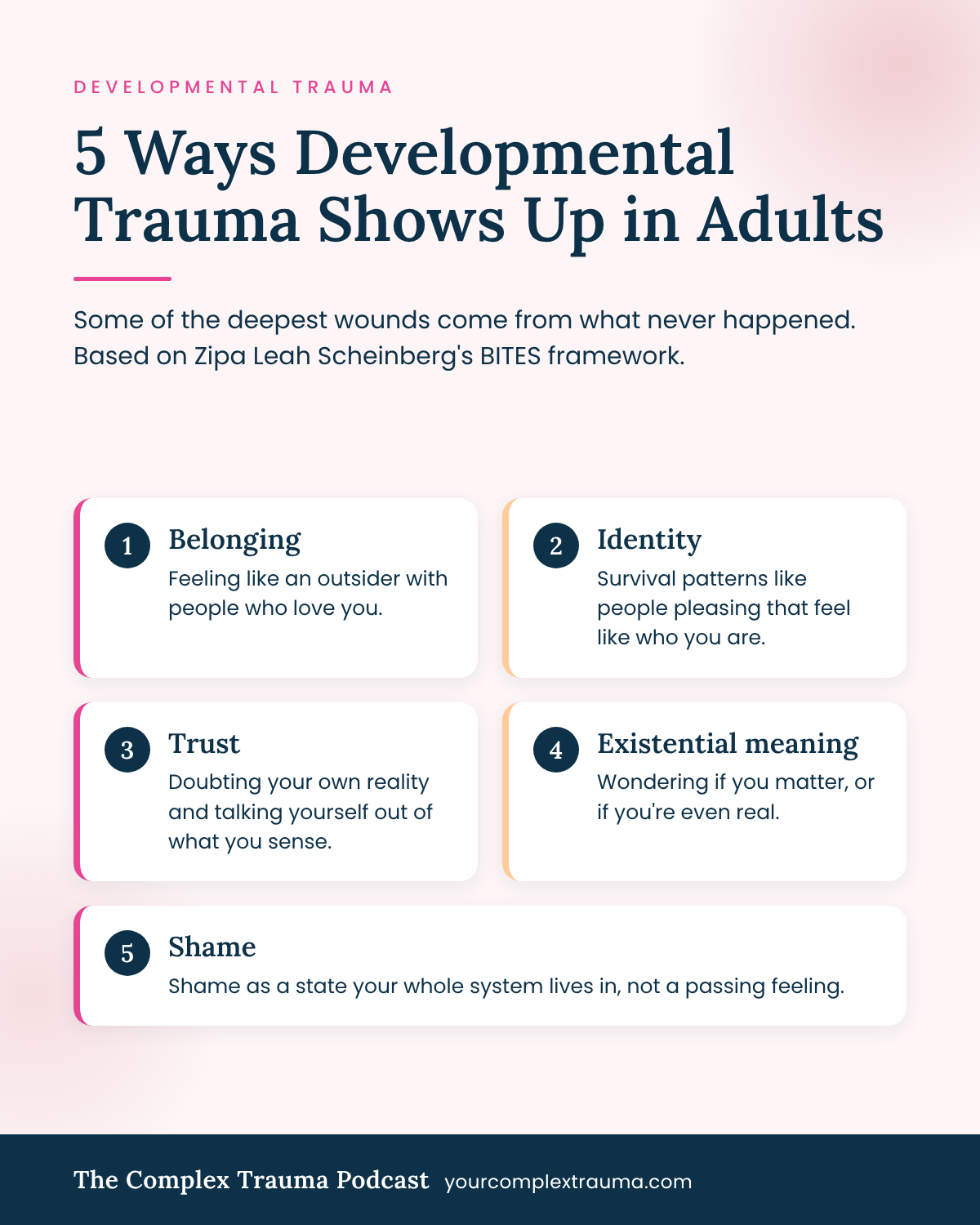
Zipa Leah Scheinberg's BITES framework names five areas that developmental trauma can interrupt: belonging, identity, trust, existential meaning, and shame.
Understanding your patterns is an important step, and it usually needs to be paired with slow, embodied practice for those patterns to change.
Developmental trauma interrupts development. It does not end your capacity to keep developing as an adult.
"But it wasn't that bad"
I hear some version of this sentence all the time. "I was loved. I had food. Other people had it so much worse. I don't know why I'm even doing this trauma thing." And then, in the same breath, "So why am I crying all the time? Why do my relationships keep hurting? Why do I feel like this?"
If that sounds like you, I want you to know you're not being ungrateful, and you're not making something out of nothing. Some of the deepest wounds people carry come from the things that were supposed to happen and didn't, which is why there's often no memory to point to.
My guest Zipa Leah Scheinberg, LCSW, an EMDR Certified Therapist and EMDRIA Approved Consultant, calls this trauma by omission. There's rarely a single scene you can point to and say, "That's the day nobody helped me understand what I felt." There's no snapshot of never being delighted in. And yet those absences can shape a person as much as the painful things that did happen.
Zipa knows this from the inside. She grew up as the youngest of ten in a home shaped by her father's survival of the Holocaust, where the two questions were "Are you warm?" and "Do you have food?" There was love, and there was very little room for wanting or needing anything beyond survival. She described having a need as feeling less forbidden than foreign, like a language nobody in the house spoke.
What is developmental trauma?
Developmental trauma is trauma that happens while a child is still developing, usually through ongoing relationships with caregivers. It includes consistently getting too little of what you needed, like love, limits, comfort, and attunement, and getting too much of what hurt for too long without support.
Zipa uses an image I love. Picture a tree. For a tree to grow well, it needs rich soil. Developmental trauma affects the soil. The tree still grows, because trees are resilient and so are kids, but it grows without enough nutrients to fully support itself.
The nutrients a child needs include love, respect, healthy limits, attunement, mirroring, comfort, kindness, reliability, and consistency. When those are missing over and over, the child adapts. On top of that, many kids are also living with harder things, like a parent with mental illness or addiction, poverty, racism, or medical trauma. Developmental trauma is what happens when a growing person has to keep surviving without what they need to grow.
What's the difference between developmental trauma and complex trauma?
Five ways rumination can show up as a trauma response, from replaying conversations to the heavy what’s-the-point loop.
Developmental trauma and complex trauma overlap a lot. Complex trauma describes repeated, prolonged trauma, often in relationships a person can't easily escape. Developmental trauma focuses on when that happens, during childhood, and on how it shapes the capacities that were supposed to form.
Complex PTSD (CPTSD) is recognized as a diagnosis in the World Health Organization's ICD-11. Developmental trauma is a clinical framework rather than a formal diagnosis, but many trauma therapists use it because it helps explain why so many adults with CPTSD struggle with identity, relationships, and self-worth. For a lot of the people who listen to the podcast, their complex trauma is developmental trauma. It started early, it happened in relationship, and it shaped how they see themselves and the world.
Signs of developmental trauma in adults, using the BITES framework
Developmental trauma in adults often shows up as struggles with belonging, identity, trust, a sense of mattering, and shame. Zipa Leah Scheinberg organizes these into her BITES framework, named because life can take a bite out of you.
What I appreciate about this framework is that it goes a layer under beliefs. In EMDR we work a lot with negative beliefs, like "I'm not good enough." BITES looks at the five domains every person needs in order to thrive, and asks where development got interrupted.
Belonging, or feeling like an outsider with people who love you
Belonging starts with belonging to yourself, and it's built in relationship with people who feel like home. When belonging was interrupted in childhood, it can show up in ways that feel confusing or even embarrassing.
Zipa shared a conversation with a friend who noticed that every time she saw a kind older woman, at the store or at Disney World, some part of her thought, "Wouldn't it be nice if she was my mom?" That longing has nothing to do with how smart or how healed you are. It's a primal need to belong to somebody.
Belonging wounds can also look like feeling homesick for a place you've never been. Or sitting at the holiday table surrounded by people who love you and feeling like you're outside the window looking in. You know they love you. You still can't quite reach them.
Identity, or who you are underneath your survival patterns
Identity is the domain for anyone who has ever said, "I'm a people pleaser" or "I'm codependent," and then wondered what to do next. As Zipa put it, nobody is born codependent. Patterns like people pleasing, overachieving, or going silent and withdrawing are survival responses that hardened into something rigid.
Sometimes those strategies are useful. There are seasons when you have to pull on your overachiever to meet a deadline or care for your kids. The problem is when you have no choice. Healing in this domain is about moving from rigidity to flexibility, and getting to decide when to use a strategy and when to set it down.
Trust, or learning that your reality is real
Trust includes trusting others, and it also includes trusting yourself. For many survivors, the deepest wound here is doubting their own perception. You had a feeling about someone, you talked yourself out of it, and it turned out you were right.
It's hard to build trust inside when it was never modeled outside. Zipa described being offered mentorship by a kind, generous supervisor and feeling half thrilled and half terrified. Even months into working together, a small part of her still wondered why she deserved that goodness. I think a lot of you will recognize that feeling.
Existential meaning, or "Do I matter? Am I real?"
This domain holds the big questions. Do I matter? Am I real? If I yell into the void, will anyone hear me? These questions often show up alongside dissociation, especially depersonalization and derealization, where you or the world around you can feel unreal.
Zipa works with this domain through meaning and spirituality, though not in a religious sense. The heart of it is that your worth goes beyond what you do or how lovable you are. You matter because you exist, and your voice deserves to be heard.
Shame, or when your whole system shuts down
For people who grew up with developmental trauma, shame can stop being a passing feeling and become a state the whole nervous system lives in. Zipa compares emotions to pieces on a chessboard. Sadness, fear, and anger are all different pieces. Shame is when you flip the whole board.
Everything shuts down. There's self-loathing, an urge to run, and a deep sense of defeat. Shame also pulls people away from love and relationships, which can make every other domain harder to heal. One small clue that shame is close is the phrase "Am I being ridiculous?" If you're asking that, shame is probably already in the room.
Why doesn't understanding your trauma change it?
Understanding your trauma happens mostly in your thinking brain, while developmental trauma lives in your body, your emotions, and your relationships. Insight can explain a pattern, but changing it usually takes slow, repeated, embodied experiences that help build the capacities you didn't get to develop as a child.
So many people come to therapy saying, "I know exactly why I do this, and I still can't stop." When Zipa hears that, she hears a real desire to understand. She also hears how many survivors learned to live in their heads, because feeling was too much. The thinking brain can study the pattern from every angle while the pain, the grief, and the body sensations never get touched.
She made a distinction I keep thinking about. You can reprocess old pain, and you can rebuild new capacities, and those aren't always the same thing. EMDR and other trauma therapies can help reprocess what happened, sometimes faster than you'd expect. Learning how to receive kindness, stay steady in a hard conversation, or trust your own read on someone still takes practice. That part goes slowly.
Zipa says it plainly in her workbook. If you're hoping that reading about development will heal you, she's sorry, but it doesn't work that way. She looked for the shortcut. There isn't one.
Can you heal developmental trauma as an adult?
Yes, adults can heal developmental trauma. The capacities that didn't form in childhood can keep developing, usually through small, repeated experiences of safety, choice, and connection. Healing tends to be slow, and it happens in the body and in relationships, not only through understanding.
Here are a few of the ideas from Zipa's work that I think are worth carrying with you.
Start by staying with yourself
Zipa teaches a practice she calls STAY, a way of coming back to yourself. The first step is simply to stop. That sounds easy, and it's one of the hardest things for a survivor to do, especially when you're running at full speed. The next step is to track what's happening inside, like "I feel terrified" or "my back just started to hurt." Each time you pause and notice, you're building a little more belonging to yourself.
Notice the voice of exile and the voice of belonging
Zipa describes two voices most of us carry. The voice of exile is the inner critic, the part that says "this is probably silly" or "I hope you don't mind" before you've even said what you need. The voice of belonging brings you back to yourself. The goal is to recognize when the critical voice is pulling you away from your steady, capable, dignified self, and to slowly strengthen the voice of belonging alongside it. You don't have to starve the critic out of existence for that to work.
Let the good moments land
Real change often happens in tiny moments. You tell a friend, "I didn't like that," and they answer, "I'm so glad you told me." If you can let that moment land in your body, something starts to build. Learning to take in good experiences is a capacity in itself, and for many survivors it's one of the hardest.
Stop blaming yourself for being dysregulated
One of my favorite parts of our conversation was when Zipa said you can't manifest yourself out of complex trauma. You also can't regulate your way out of it on command. Your nervous system responds to threat for a reason. When wellness culture tells you that you attracted a harmful person or failed to stay regulated, it becomes one more way to blame yourself. Healing includes building the discernment to notice when something doesn't feel right, without turning that awareness into shame.
Expect it to take time
Development works slowly. Zipa compared it to a one-year-old running a marathon. Adults can develop faster than children can, and you can have powerful breakthroughs in an intensive weekend. Your mind, body, and heart still need time to catch up, and you still need to practice. If someone promises to erase your trauma in a weekend, that's a marketing strategy.
What Zipa wants survivors to know is this. Have deep respect for what you lived through, because it actually happened and it was painful. Then get curious instead of ashamed. Your triggers, your dreams, and your hardest moments are stories to be curious about, not proof that something is wrong with you.
Developmental trauma interrupts development. It does not end your capacity to develop. The parts of you that never got the chance to grow are still allowed to grow now.
Listen to the full conversation
You can hear my full conversation with Zipa Leah Scheinberg on The Complex Trauma Podcast. We talk about her BITES framework, what it was like to grow up without language for her needs, toxic belonging, and why healing takes time.
To learn more from Zipa, visit her website for free resources and her BITES email series, or join the waitlist for her belonging workbook. She also writes on Substack and shares on Instagram.
If this post hit close to home, you might also like my episode on grieving what you never had, which explores what it means to grieve the things that never happened in childhood.
Frequently Asked Questions
What is developmental trauma in adults?
Developmental trauma in adults is the ongoing impact of growing up without enough of what a child needs, like comfort, attunement, and consistency, or with too much pain for too long without support. In adulthood, it often shows up as struggles with belonging, identity, trust, self-worth, and shame.
Can you have developmental trauma if your childhood was fine?
Yes. Developmental trauma often comes from what was missing, like emotional attunement or permission to have needs, rather than from obvious harm. Many adults with developmental trauma describe loving families and still feel the effects of what they didn't receive.
What is the difference between developmental trauma and CPTSD?
CPTSD is a formal diagnosis in the ICD-11 that describes the effects of repeated, prolonged trauma. Developmental trauma is a clinical framework that focuses on trauma during childhood and how it interrupts development. The two often overlap, and many adults with CPTSD have developmental trauma underneath it.
Why do I feel like an outsider with people who love me?
Feeling like an outsider with people who love you can be a sign that belonging was interrupted in childhood. Your mind may know you're loved while your body never learned what belonging feels like. Building that sense of belonging, starting with belonging to yourself, is part of healing developmental trauma.
Why can't I stop patterns I understand?
Understanding a pattern happens mostly in your thinking brain, while developmental trauma is held in your body and relationships. Changing a pattern usually takes repeated, embodied practice that builds capacities you didn't get to develop as a child.
What is the BITES framework?
The BITES framework is Zipa Leah Scheinberg's model for understanding and healing developmental trauma. It names five domains that trauma can interrupt: belonging, identity, trust, existential meaning, and shame. Each domain includes capacities that can keep developing in adulthood.
Can developmental trauma be healed in adulthood?
Yes. Developmental trauma interrupts development, but it does not end your capacity to develop. Healing usually happens slowly, through therapy, embodied practice, and safe relationships that help you build what you missed.
If you love tuning in to the podcast, please take a second to leave a review! It truly helps other people find the show.
-
Sarah (00:40) Hey everybody, welcome back to the Complex Trauma Podcast. I'm so excited to have an interview for you today. I'm here with Zippa Leia Scheinberg, and we're gonna be diving into her framework that she's developed for developmental trauma survivors and complex trauma survivors. And you know, I just think that she's a wonderful clinician that I think you're gonna learn so much from. So welcome to the podcast, Zippa. Zipa Leah Scheinberg , LCSW (01:04) Thank you so much. Thanks for having me. Sarah (01:06) Of course, I'd love to just kind of dive right in and ask you how you got into this work, how you got interested in developmental trauma. Um, yeah, what brought you to this point? Zipa Leah Scheinberg , LCSW (01:18) Yeah. So uh like difficult slash interesting backstory. So my dad was a Holocaust survivor. Uh and just to give you historical kind of context, he was in the back-to-back bunker with Anne Frank. Sarah (01:34) Wow. Zipa Leah Scheinberg , LCSW (01:36) So he was liberated in 1945. Um And he then his mom and his siblings survived, two siblings. Like about a year later they moved to Australia. He went to England to finish his education. He was thirteen. The next time he saw his mother, he was a father of six. So you're talking decades later. Um and then I I'm the tenth. I'm the youngest by far. Okay. Sarah (02:03) Wow. Zipa Leah Scheinberg , LCSW (02:03) Yeah. So so I grew up with developmental trauma. I Sarah (02:08) Mm. Zipa Leah Scheinberg , LCSW (02:09) I I grew I was born into it. I was born into a situation where he'd lost so much. Um and I as a child understood that I was looking at something that I didn't understand and that I had no words for. I understood a little bit about trauma by commission, like terrible things had happened, but I knew I was looking at trauma by omission. There were also wonderful things that didn't happen for him. So I love to read, I love to write as a kid. And I try to I try to put words to this, and there were no words I could find. Sarah (02:46) Yeah. Zipa Leah Scheinberg , LCSW (02:48) I want to be a therapist probably from the time I was about seventeen, right? And Sarah (02:51) huh. Zipa Leah Scheinberg , LCSW (02:53) and then um I also love language and writing and words. Um we have this phrase that silence is violence. Sometimes Sarah (03:02) Mm. Zipa Leah Scheinberg , LCSW (03:02) when you stay silent or you're you're bred with silence, it's a way of shutting somebody down utterly. Um I became a therapist and in my office and in my own life I just began to track these themes of themes of pain and putting words to the themes. Belonging, right? Identity. Like identity is who am I under these trauma adaptations, these these these responses that I have? Trust. Can I trust myself? existential meaning which is am I real Sarah (03:44) Yeah. Zipa Leah Scheinberg , LCSW (03:45) bites association I don't feel real no I actually am real and then the last one is shame so we call the framework the bites framework because life can take a bite out of you but those are the five those are the five Sarah (03:56) okay. To back up a little bit, do you you know, when you think about that as a child, you know, like not having words for for what you were like in, right? What you were born into and what you were experiencing. Do you remember like what that was like for you? You know, how it shaped you as a as a little kid? Zipa Leah Scheinberg , LCSW (04:15) Yes, very much. Um there was a very practical piece I could tell you, which was having a need or a want. It's more than it was forbidden. It was it was it was so foreign. Sarah (04:35) Yeah. Zipa Leah Scheinberg , LCSW (04:36) Right? It w nobody said you're not allowed to want that. It was just like, you know, my father had two questions for us. You know, are you warm? And do you have food? And after that there is nothing else. Sarah (04:48) Right. Zipa Leah Scheinberg , LCSW (04:49) So definitely no discussion about emotions, for sure not, but Also like if you wanted a different briefcase or you wanted you were upset because you moved countries, which I did. It was like, huh? Uh and there was no language to say, oh, you know you know, this is okay to want and need. It was it was foreign. I I I I don't know if that's clear, but that's what it felt like. Sarah (05:12) Yeah. Yeah. It sounds like just, you know, like pure survival, right? Like he was in survival mode and that's what like you were born into. Zipa Leah Scheinberg , LCSW (05:20) Yeah, yeah, yeah. And I remember getting older. I moved actually from England to New York it when I was ten and like going into school with people who like had four pairs of sneakers and this was not about money. I wanna be very clear. This was about allowing yourself to want like a pink pair and a white pair. And a b Sarah (05:41) Uh-huh. Zipa Leah Scheinberg , LCSW (05:42) right and it's like, you're allowed to want that much? Like that doesn't make you needy. No, actually it doesn't. But it was such Sarah (05:50) ajá Zipa Leah Scheinberg , LCSW (05:50) a learning curve for me that I Sarah (05:52) Yeah. Zipa Leah Scheinberg , LCSW (05:55) Still today sometimes I marvel how what an enormous learning curve that was for for years. Sarah (06:01) Yeah. Yeah. What do you feel like supported you through that at the time? Zipa Leah Scheinberg , LCSW (06:06) Growing up I would say ten ten to about thirty, which is a long time, right? I would say having wonderful friends who um like I was a really quick study, so I was kind of like You know, look around what's going on and okay, this is normal. I know how to do that, which is such a tell for developmental trauma survivors where you like you know something isn't normal, you kind of go out into the world and go, aha oh. Sarah (06:35) And to back up to this kind of like pinged in my mind, when when we talk about developmental trauma, can you kind of define that for folks who are who are tuning in who maybe haven't listened to the podcast for a long time or just as like a refresh, what do we mean when we say developmental trauma? Zipa Leah Scheinberg , LCSW (06:49) Yeah. So a couple of things. I think the EMDR community, talks about the things that you needed, there was too little of it. Consistently too little, right? Or there was too much of something that was really difficult for too long without support or comfort. That's I would say the classic rate. I would say it a little differently, and I really describe it with these five domains. There are like think of a tree, right? It needs really good soil. You you need good soil to really do well. So developmental trauma affects the soil. So it is um not having enough, and again, consistently enough of love, respect, limits, attunement, mirroring, comfort. Kindness, reliability, consistency, right? And that's all the stuff that you need. If you want to add in then the stuff that you can go through, and there's so much, there's so many different types of trauma, but growing up with a parent or a sibling with severe mental illness, addiction, poverty, racism, there's there's medical issues, right? But developmental trauma is as that tree is growing, it doesn't have enough nutrients in the soil to support itself. Sarah (08:08) Mm. Yeah. Zipa Leah Scheinberg , LCSW (08:09) That that's how I would put it. Sarah (08:11) Mm-hmm. So, you know, in your work, I know in my therapy office there can be a lot of people that come in and say, okay, like I have trauma, right? I've been through all this stuff. They can talk about it. They can say, like, I know I why I do what I do, but like I just can't stop. Um, what do you hear like underneath those types of statements? I imagine you hear them a lot too. Zipa Leah Scheinberg , LCSW (08:35) I I real yeah, and that's where absolutely like what do I do now? Sarah (08:39) huh. Zipa Leah Scheinberg , LCSW (08:41) So I hear under that a real intellectual desire to understand. But like many trauma survivors, we cut things off like right here. So like our brains can really, really think about it. Our feelings, which are somewhere down here, right? Embodied, embodied emotion, pain, suffering, that kind of doesn't get touched if we are all the time in our head. Right. So I would say it's a cuddle from emotion. Right. And and that's so much what I try to gift to people in these five domains. Like actually, you know, we talk about in my office, and you know, I'm doing a whole bunch of free resources. I just want to get it out there like to kind of figure out which domain you want to work with and then say capacities to rebuild. Not just what happened, but okay, how am I going to change this? How am I body, mind, heart and soul, all four faculties, not just my brain, how am I going to do this differently? How am I going to repair for myself what happened? Sarah (09:45) Yeah, yeah. That feels like a perfect, you know, segue into talking about your Bytes framework. Can you tell everyone what that is? You know, and I like I think it will help people understand like why you you've kind of built this out, um, and how it can support people to kind of understand and lean into this this framework. Zipa Leah Scheinberg , LCSW (10:04) Yeah, I mean if you've done and I know a lot of your clients and many listeners which I've said do right if you've done some EMDR work, you know that EMDR will really target beliefs. So like I'm just gonna give that as a so this is not about beliefs, this is a little bit under that, which is these are five domains that we all need to thrive. Sarah (10:26) Yes. Zipa Leah Scheinberg , LCSW (10:27) Belonging, identity, trust in ourselves, in in others, within others in the world, um, existential meaning and shame slash dignity. Like to have that sense of dignity or shame, right? So starting to give words to where you're struggling, starting to not just understand why, but process some of the pain of what was missing. And then learn to practice tiny bits by tiny bits some of the new capacities that are at each domain. So would it be helpful? I'll give you an example. Okay, Sarah (11:03) Yeah, that would be great. Yeah. Zipa Leah Scheinberg , LCSW (11:05) so let's say for I I I know you definitely have, I have, many of your listeners have this piece of like They'll kind of come in and they'll say, look, look, I I really I it it it was nothing. I was I was really loved and I had food. So it was nothing. It it really Sarah (11:21) Wasn't that bad. Zipa Leah Scheinberg , LCSW (11:22) it wasn't that bad. Other people have it much worse, and I don't know why we're doing this trauma thing. Right? And yet, and yet I'm struggling. I don't understand why I have triggers and I'm crying and you know, and people and I'm my relationships are struggling. What is happening? Because it wasn't that bad. And it's a real piece, so The first thing we talk about is belonging, which is belonging to yourself. And I have this protocol, which I call stay, which is to stay with yourself. So S is for stop. Can I say how difficult it is to find somebody who will just pause and stop in the middle of something and go, wait, wait, wait. Right? I'm and speaking for it's Sarah (12:09) So hard. Zipa Leah Scheinberg , LCSW (12:10) so hard, right? It speaking for myself sometimes if you're in full throttle to say, Hey, I I I just need to pause for a second. Right. So S is for stop. T is for track. And we talk about how to track. Which again you belong to yourself when you are able to say, Hey, I'm feeling terrified. I'm feeling like my back just started to hurt. Just to track. And then we go into the other well, just even beginning to really work with those capacities start to sometimes unfortunately invite pain 'cause old stuff comes up, but also build build more belonging to self. Sarah (12:52) I'm thinking about belonging. It's such a a common theme that that comes up, I think, in in therapy and for trauma survivors. When belonging kind of gets interrupted in childhood, you talk a lot in your work about survival architectures. Like what can form around that when it gets interrupted over and over again in childhood? Zipa Leah Scheinberg , LCSW (13:12) Yeah. Yeah. So I actually just had a discussion with a friend of mine who we were talking about this belonging piece and she's like, Is that why I want everyone to be my mother? Yes. Right? She's like, I I'm I'm in Disney World or I'm in Walmart and I see this really lovely old lady, and I'm thinking to myself, wouldn't that be nice if She was my mother. Now, it has nothing to do with how smart you are, how worked out you are. This is a primal need to belong to somebody. That somebody is home for you, that somebody comforted you, that you somebody was kind to you consistently. So it shows up in so many ways. I don't know if that answers your question. Right? But Sarah (13:55) Yeah, I think so. Yeah. Zipa Leah Scheinberg , LCSW (13:58) Or if you feel sometimes if you feel homesick for a place that you've never been to and you're not quite sure what's happening. Right? Sarah (14:05) Hm. Zipa Leah Scheinberg , LCSW (14:05) Or you're sitting at Thanksgiving dinner and you're surrounded with people that you love and you feel like I a client said it so well, like I'm outside. They're all laughing around the table and I'm outside the window looking in and I can't quite reach them. And I know they love me. That's not what's happening. Those are all baloney wounds. Sarah (14:25) Right. Yeah. And when someone starts to build capacity, particularly with belonging, what does that usually look like? I I know kind of like the framework that you're talking about helping people track and you know build capacity inside. What how does that reflect outside? Do you know what I mean? Zipa Leah Scheinberg , LCSW (14:42) Yes, yeah, of course. So some of the other capacities in belonging, and I talk about this in this workbook, is let's say, for example, tracking and starting to learn discernment. Discernment is about self-trust. Right? So really What does it look like? It looks like a much more steady platform inside from which to launch, right? From which to deal with difficult situations. We're like if you're a complex trauma survivor or developmental trauma, we all know what this feels like. You you know, you're in a difficult meeting with a boss and you just want to run. Right? So you have a capacity to go, my god, I do want to run, but hey. I think I got this without memorizing a script. That's you know, it's real internal steadiness. And Sarah (15:32) Yeah. Zipa Leah Scheinberg , LCSW (15:34) if it it just really does feel a lot better. Sarah (15:37) Yeah, yeah, and that gets built so slowly over time, right? Zipa Leah Scheinberg , LCSW (15:41) Yeah. Yeah. Yeah. I wrote in the workbook, I'm like, if you're anything like me, you wish that you read about development and then you were all healed. So I'm so sorry. Sarah (15:48) Right. Zipa Leah Scheinberg , LCSW (15:49) There is no eight. Right. I looked for it. There isn't one. Right? And like this Sarah (15:53) huh. Zipa Leah Scheinberg , LCSW (15:53) goes really slowly. And I'm I'm so sorry, but it does. Sarah (15:57) Yeah, it's slowly and experientially, right? Like relationally, experientially, and like letting that actually land in your system. Zipa Leah Scheinberg , LCSW (16:04) Yeah. Yeah. Yeah. Well, the tiny moments where you were brave enough to say to a loved one or a friend or a coworker, I didn't like that. Or, you know, just and the other person greets that with, I'm so glad you told me. It it just really starts to build if you can take it in. And that's what we work on as well. One of the capacities is just taking it in. Sarah (16:29) Yeah, absolutely. What about I? So the I in the Bytes framework, remind me again. What is the I again? Identity. Okay. Okay. Zipa Leah Scheinberg , LCSW (16:35) Identity. Identity. Right. Sarah (16:38) Talk a little bit more about identity. I mean I think they all piggyback off of each other, but yeah, let's cover all. Zipa Leah Scheinberg , LCSW (16:41) Yeah, yeah, they do. They Okay, okay, so identity is for the people who come in and say, I'm a people pleaser, what should I do? Or I'm Sarah (16:49) Mm. Zipa Leah Scheinberg , LCSW (16:49) codependent. Now what? Right? Sarah (16:53) Uh-huh. Zipa Leah Scheinberg , LCSW (16:53) And I start to say, like, were you born codependent? I I I I think not. Right? These are trauma responses. I think underneath the or maybe with a fight, flight, freeze, flop, phone with a five, it then creates this very rigid. pattern and I talk about the overachiever let's say the ghost where you just kind of go very silent you withdraw um and I give seven and I say you know it's architecture when you don't have a choice. Sarah (17:24) Mm, yeah. Zipa Leah Scheinberg , LCSW (17:26) I mean, sometimes we need to embody the warrior as an archetype. Sometimes we need to embody uh the overachiever when we have to really get something done. Sure, but if we don't have a choice, we're now talking rigidity versus flexibility. Sarah (17:41) Yeah. That idea of agency of having choice like what should like kind of like what mask you put on in some ways. You know, not Zipa Leah Scheinberg , LCSW (17:46) Yes. Sarah (17:47) that you're meant to mask all of the time, but sometimes we have to like choose, okay, I have to I have to do this thing. I have to overfunction a bit to get it done because there's a deadline and there's a consequence, whatever it is, right? Zipa Leah Scheinberg , LCSW (17:58) Yeah, and I would say especially if you have small children, right? Or big children like I have, you you sometimes have to pull on that strength. Right? Sometimes Sarah (18:10) Yes. Zipa Leah Scheinberg , LCSW (18:11) you just have to. And right, you can let it go. And how like this goes back to my stop, right? How many times in my own life and life of people I love, okay, the deadline's over. Right? For me, the manuscripts handed in, and they're still like, okay, what next? Right? It's you're unable Sarah (18:30) Uh-huh. Zipa Leah Scheinberg , LCSW (18:31) to stop. And that's something that is such a skill to work on. Sarah (18:35) All right, what's next in the in the bytes framework? Yes. Zipa Leah Scheinberg , LCSW (18:37) B I T so T is trust. Trust. And I I couldn't think of a more timely, like a more timely moment in in in life, right? In what's going on in the world. We're teaching people to trust that their reality is real. Sarah (18:55) Yes. Zipa Leah Scheinberg , LCSW (18:56) Right? I I just I just read this incredible subsec article this morning. Dr. Lisa Rankin, who writes about she was introduced to all these spiritual gurus, she had a really feeling about some of them, and uh she was right, but she and she wrote, I couldn't trust my own wisdom. And I I don't know any woman who hasn't had that moment. Sarah (19:16) Yeah. Zipa Leah Scheinberg , LCSW (19:17) Right? So it's like, can I trust that my reality is real? Sarah (19:21) Hmm, yes. Zipa Leah Scheinberg , LCSW (19:24) I can I stand in I I'm gonna kick on going back to those words because it really does keep us safer. It keeps us from doubting ourselves and it keeps us from Being too vulnerable, I would say. Sarah (19:39) Yeah. Yeah. And the trust piece, I'm thinking, of course, for complex trauma survivors, there isn't a lot that a lot of survivors can trust, you know, like developmentally through the years growing up. That sense of trust, like how how do you build it inside when it's not modeled outside, right? So it makes sense that that's very fractured for most people. Zipa Leah Scheinberg , LCSW (20:01) Right, and I would say going back to the Holocaust piece, um, I remember I was in my forties, I was at an institute training, and this wonderful, wonderful man came over to me, must have been in his 70s, and he's like, Zipilea, um, if you're looking for a supervisor in this model, I'd love to supervise you. And I can tell you that 50% of me went amazing, and the other 50% was like, heh, um, Sarah (20:28) Mm-hmm. Zipa Leah Scheinberg , LCSW (20:29) um I was really frightened, and I have to honor that part of me that was frightened, and that's why I say it out loud, right? Sarah (20:35) Yeah. Zipa Leah Scheinberg , LCSW (20:35) So then it shifted to sixty-forty. So I agreed, and then it shifted to seventy-thirty. And we worked together for about six months, and now I was up to about ninety-eight thrilled and two percent still scared. And Sarah (20:49) Yeah. Zipa Leah Scheinberg , LCSW (20:50) I said to him, um Again, one of the nicest human beings I've ever met in my life. So I said to him, um, I just want to ask you, like when you came over to me and offered to supervise me, which I'm very grateful for, I just want to ask, I know you're part of the diversity group in your institute. Was it like you were looking for somebody from this religion and somebody from that? Like, was there a quota? Sarah (21:16) Mm. Zipa Leah Scheinberg , LCSW (21:17) And there was a very long silence and he's like, it's a Balea, quotas, I I have tears on my eyes, quotas are for the Holocaust. Sarah (21:25) Mm. Zipa Leah Scheinberg , LCSW (21:26) If they're not for you. I I just really liked you and I liked what you were saying and I just wanted to help you. Sarah (21:32) Wow. Yeah. Zipa Leah Scheinberg , LCSW (21:37) And there was just this niggling thing like, why? Sarah (21:41) Yeah. Zipa Leah Scheinberg , LCSW (21:42) Why do I deserve this goodness? Sarah (21:44) Yeah. Yeah. yeah, that has some roots. Zipa Leah Scheinberg , LCSW (21:50) So just just to see like how the reason why I give these stories is because these are common themes again in complex trauma. Sarah (21:59) Yeah, absolutely. Sarah (22:00) I'll right back after a quick word from this episode's sponsor. Sarah (22:09) It's dark by five now and the tree will be up before we know it. Picture it. The lights are on, the house is finally still. You sit down and your brain immediately starts reading you tomorrow's to do list. Anybody else? I know you know resting is really hard for some of us. This is where the bubble cuddle blanket comes in for me. It's so, so soft, and it adds a little bit of weight across your lap. And that really helps my body catch up to what I keep telling it, which is that we're done for the day. It's also the perfect gift for the person who takes care of everyone and never buys anything nice for themselves. And if that's you, maybe consider this your permission slip. Right now it's Cozy Earth's best pricing of the year. and with a hundred night trial and a ten year warranty, there's no risk in trying it. Cozy Earth's biggest sale of the year ends December third. Head to cozy earth dot com and use code RECLAIM for thirty five percent off of home and sleepware. That's cozy earth dot com, code reclaim, And when they ask a checkout where you heard about them, let them know that the Complex Trauma Podcast sent you. Sarah (23:16) So then the so there's trust and then E. Let's dive into E. Zipa Leah Scheinberg , LCSW (23:22) So E is existential meaning, which is a very nice way of saying, do I matter and am I real? So this goes really, I would say, an EMDR, I mean Mark Nickerson does this beautiful work with the belonging piece, but I don't have this and I'm I'm I'm in the middle of writing out actually something to submit to the MGR um faculty. Do I matter? Am I you know you know how dissociation is like, am I real depersonalization and derealization? If I yell into the void, is somebody actually hear me? Right? So that's where we start to talk about the soul, n not from a religious perspective at all, but how your value is beyond words. Not what you do, but your actual value and worth as a person. And you are real and you do matter. Not because you're lovable, but because you actually matter. It's it's a little bit of a different twist. I think I was really inspired by the Victor Frankel book again when I was very young. And I Sarah (24:26) Yeah. Zipa Leah Scheinberg , LCSW (24:27) I I really, it's something, spirituality is a piece that I really talk about to help association. Sarah (24:33) I know there's there's a lot of folks who are like that question, like, am I real? And also kind of along with that, like what what does it matter? Like existentially, like like big question Zipa Leah Scheinberg , LCSW (24:43) Yes. That's it. Yeah. Sarah (24:46) mark, like blank, like what what's the point of all of this? Zipa Leah Scheinberg , LCSW (24:49) Yeah. Uh after Epste Epstein Files came out, right? I had so many women go, what is the point of bringing a child into the world? Like j again, existentially, or the existential dread of like what's gonna be with the next generation? Right? And I just I I don't know if you've seen this book, it just came out, Season of the Witch. I don't know if you've seen Incredible. Incredible Sarah (25:07) I saw it and I I ordered it. I'm waiting for it to come. Yeah, I can't wait to read it. Zipa Leah Scheinberg , LCSW (25:11) Right, so it's a psychiatrist case for magic, which right away, you know, we were all like, Oh, okay but Sarah (25:16) Yep, like purchased, yes. Yes. Zipa Leah Scheinberg , LCSW (25:18) Yeah, purchase in my cart, done. But she she the her first like in her introduction, the first thing is a quote from Lord of the Rings, The Two Towers, which is all about existential pain, right? Quest. A thing is about to happen here that hasn't happened since the elder days. The ants are going to wake up and find that they are strong. Right? And that's underlying this piece of existential meaning. Not only are you strong, not because you have to be, but because you actually matter. And your voice needs to be heard. Sarah (25:51) Mm-hmm. Yeah. Yeah. It's so funny. I'm just I'm even like thinking about this podcast, right? Like as I'm staring at a screen most of the time, talking to myself, I'm like, what's what's the point of like why am I doing this? and I come back to I'm doing it for survivors to feel seen and heard and less alone and to learn. But I think that can kind of like flow in when we least expect it. Like, what's the point? does my voice matter? Zipa Leah Scheinberg , LCSW (26:14) This is right, right, and then the sh and then we go right into S, the shame creeps out. Yeah, right, right. It's like Sarah (26:17) Yep. yeah. yeah. Zipa Leah Scheinberg , LCSW (26:20) d it is am I being ridiculous, you know, I right I think I've told people like if we're already seeing Am I being ridiculous, we're we're already touching shame. Like nothing about this is ridiculous. In fact it's incredibly worthy. So you know, Anybody who's putting work out there, author, podcaster, therapist, right, this stuff is a little bit lonely. Right? And like sometimes even like a DM of a heart in the middle of the night, you know? And it's like, this reached you. Okay, good. I'm not shouting into Sarah (26:50) Mm-hmm. Zipa Leah Scheinberg , LCSW (26:50) the void. Sarah (26:51) Mm-hmm. Right. Yeah. Yeah. And shame, right. That's so big, I think, about toxic shame and the the roots of shame and how it can pull people really away from all of the the the bite, right? The bite part, belonging, trust, you know, identity, how shame really does pull people away from all of that. Zipa Leah Scheinberg , LCSW (27:13) it away from love and relationships. It just like Right, and I think shame is if you've grown up with developmental trauma, shame stops being a feeling and is a state. It's actually Sarah (27:26) Yes. Zipa Leah Scheinberg , LCSW (27:26) a state. It's you know, I give the example, like, you know, if we're talking about a chessboard, different emotions are different pieces on the chessboard. Shame is when you flip the chessboard. Right? The whole system shuts down. There's a sense of self loathing and just want to run. It it it it literally if like you know, you know in those old sometimes mafia movies where they Flip the table, that's what it feels like. Right? It Sarah (27:48) Yeah. Yeah. Zipa Leah Scheinberg , LCSW (27:50) goes everywhere and you're like, right, I'm done here. Sarah (27:53) Mm-hmm. Mm-hmm. Yeah. Yeah. And so many survivors live in just that state, right? That state of like I'm done, like I'm worthless. It doesn't matter, right? Zipa Leah Scheinberg , LCSW (28:02) Doesn't ma it doesn't matter, right? Like that def internal defeat. Sarah (28:05) Mm-hmm. Mm-hmm. Yeah, in your framework, tell us more about like that shame piece. I I could talk about shame all day, I think. But what what are Zipa Leah Scheinberg , LCSW (28:14) Yeah, yeah Sarah (28:15) what are some some tools and and things like that that you talk about in your work that, you know, even like a teaser that people can maybe take with them. Zipa Leah Scheinberg , LCSW (28:23) Yeah, absolutely. So I talk about the two voices inside. I don't know like Liza Cheroke's story with the two wolves. the point of this is I talk about the voice of exile inside, right? And the voice of belonging. So The story with the two wolves is, you know, somebody said to the elder, which which you know, I I have a wolf that's critical and I have a wolf that's loving. Which one do I feed? And he said, whichever one you feed gets fed. Right? So, There's a voice of belonging and there's a voice of exile and we have them in us. You know, in IFS we talk about, you know, a critical part. You know, we might talk about the inner critical different words, but there's a there's a voice and it's so often it mimics our own. Where it's we'll say something like, This might be silly, but right? Or like, hope you don't mind where we're just exiling our actual words from belonging to ourselves. So I s ask people to start to differentiate and You know, I love DBT, so we talk about holding both for a long while. Bringing in that voice of belonging where you're coming back, you actually feel it. You can actually feel back to yourself if you like. And then to hold both, and then to start to strengthen the voice of belonging, while understanding that the voice of exile is not only personal, but it's also in society. It's it's everywhere. It's everywhere. So Sarah (29:50) Yeah. Zipa Leah Scheinberg , LCSW (29:52) just with a not you're not trying to starve it out of you, but you are gonna learn to recognize ooh, this takes me. Away from my loving, steady, capable, respectful, dignified self. Sarah (30:06) Yeah. I'm curious what you would say to people. This again kind of just like popped into my mind. There's there's folks who have like DM'd me and commented on on Instagram, like, you know, I know that these things are learned in relationship, right? That that I belong, that I can be steady and I can strengthen that voice. But what if in relationships I keep getting rejected or wounded or harmed? Um How how do you kind of hold that and support people in that when, you know, it feels like the internal that work they're doing is kind of being undermined and undone by relationships in the here and now? Zipa Leah Scheinberg , LCSW (30:44) And that is so common. That is so incredibly common. Couple of answers. I mean in my book I write about the concept of toxic belonging, where sometimes it isn't that you didn't get in, sometimes you got it and y you wish you hadn't. Sarah (31:00) Yeah. Zipa Leah Scheinberg , LCSW (31:00) Right, so sometimes, just to make it very concrete, sometimes as we're doing healing work, we we realize that we've either chosen or we've drifted into relationships that need to be tweaked. Not saying you know, up and leave every relationship that you ever, you know, but I am saying you start to be aware of some patterns that you never quite saw before. And that's what I meant by like being steady in yourself, because now you have a choice. Hopefully, Sarah (31:33) Uh-huh. Zipa Leah Scheinberg , LCSW (31:34) hopefully, with support, you have a choice of like, do I want to engage in that for an extended amount of time with that person? Or do I want to limit our time together and keep it shallow? Sarah (31:45) Mm. Yeah. Zipa Leah Scheinberg , LCSW (31:46) Do I do I want to trust this person who talks to me about others? Do I want to trust this person with my innermost secrets? Right? And I I I I I can't tell you how many times I've sat with people who really blame themselves and like they kind of take stuff from the wellness world and they apply it to trauma, which just to say out loud, you cannot manifest yourself out of complex trauma. No, right? So those Sarah (32:13) No. Or like a nervous system regulate yourself out of comfort. Right. Like Yeah. Zipa Leah Scheinberg , LCSW (32:16) my gosh, right? Yes, did you see I just wrote a substack article on that. Like it's another way to blame yourself. It's like Sarah (32:20) my gosh, I'll check it out. Yeah. Zipa Leah Scheinberg , LCSW (32:22) nervous system regulation is responding to a threat. It's there for a reason. Don't beat yourself over the head because I my nervous system wasn't regulated. Like as if you've done something wrong. Sarah (32:31) Right. Zipa Leah Scheinberg , LCSW (32:32) Right? in the wellness field, it's something like, well, I I must have attracted this person and I like somehow it's also my fault. Uh Sarah (32:39) Yes. Zipa Leah Scheinberg , LCSW (32:41) huh. Right, I right? Sarah (32:42) Mm. Zipa Leah Scheinberg , LCSW (32:43) You know, and that's why I go back to the thing of like discernment and steadiness to really start to Be aware of like I would say microaggressions and little pieces that are happening, because people who are significantly toxic start small. You Sarah (32:59) Mm-hmm. Zipa Leah Scheinberg , LCSW (32:59) know, I write a lot about coercive control and and people who are sexual abuse survivors, narcissistic abuse survivors, spiritual abuse survivors. If you've been used to your consent and your sovereignty really being overrun, right? There's skills in relationships and there's there's embodiment in relationships and the embodiment itself that has to happen so that you you kind of have a sense of like this doesn't feel right. Without blaming yourself for it. That that's the piece. Right. Sarah (33:29) Right. Right. Without that shame kind of like pulling you back under. Zipa Leah Scheinberg , LCSW (33:33) Yeah, like I should have known. Well, nobody would have known. Right? But now you do know. Okay, what are some choices? And how can you also like and like I've listened to so much of your work where you're like, okay, this is slow. So if somebody promises you come for a weekend and all your trauma is gone, like that's a marketing technique. Sarah (33:53) Yes. Zipa Leah Scheinberg , LCSW (33:54) Right? I wish it wasn't, but it is. Sarah (33:57) Right. Yeah. one of my friends is just telling me about some pod. And I haven't I haven't done any research into it. So if the pod is legit, like everyone should have one. But they're marketing it in a way that like you get into this pod and it does all of these fancy things and then like your nervous system is regulated and your trauma is gone. And I was like, What? Like that That's not accurate, you know? But there are, there are all these promises out there that if you if you do the thing, if you take the supplements, if you go on the weekend, if you yell into the void, right, like things are going to just be better. And it's just it's not true, Zipa Leah Scheinberg , LCSW (34:32) It's not true and I would say think of a one-year-old if I would tell you that he ran a boss and marathon. Right? It just development works slowly. Now, thank God we're adults, so it works quicker than we did as children. But it doesn't work over a weekend. Which is not to say that you can do significant healing over a weekend, but then the mind and the body and the soul and the memo has to catch up. And then you still need to practice. You can you can reprocess, but you can't always rebuild. It's not always the same thing. So sometimes we reprocess old stuff, but then we have to practice how to do the good stuff. And that takes a while. Yeah. Sarah (35:14) Yeah, that's the integration of it all, right. Zipa Leah Scheinberg , LCSW (35:16) Yeah. Sarah (35:16) and then the embodiment of of the skill, right? That's how that carries like into your actual life. Zipa Leah Scheinberg , LCSW (35:22) but it's not easy. It's super worthwhile, but it's not easy. Sarah (35:26) Mm-hmm. Mm-hmm. For sure. For sure. So, you just said something about, development doesn't happen overnight, right? so I think in your initial email that you sent me, you said, you know, trauma interrupts development and doesn't end our capacity to develop That feels like what we just said. But do you have anything to add about that? Zipa Leah Scheinberg , LCSW (35:50) I think I've I mean, I've seen people do miraculous things with their lives. Right, I've seen them put in the work and I've seen people's lives. Like I'm honored, right, to see people's life absolutely change for the better. Right. And when I say miracle, I don't mean some esoteric wand waving miracle. I mean the miracle of working hard and seeing results, which is not always the case. You can work hard and not always see results. So right? So just you know, somebody that I work with for years went you know was a sexual abuse survivor for decades. I really struggled with infertility and you know went on to have a beautiful, healthy pregnancy, which is a very big deal, and then a healthy birth and like it's just it's it's it's real. Sarah (36:41) Yeah, yeah, for sure. Well, tell us more about your book and how people can gain more access to the Bytes framework and yeah, just the the wisdom and the work that you're putting out in the world. Zipa Leah Scheinberg , LCSW (36:55) Okay, so my website, sipalaya.com, Z-I-P-A-L-E-H-Sipilea.com, um belonging should be out February 2027. Um, you know, the the wait list is up for that. it's experiential, the workbook, just like we've been talking about. It's really uh giving you the capacity and then giving actually the exercise in which to do the capacity. And then Sarah (37:18) Mm. Zipa Leah Scheinberg , LCSW (37:19) coming on the website are tons of free resources. For survivors. I just want somebody in the middle of the night who's searching for I've just had a terrible nightmare. What do I do now? To be able to go, you know, just download the sheet and like let it be a resource for you. you know, the stay protocol. I'd say the three lies of a of developmental trauma. Just just a little small piece of that like you can carry with you. Uh the books on there. Um I have a whole bunch of podcasts being uploaded on there. Resources are on there and I do like a bytes kind of email sequence that's free. People can sign up there. Yes, Sipaleia.com. Yeah. Sarah (37:54) Cool. Awesome. And that all lives on your website. Okay. Awesome. I'll make sure I link to that so people can sign up on the wait list and then get access to the free resources that you have going on. Zipa Leah Scheinberg , LCSW (38:06) Thank you. Sarah (38:07) And I guess, you know, to close things out, what what message do you feel like you have for complex trauma survivors, the folks who are listening and learning and trying and trying and trying so hard? what would you like them to know? Zipa Leah Scheinberg , LCSW (38:21) I think two things. I think to have like deep respect for suffering. I don't mean toxic positivity at all. Right? I think that's so disrespectful. But I think people have this thing of like, if I just kind of like, and you've heard this, but just EMDR it, if I just kind of like somatic therapise it, it will go. And I yes and This actually happened to you. So, like to have respect for what happened, that it was very painful. To actually and then the second piece is just to get curious and not to be shameful. Right? Like you've done nothing wrong. And I would look at triggers and dreams and painful moments as stories to be curious, not stories to beat yourself up on. Sarah (39:10) absolutely. Yeah. Well, where else can people find you online? On Instagram or any other kind of social platforms? Zipa Leah Scheinberg , LCSW (39:17) Yes. So I'm just getting kind of like in into Instagram. Um I'm on Instagram, I'm on LinkedIn, and I'm on Substack. So Substack gets my like personal writings. It's not behind a paywall. It's just a place to actually write to support survivors. So it's more personal stuff. Um LinkedIn, Instagram. Sarah (39:41) Well, I will link to to all of those places so people can find you and follow you and and learn from you. And I just so appreciate the work that you're doing in the world and for coming on the show to share more about your framework. I love it. Zipa Leah Scheinberg , LCSW (39:55) Thank you so much. Thank you for having me. This is just your podcast has been such a resource for people. So really appreciate you. Sarah (40:03) I'm so glad. I'm so glad. Okay, everybody, we will be back next week for another episode. So until then, take good care.