Why Explaining Your CPTSD to Others Feels So Urgent
Episode 146
Written by Sarah Herstich, LCSW, Certified EMDR Therapist, EMDRIA-Approved Consultant, Somatic Experiencing Practitioner, and owner of Reclaim Therapy in Horsham, PA
Explaining CPTSD to others can feel urgent because finding words for complex trauma changes the way you see your whole history, and you want someone you love to witness that change. After relational trauma, a dismissive response can feel like a threat to the connection, which is why many people explain harder instead of stopping.
Key Takeaways
Wanting people to understand your CPTSD is a human need, and it often gets louder right after you find language for your experience.
Over-explaining can be a protective strategy, and for some people it shows up as a fight or fawn response when a conversation starts to feel unsafe.
Traumatic invalidation, the experience of having your reality questioned or dismissed, can make the stakes of every conversation feel higher.
You get to choose how much you share, with whom, and in what amount, and a clear request often lands better than a longer explanation.
Someone else's understanding is welcome, and your own understanding of your experience stays valid without it.
Why does explaining CPTSD to others feel so urgent?
It's 11:14 at night and you are typing a text to your sister. You found a paragraph in a book about emotional flashbacks that describes something you have felt since you were a kid, and you screenshotted it and highlighted the second sentence. The first draft of your message sounds too clinical. The second sounds like a plea. The third includes a story about your seventh birthday that you did not plan to tell anyone today.
If you have ever sent that text, or deleted it with the speed of someone defusing a bomb, you are in good company. CPTSD, or complex post-traumatic stress disorder, is a trauma response that develops after prolonged or repeated trauma, often within relationships, and the World Health Organization recognizes it in the ICD-11. Understanding it gives you information and also rearranges the story you have been telling about yourself. The things you called laziness, being too sensitive, or being bad at relationships begin to look like adaptations to what you lived through, and that is a big enough shift that you want the people closest to you to see it too.
I know that pull well. When something finally clicks for me, I want whoever is closest to understand it right then too. A listener wrote in about exactly this on the podcast this week, and it felt worth giving the longing its own space here, because the advice people usually get ("just say it more simply") skips right past it.
Is wanting to be understood a trauma response?
Wanting to be understood is a basic human need, and it points to nothing wrong with you. What complex trauma can change is how much weight that need carries when someone responds poorly.
Trauma researchers have written about this for a long time. In Trauma and Recovery, Judith Herman describes a pull many survivors feel between wanting to say what happened and wanting to keep it buried, and she emphasizes that how the people around a survivor respond shapes what happens next.
A 2022 study by Andreas Maercker and colleagues looked at 251 older adults, 126 of whom had experienced compulsory placements in childhood or adolescence. The researchers found that being acknowledged as a survivor by other people, along with attachment, difficulty talking about trauma, and social support, were associated with some aspects of complex PTSD symptoms. This was a correlational study of a specific group, so it cannot tell us that acknowledgment causes anything. It does suggest that other people's responses deserve a place in how we think about trauma.
Martin Bohus, a trauma researcher who spoke about this in an NICABM interview, uses the term traumatic invalidation for the experience of having your basic footing in the social world questioned, which can leave a person scanning constantly for signs of rejection. He has described a "dual hit" in some PTSD, where a person experiences both the event itself and the social injury of not being believed or accepted, and he suggests those two may need different kinds of attention in treatment.
If you grew up with caregivers who were emotionally unavailable or emotionally immature, there may be an earlier layer to this. Emotional loneliness is the felt experience of being around people and still carrying everything by yourself, and it often starts in a house where your inner world was ignored or treated as too much. When you finally find language for what happened, the part of you that has been waiting to be seen gets words, and it makes sense that it reaches toward the people around you.
Why does explaining your trauma start to feel like proving it?
Explaining can turn into proving when a dismissive response makes your nervous system treat the conversation as a threat to your standing with that person. The effort to be believed then feels urgent, and some bodies respond by pushing harder, some by pulling back, and some by agreeing with whatever will end the tension.
Picture telling your mom that certain family gatherings leave you drained for days, and she says, "That was years ago, why bring it up now?" You feel your jaw set. You hear yourself reach for a date, a detail, a witness who saw it too. Or picture telling your partner something similar and hearing, "I'm trying, what do you want me to say?" You apologize, tell them it's fine, and spend the next hour managing their mood instead of yours.
Many people recognize fight, flight, freeze, and fawn in moments like these, and more than one can show up in the same conversation. Pushing to make your case can be a fight response, going quiet after a brush-off can be flight or freeze, and rushing to reassure the other person can be fawning. You do not have to label the response correctly for it to make sense, because each one is a way a body tries to protect connection and safety.
One CPTSD Foundation article on over-explaining describes it as a skill learned in places where being misunderstood carried real consequences, so adding context and reasons felt safer than a short answer. The article suggests asking "what am I trying to prevent right now?" before trying to talk less, which treats the habit as useful information about what you are protecting.
Psychotherapist Pete Walker uses the term emotional flashback for a sudden wave of old feeling, such as fear, shame, or abandonment, that gets set off by something in the present, often without a memory attached. If one dismissive sentence sends you straight into the old feeling of not being believed, that can be one reason it lands so hard. It also does not rule out that the person in front of you really is being dismissive. Both can be true.
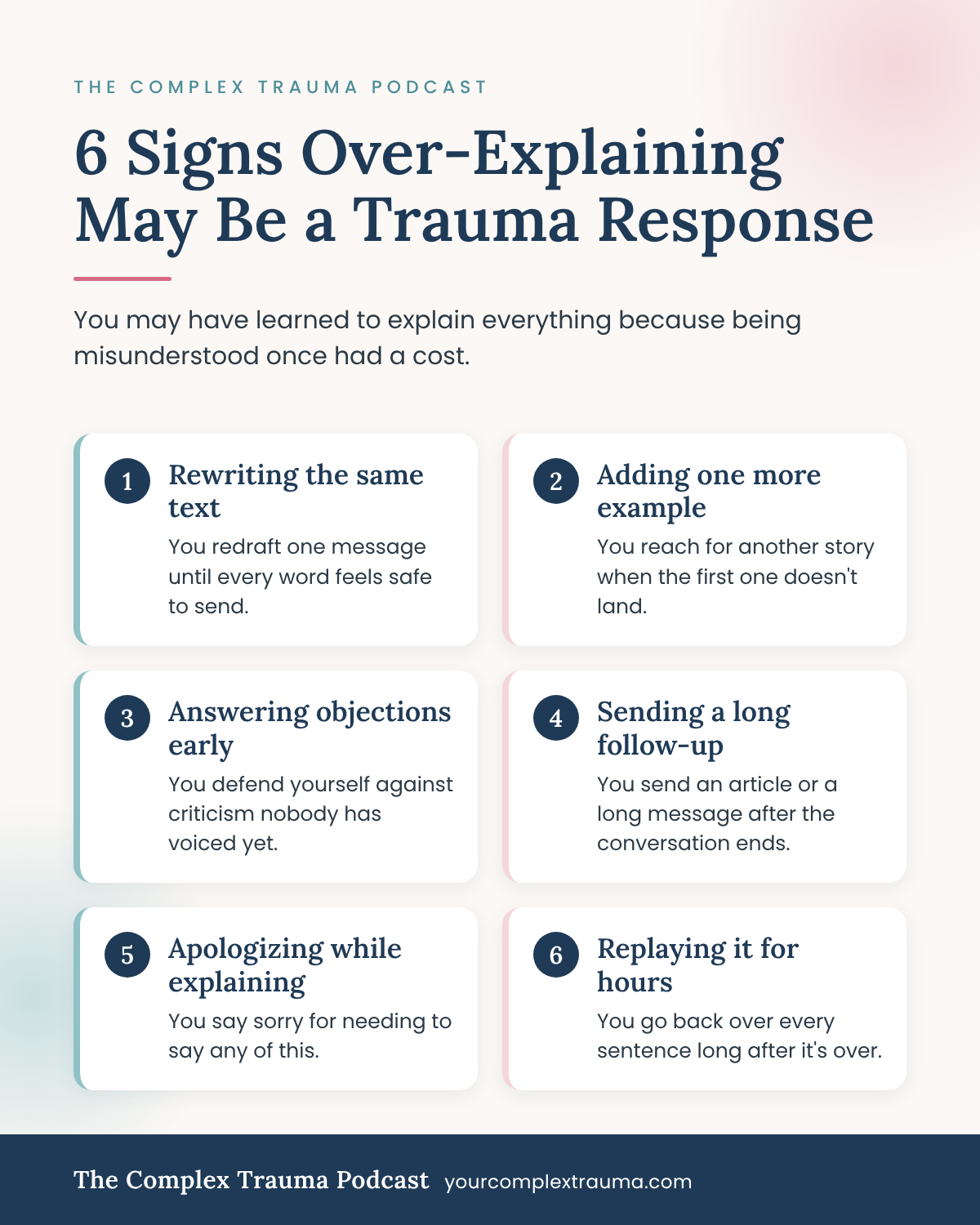
Over-explaining can show up in a lot of small ways. Here are some that people often describe.
Rewriting the same text. You redraft one message until every word feels safe to send.
Adding one more example. You reach for another story when the first one doesn't land.
Answering objections early. You defend yourself against criticism nobody has voiced yet.
Sending a long follow-up. You send an article or a long message after the conversation ends.
Apologizing while explaining. You say sorry for needing to say any of this.
Replaying it for hours. You go back over every sentence long after it's over.
What is the difference between over-explaining, oversharing, and sharing on purpose?
The difference usually comes down to choice and pacing rather than word count. Explaining to be understood, over-explaining to stay safe, and sharing on purpose can look similar from the outside, and they often feel very different from the inside.
What to noticeExplaining to be understoodOver-explaining to stay safeSharing on purposeWhat it often feels likeA wish to be knownUrgency, speeding up, a sense that you cannot stopA steadier pace with room to pauseWhat you are reaching forRecognitionProtection from judgment or rejectionConnection at a depth you choseWhat your body may be doingOpen and engagedBraced, tight, or scanning their faceSettled enough to notice what you wantWhat can helpA clear askA pause and a smaller amountChecking in with yourself as you go
This table is for reflection and is not a way to diagnose yourself, and a single conversation can move through all three columns.
Oversharing deserves a gentler look than it usually gets. Feeling exposed afterward does not prove you did something wrong, because exposure is also what being known feels like when your nervous system is not used to it. A more useful question is whether you had a choice about how much to say, and with whom.
In somatic work, we call the practice of sharing in small amounts titration. You let a little out, notice how your body responds, and decide whether to continue, which keeps you inside the amount your system can stay with. You can also share a headline before the history, which I'll get to below.
What can you do when someone doesn't understand your CPTSD?
You can get specific about what you are asking for, share a short headline instead of the full history, and give any follow-up message a night before you send it. None of these guarantee that the other person will respond the way you hope, and all of them keep more of the choice in your hands.
Picture what understanding would change tomorrow
Imagine the version where this person truly gets it. What would they do the next day? Maybe they would text you back within the hour, stop joking about your reactions, or stop pushing you to stay when you need to leave. Those are requests, and a request is often easier for someone to meet than a full explanation of your history.
Try a headline before the history
A headline is one or two sentences about what happens and what helps. For example, you might say, "Loud, crowded rooms wear me out fast, and stepping outside for ten minutes helps me stay for the rest of the night." The person has something they can act on, and you still decide whether to share more once you see how they respond.
Give the follow-up message a night
If you get home and want to send the long message or the article that finally says it right, write it somewhere private first and wait until morning. Ask yourself whether you want to clarify something, make a specific request, or make the exposed feeling go away. If it is one of the first two, a shorter version tomorrow will probably do the job. If it is the third, that feeling usually needs company or time more than it needs another explanation.
Honoring a no applies in both directions. Someone can say they do not have room for this tonight, and that can be a respectful limit. You also get to say no to explaining at all, including to people who ask. If speaking up could put you at risk, or you depend on this person for housing or support, protecting your privacy for now can be the wiser choice, and you can get your understanding met somewhere else.
What if the person you want to understand you never does?
Then the longing is still valid, the grief is real, and you still get to keep your own understanding of what happened to you. I cannot promise that the right wording will bring someone around, and I would be doing you a disservice if I implied it could.
It can help to separate two wishes that tend to get tangled together. One is the wish to be understood, which other people can meet. The other is the wish for a particular person to change, which belongs to them. When you notice yourself preparing another explanation, you can ask which wish is driving it.
There may be grief in that. You may have imagined the moment this person finally said they saw it, and part of you may have been rehearsing toward it for years. You deserve support with the disappointment, including the anger and the sadness, and that support does not have to come from the person who let you down.
Here is what you get to keep, whatever anyone else does. You keep the understanding itself, which stays true without a witness. You keep the choice about who hears the history, who hears about a present need, and who just gets your company. And you can look for places where being understood is built into the setting, such as therapy, one trusted person, or a peer community, because being heard somewhere often makes the places where you are not heard easier to carry.
If this pattern shows up in a lot of your relationships, The Hidden Cost of High-Functioning Trauma looks at what it can cost to keep everything together, and Nervous System Dysregulation Is Not the Enemy You Think It Is covers the body side of those reactions.
How can trauma therapy help with feeling misunderstood?
Trauma therapy can give you a place where being understood is built into the structure, while also working on the older experiences that make dismissal feel so big. In my work at Reclaim Therapy in Horsham, PA, and virtually across Pennsylvania, we use several approaches for this.
EMDR therapy can help some people process memories where they were not believed or were told their feelings were too much, so that present-day moments carry less of the old charge. Somatic Experiencing focuses on building your capacity to notice sensation and stay with it when a conversation gets activating, which can make pausing more available. Parts work makes room for the part of you that keeps explaining and the part that wants to stop talking, so both can be heard instead of competing for control. For people whose symptoms come from long-term relational harm, complex PTSD treatment brings these together at a pace that fits you.
If you are in Pennsylvania and want support with this, you can book a free consultation with a member of our team.
Frequently Asked Questions
Why do I feel the need to over-explain my trauma?
Over-explaining can develop as a protective habit in places where being misunderstood carried real consequences, so adding context and reasons felt safer than a short answer. For some people it also grows out of feeling unheard or dismissed for a long time. It can help to ask what you are trying to prevent in that moment, which tells you more than telling yourself to say less.
Is it normal to want people to understand my CPTSD?
Yes. Wanting the people you love to understand what you live with is a normal human need, and it often gets stronger when you first find language for your experience. The wish itself is not a problem, and the work is usually about how much you share, with whom, and what you hope their response will give you.
How do I explain CPTSD to someone who doesn't get it?
Start with a one-sentence headline about what happens and what helps, then add detail only if the person stays curious. For example, you might say that loud, crowded rooms wear you out fast and that stepping outside for ten minutes helps you stay for the rest of the night. Sharing the pattern and the request first, without the full history, gives them something they can act on right away.
Is over-explaining a form of fawning?
Sometimes. Fawning describes appeasing or accommodating another person to reduce conflict or keep a connection, and over-explaining can serve that purpose when it is aimed at keeping someone calm or approving. Over-explaining can also come from fight energy, from anxiety, or from simply wanting to be heard, so it helps to look at what it is doing for you in a particular conversation instead of giving it one label.
What is an emotional flashback?
An emotional flashback is a sudden wave of old feeling, such as fear, shame, or abandonment, that gets set off by something in the present, often without a picture or memory attached. Psychotherapist Pete Walker uses the term in his work on complex PTSD. A dismissive comment can set one off, which is one reason a small moment can feel so large.
What if my family never understands my CPTSD?
Many people live with families who never fully understand, and understanding can still be built elsewhere. You can decide how much to share with family, bring the full story to therapy or to people who can hold it, and watch what they do over time instead of what they say in one conversation. If you depend on them for housing or support, protecting your privacy for now can be the safer choice.
Sources
Herman, J. L. Trauma and Recovery. Basic Books.
Maercker, A., and colleagues (2022). A cascade model of CPTSD. Journal of Traumatic Stress. onlinelibrary.wiley.com
Bohus, M. on traumatic invalidation. NICABM. nicabm.com
CPTSD Foundation. When over-explaining is a trauma response. cptsdfoundation.org
Walker, P. Complex PTSD: From Surviving to Thriving.
World Health Organization. ICD-11 classification of complex post-traumatic stress disorder.