Episode 156
You can talk to your partner about childhood trauma without telling them everything that happened. Sharing the impact, meaning what happens in your body and your relationship now, is often more helpful than sharing the story itself. Pacing the conversation in small, manageable pieces makes it easier on your nervous system and easier for your partner to take in.
Key Takeaways
You get to decide how much of your story to share, when to share it, and whether to share the details at all.
Describing what happens in your body now often helps a partner understand you more than a full account of the past.
Talking about trauma works best when both of you are settled, and when you share in small pieces instead of all at once.
It's common to feel exposed or want to take it all back after sharing, and that feeling usually passes.
A partner's first reaction is often clumsy, and many couples get to understanding over several conversations instead of one.
Why is it so hard to talk about childhood trauma with someone you love?
Talking about childhood trauma is hard because being truly seen can feel dangerous to a nervous system that learned closeness wasn't safe. Even with a partner who is kind and trustworthy, your body may brace for the same disappointment, dismissal, or punishment you learned to expect as a kid.
Maybe you've had the conversation planned in your head a hundred times. You know exactly what you want to say on the drive home, and then you sit down across from your partner and your mind goes blank. Your throat tightens, and what comes out is "never mind, it's not a big deal." Later, you're frustrated with yourself for chickening out, even though nothing about that moment was a choice.
There's often shame tangled up in it too. A lot of survivors carry a belief that their needs are too much, so talking about trauma can feel like handing someone proof that you're a burden. And if you grew up with childhood emotional neglect, there's another layer. Kids learn feeling words when the adults around them name those feelings out loud. If nobody ever did that for you, it makes sense that the language isn't there when you reach for it now.
Your body learned to protect you by keeping the most tender parts hidden, and that protection still kicks in when the stakes feel high. It has nothing to do with being bad at communicating.
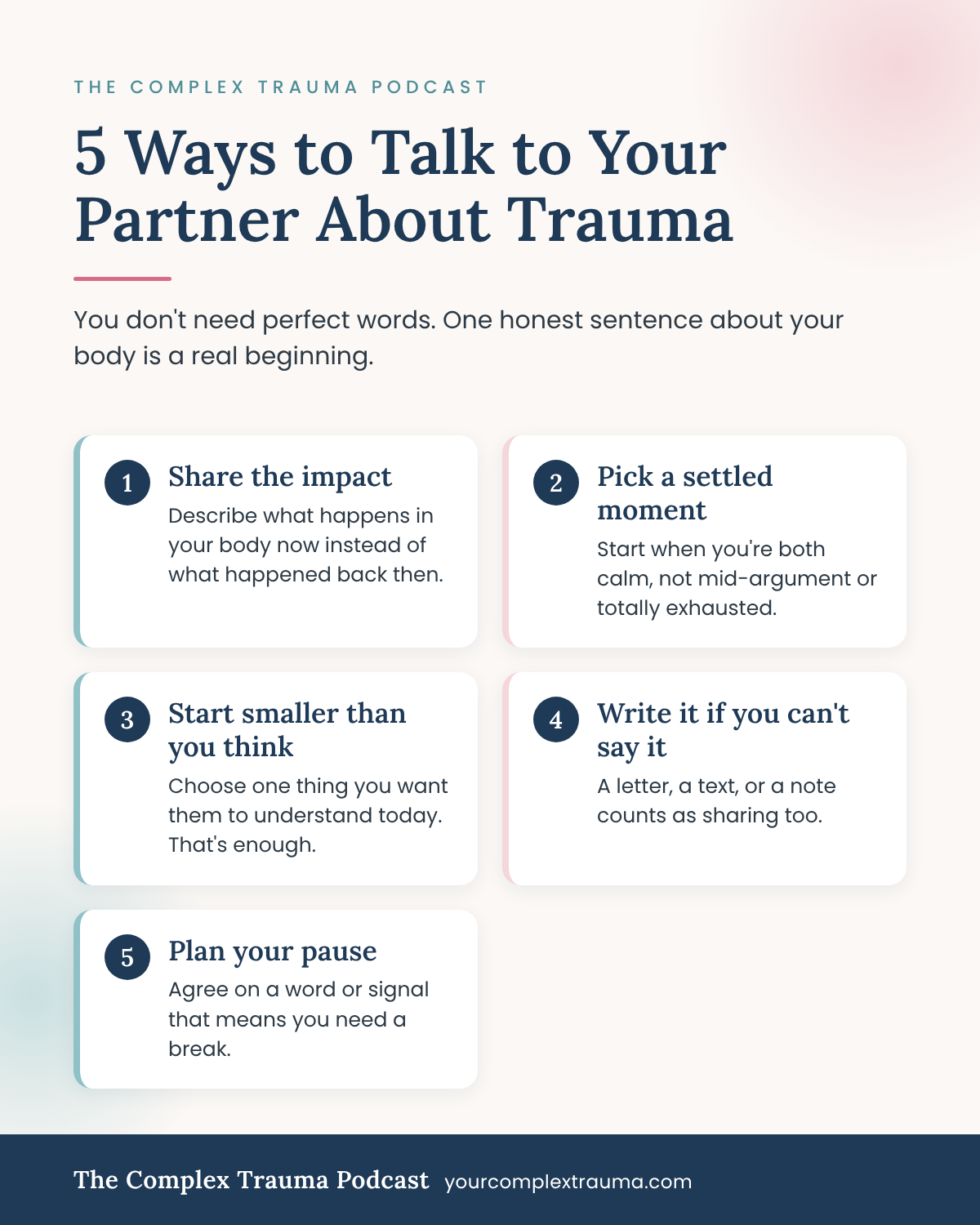
Do you have to tell your partner everything that happened?
No, you don't have to tell your partner everything that happened to you. Sharing the details of your trauma is a personal choice, and many survivors build deeply understood relationships by sharing the impact of their trauma rather than the full story.
There's a difference between your story and your impact. Your story is what happened back then. Your impact is how it shows up now: the startle when someone walks up behind you, the way you go numb during conflict, the reason crowded holiday gatherings leave you wiped out for days. Your partner is already living alongside your impact, even if they don't have words for it yet. Helping them understand it can change a lot, whether or not you ever share a single memory.
Research backs this up. A 2021 meta-analysis of 29 studies on survivors of betrayal trauma, which includes childhood abuse, found that negative reactions to disclosing trauma were linked to more PTSD symptoms. Positive reactions to a disclosure, on their own, weren't linked to fewer symptoms. What was linked to fewer symptoms was general, everyday social support (Tirone et al., 2021). In other words, one big conversation may matter less than a relationship where support keeps showing up in ordinary ways.
So if the idea of telling your partner everything feels impossible, you can take that pressure off. You can start with how things feel now and decide about the rest later, or never.
How do you get your body ready before the conversation?
The best time to talk about trauma is when both you and your partner feel fairly settled, not in the middle of a fight or when one of you is exhausted. Preparing your body ahead of time can make it much easier to stay present while you share.
In trauma therapy, we often talk about the window of tolerance, a concept from psychiatrist Dan Siegel. It's the zone where you can feel your feelings, think clearly, and stay connected to another person all at the same time. Hard conversations go best when you start inside that window. A few things can help you get there:
Pick a settled moment. A slow weekend morning usually goes better than right after an argument, a long workday, or a stressful family visit.
Check in with your body first. Notice your feet on the floor, where your breath is sitting, and whether your shoulders are up near your ears. You don't have to fix anything. Noticing is enough to bring you a little more into the present.
Decide what "enough" means for today. Before you start, choose one thing you want your partner to understand. If that's all you get through, the conversation was still a success.
Tell your partner what you need. You might say, "I want to tell you something important. I don't need advice. I just need you to listen."
Practice first, if you can. Saying the words out loud in a therapy session first can take away some of the shock your body feels the first time you say them to someone you love.
How do you explain the impact of trauma without the details?
One of the simplest ways to explain the impact of trauma is to describe what happens in your body, then name what helps. Your partner usually can't see what's happening inside you, so putting words to the physical experience gives them a window in.
Try filling in this sentence: "When ___ happens, my body ___, and what helps is ___." Here are a few examples:
"When plans change at the last minute, my stomach knots up and I get short with you. What helps is a heads up, even a small one."
"When you go quiet after we argue, I feel about six years old and start apologizing for everything. What helps is hearing that we're okay, even if we're both still upset."
"When someone compliments me in front of other people, I feel really exposed and want to disappear. What helps is letting it land without making a big deal of it."
"When I'm overwhelmed, I go numb and far away. What helps is you staying close and not asking me a lot of questions right then."
Notice that none of those sentences mention what happened in childhood. They're still deeply honest, and they give your partner something real to work with. If you want to set a limit around the details, you can say that too: "There are parts of my childhood I'm not ready to talk about. What I can tell you is how they show up now."
What if you start to flood or shut down halfway through?
If you start to feel overwhelmed or shut down while talking about trauma, it's okay to pause. Taking a break, grounding yourself in the present, and coming back later is a healthy way to share, and it often keeps the conversation from going sideways.
In Somatic Experiencing, the body-based trauma approach developed by Peter Levine, there's an idea called titration. It means working with hard material in small doses, so your nervous system can take in a little at a time without getting overwhelmed. There's a related idea called pendulation, which means moving back and forth between something activating and something that feels steadier, so your body gets to settle in between. Both apply beautifully to talking with a partner. You don't have to say it all in one sitting.
It helps to know your early warning signs. For some people, it's heat rising in the face or chest. For others, it's speaking faster and faster, a tight throat, words slipping away, a foggy feeling, or a sudden urge to leave the room or apologize. When you notice those signs, you can try a few things:
Name it out loud. "I'm getting overwhelmed. Can we pause for a minute?"
Come back to the room. Look around and notice a few things you can see. Feel the couch underneath you. Remind yourself where you are and who you're with.
Shift to something steadier. Talk about something easy for a few minutes, step outside together, or get a glass of water. Then check in with yourself about whether you want to keep going.
Agree on a signal ahead of time. A word or a gesture that means "I need a pause" can do the talking for you when words aren't available.
Pausing is part of the conversation. Every time you step back and then come back, your body gets a little more evidence that this is something you can survive.
What should you do after you share something vulnerable?
After sharing something vulnerable, it's common to feel exposed, regretful, or anxious, sometimes for a day or two. That feeling is normal, and it usually passes, especially when you're gentle with yourself in the meantime.
Brené Brown calls this a vulnerability hangover, and it's such a good name for it. You might wake up the next day replaying everything you said, convinced you said too much, or scanning your partner's face for signs that they see you differently now. Part of you might want to take the whole thing back, or make a joke so it feels smaller.
That reaction makes sense. For a lot of survivors, being seen used to be followed by something painful, so your body is waiting for the other shoe to drop. You can help it by planning a gentle evening after a big conversation, keeping the next day as low pressure as you can, and doing something that helps you feel grounded, like a walk, a shower, or time with a pet.
It can also help to check in with your partner the next day. You might say, "How did that land for you? I've been feeling a little exposed since we talked." That kind of check-in often brings relief to both of you.
What if your partner doesn't react the way you hoped?
If your partner doesn't react the way you hoped, it doesn't necessarily mean the conversation failed. First reactions are often clumsy, and many partners need time to take in what they've heard before they can respond in a way that feels supportive.
Partners mean well and still get it wrong all the time. They might jump straight into fixing, go quiet because they don't know what to say, get angry on your behalf at the people who hurt you, or start talking about their own childhood. Those reactions can sting, but they don't have to be the final word. It's okay to come back to it later: "When I told you about this, I really needed you to just listen. Can we try again?"
There's an important exception. If your partner mocks what you share, uses it against you in arguments, or tells you how you should feel about your own experience, that isn't clumsiness, and you don't owe them a better explanation. You deserve support and safety. The National Domestic Violence Hotline is available 24/7 at 1-800-799-7233, by texting START to 88788, or by chatting at thehotline.org.
How can therapy help you talk to your partner about trauma?
Therapy can help you talk to your partner about trauma by giving you a safe place to find your words first, and by helping your nervous system tolerate the experience of being seen. Many people find that sharing gets easier as their own healing moves along.
Approaches like EMDR, Somatic Experiencing, and parts work can help your body learn that the past is over, so being known by someone safe stops feeling so threatening. Couples therapy with someone who understands trauma can also give both of you a guided space to have these conversations, as long as the relationship itself is safe.
I talk about all of this in much more depth in the episode that goes with this post, including what's happening in the body during flashbacks, shutdown, fawning, and big emotions, so you can share it with your partner if you're not sure where to start. You can listen here: How to Explain Complex Trauma to Your Partner.
And if you're in Pennsylvania and looking for a trauma therapist, my team at Reclaim Therapy would love to help. You can learn more at sarahherstichlcsw.com.
You don't need perfect words or your whole story figured out to be understood. One honest sentence about what happens in your body is a real beginning 🧡
Frequently Asked Questions
When should I tell my partner I have CPTSD?
There's no perfect timeline, but many people share once the symptoms start affecting the relationship or once they feel the relationship is safe enough to be honest. You can share that you have CPTSD and how it shows up long before you're ready to share any details about what caused it.
Can I tell my partner about my trauma in writing?
Yes, writing a letter, a text, or a note is a completely valid way to share. Writing can give you time to find your words and keep your body calmer than talking face to face, and your partner gets time to take it in before responding.
Is it okay if I never share the details of my trauma?
Yes, it's okay to never share the details of your trauma with your partner. Many survivors have close, understood relationships by sharing how their trauma affects them now, while keeping the specifics for therapy or keeping them private.
How do I explain childhood emotional neglect to my partner?
You can explain childhood emotional neglect by describing what was missing rather than what happened, such as nobody noticing when you were upset or helping you name your feelings. Then share how that shows up now, like struggling to ask for help or not knowing what you feel in the moment.
What if I don't remember much of my childhood?
Many survivors have gaps or foggy stretches in their childhood memories, and you can still explain how you're affected now. Memory gaps don't prove that something specific happened, and they don't prove that nothing did, so you don't need to recover memories to deserve support.
Can couples therapy help with childhood trauma?
Couples therapy with a trauma-informed therapist can help partners understand each other and practice these conversations with support. It works best when the relationship is safe. If there is abuse or coercive control, individual support and safety planning come first.
If you love tuning in to the podcast, please take a second to leave a review! It truly helps other people find the show.
-
Sarah (00:40)
I want to tell him so much, but I just can't. that's from a message that one of you sent me, and I kept reading it over and over again. This person, she was asking for this episode. She wanted something she could share with her husband, something that could explain what it's like to live with the effects of childhood abuse, because she couldn't find the words herself. And then she said he's wonderful, he's supportive,
But most days she's so tired of herself that she figures he has to be tired of her too. Ugh. think that so many of you know that one, right? You want someone to get what's happening inside of you. But to explain it, you'd have to put words to stuff you barely understand yourself sometimes. And you'd have to do it while you're watching their face the entire time, trying to figure out if you just said too much. So today.
I'm going to try to do some of that explaining for you.
Hey everybody, welcome back to the Complex Trauma Podcast. So this episode, it's a little different. I kind of want you to listen to it on your own first. And then maybe send it to someone you love and care about and who you want to understand your experience a little bit more deeply. Or maybe play it in the car together and let me do the talking for a little bit.
Today I'm mostly going to be talking about partners, but honestly, a lot of this works for your best friend, your sister, whoever that person is.
And I want you to know that you don't have to agree with everything I say. And I really mean that. You might send this to your partner and be like, okay, the part about going quiet, that's me. But the reassurance stuff, that's not me at all.
And you know what? Great. Now you're talking about it. That's kind of the whole point.
But before we get into it, I need to say this part. Everything in this episode assumes that you're with someone where it's safe to be honest, to disagree, to say no. If your partner is threatening, punishing, or uses things that you tell them against you, a better explanation is not going to fix that. And I don't want you thinking that it's on you to explain yourself better. If that's happening right now, you deserve support.
including help figuring out how to stay safe. The National Domestic Violence Hotline is one eight hundred seven nine nine seven two three three, or you can text start to eight eight seven eight eight. Like I said, just had to put that out there.
And if you're the partner or the loved one listening because someone sent you this, hi, welcome. I'm so beyond glad that you press play. You don't have to walk away from this episode as like a trauma expert of sorts. If you come out of it understanding your person just a little bit better
maybe with a couple questions to ask them and maybe feeling a little less pressure to get everything right, That's what I call a win.
Okay, so I want to start where we can take some of the pressure off. Helping someone understand your trauma doesn't require you to walk through everything that happened to you.
You can tell them. You can also just want them to know. there's nothing wrong with that at all. But you, you get to choose how much, when, and whether you're ready. I think sometimes we make this conversation so big in our heads that it becomes impossible to start because this stuff is big. Like we picture sitting someone down, opening up our entire childhood while somehow staying like coherent and also making sure that they're okay with what they're hearing.
that's a lot to ask of yourself on a regular Thursday night.
So permission to start so much smaller. Something like sometimes when we disagree, I get so scared of making things worse that I can't figure out what I actually think. Or
when you touch me and I don't expect it, I startle. Could you start to say my name first? Or there are things from my childhood that affect me. I'm not ready to talk about the details, but I want you to understand what happens for me now.
Do you see how none of those things tell the story? And your partner still learned something real from every single statement. There's actually some research that I want to share that backs this up. A meta-analysis looked at 29 studies of people who'd been hurt by someone they trusted, which includes childhood abuse. people disclosed and got negative reactions like being doubted or blamed, that was linked to more PTSD symptoms.
But also a good reaction to one big disclosure by itself Didn't seem to make much of a difference. What was linked to fewer symptoms was everyday support. People who show up in everyday ways over and over again. So all of that to say,
you don't need one big perfect conversation where you finally say everything. you need a relationship where support shows up on a regular Tuesday.
You also really don't need a complete explanation for a why of every single reaction. I got overwhelmed, and I'm not sure why yet, is an honest answer.
Okay, partners, let me talk to you specifically for a minute here.
You might know some of what happened to the person that you love and care about. you also might know very little. Either way, it can be really confusing to understand why something from years ago is still showing up in a conversation you're having today. So here's a little bit of background. complex PTSD or CPTSD is a diagnosis in the World Health Organization's diagnostic system. It's called the ICD 11.
It includes PTSD symptoms you've probably heard of, like reliving traumatic experiences, avoiding reminders, and feeling under threat. And then it adds ongoing struggles in three areas, regulating emotions, a deeply negative sense of self, and relationships.
It often follows trauma that was repeated or went on for a long time, like childhood abuse and childhood emotional neglect. And people can absolutely struggle with the effects of childhood trauma and emotional neglect without meeting the full criteria for that particular diagnosis.
And your person, they might not call what happened to them abuse at all. For a lot of people, it was more that nobody was really paying attention to what was going on inside of them. That's emotional neglect. And so much of this applies there too.
So today we're talking about patterns you might recognize. Please do not use this as a checklist to diagnose one another. When someone grows up afraid of the people they depend on or just really alone with their feelings, relationships come with a lot of learning that no kid should actually have to do. When do I speak? When do I stay quiet?
What does that look on their face mean? How can I keep this person from getting angry? What happens if I need something they don't want to give? Does anyone else ever notice when I'm upset? And these questions they can keep showing up in adulthood. even with people who are caring and trustworthy.
So someone can know you love them and still feel scared when your voice changes. They can want your comfort and feel super exposed when you offer it. They can have something really important to say and hear themselves saying, never mind, it's fine. which is confusing as hell from the outside and honestly from the inside too.
But I wanna put something really clearly on the table before we go any further.
Just because your person has a trauma history, it doesn't mean that every single reaction is about the past. sometimes something really did just happen between the two of you and their feelings about it are completely valid. An old fear can get stirred up during a real disagreement. A trauma response can happen after a comment that was really hurtful. Someone can be completely overwhelmed and still have valid concern about how you just spoke to them.
So please don't walk away from this episode thinking like, oh, when you're upset with me, that's just your trauma. We still need to ask what happened between you. We still need to listen to the concern. Knowing the history is supposed to help you have that conversation, not get you out of it.
Okay, so now that you've got a little bit of background, here's the thing that I think makes everything else in this episode kind of click. Your body is talking before you ever open your mouth. And let me explain that a little bit. Our bodies are constantly scanning for safety and danger way underneath our awareness. We call this neuroception.
Your person's body is reading the tone of your voice, your face, how fast you're talking, how you're breathing, before their brain has even finished processing your words. and for someone who grew up having to track the adults around them to stay safe, that scanning is turned way up. So you can say all the right words. And if your jaw is tight and your voice has an edge, their body might still hear danger.
But it also works the other way too. When your voice slows down, when your face kind of softens and your body isn't in a big rush, your person, their body, can pick up on, you're okay with me, before you've even said a word. That's what we call co-regulation. Nervous systems, they borrow from each other. It's how babies learn to calm down. And honestly, it's still how adults we settle with one another,
Which means sometimes the most helpful thing you can do in hard moments is take a breath and settle yourself first. Your calm is actually contagious, and so is your panic.
The other idea I want you to have is something called the window of tolerance. Picture a zone where your person, your partner, your friend, whoever can feel their feelings. Think really clearly and stay connected to you all at the same time. That's the window. When something stirs up old stuff, they might get pushed out of that window in two directions. They might go up. That can look like anger, panic, crying, arguing,
Leaving the room or talking really fast.
Or they might kind of go down, they might look kind of flat or foggy, they might be a bit numb or far away from you, or give you a really kind of unconvincing I'm fine.
And the reason why I share that, the window of tolerance, is because it's really hard to solve a problem when someone is outside of their window.
Again, that zone where they can feel their feelings. Think really clearly and stay connected to you.
Honestly, it's hard for anybody. So in those moments, set aside figuring out who's right. Focus on helping both of you come back.
Whatever it is that you are talking about in these moments, the dishes, the in-laws, the thing they said at dinner, can wait until you're both back into your window. It's going to be so much better then. And survivors, this of course applies to you too. Your partner also has a window, right? When they're stressed or flooded, they might not be able to show up the way that you want to either. you're actually two nervous systems in this, not just one.
Okay, partners, let's put this into real life. Have you ever had a moment where something kind of tiny, at least you thought tiny, happened, and all of a sudden your person was way more upset than the moment seemed to call for. And neither of you could figure out how you actually got there. It usually starts with something pretty small, like your tone shifts a little bit. A conversation ends kind of abruptly, or you say those four words, like we need to talk.
On the inside, your person might be getting hit with a huge rush of fear or shame or total certainty that they've done something terrible.
sometimes there are images or memories that kind of show up for your person, and sometimes there aren't. They might suddenly feel really young, kind of powerless, or like they're about to be abandoned without any clear memory attached to it. You might have heard the phrase emotional flashback. It was popularized by Pete Walker to describe that kind of experience. And a lot of people find it to be really helpful language.
It's not a label for every big feeling though, and it doesn't replace understanding what's actually happening for your person.
In the body, it can kind of look like this. The stomach drops, the face gets hot, the chest tightens, or the whole body kind of folds in like it wants to get really small. Some people describe it like the floor suddenly kind of tilted. And underneath all of this, there's a feeling of being much younger than you actually are in this moment.
And here's why that happens. Your person's nervous system learned what danger looked like a long time ago. And it stored that learning in the body way more than some neat kind of little memory file of sorts. So when something in the present looks or sounds even a little bit like back then, a certain tone, a door closing a little too hard, a pause that goes on too long.
The body doesn't stop to check the date. It actually brings back the whole state all at once. The fear, the shame, the smallness. That's why it feels so much bigger than the moment. And in a way, it is bigger than the moment. because it's still carrying the weight of a lot of moments throughout childhood.
From the inside it might sound like
I know we're talking about the dishes, but I feel like I'm about to lose my entire relationship.
And survivors, if that's you, I know how scary that gap can be.
I imagine you're even judging yourself while it's happening. Like, why am I this upset? Why can't I just keep my cool? Why can't I just answer? So, partners, back to you. Here's what tends to make this harder. Demanding an explanation of what's going on in the middle of it. Like, tell me why you're acting like this is asking for clarity at the exact moment. Clarity is the hardest to get to. That's outside of your person's window in that moment.
A better starting point might be, do you wanna pause for a minute or would you like me to stay close or do you need a little bit of space?
And then when things are calmer, talk about what actually feels supportive in these moments.
Some people love being reminded where they are and who they're with. Other people really hate having someone announce that they're just triggered.
This is one of those things where you actually have to ask your person what they need in these moments.
and I really want you to keep your reassurance honest. Like, I'm upset about this and I wanna work through it with you can be so much more helpful than saying, like, okay, I'm fine, everything's fine, let's just move on when clearly things are not that fine.
You absolutely don't have to promise that you'll never get frustrated or you'll never need space. That's not actually what happens in relationships, right? You can just be honest about where you are in each moment.
And speaking about being honest about where you're at, this next one comes up so much. Partners, maybe your person notices every sigh, every pause before you answer, every little change in your face. You're tired after work and they're already trying to figure out what exactly they did wrong. Being on guard all the time can be part of PTSD. But I want you to understand what's actually going on here because
It has very little to do
with your person being what a lot of people would label as insecure.
When a nervous system grows up in a house where an adult's mood could flip in a second, and that flip meant something bad was coming, it gets really, really good at reading faces. and it learns something else too. Not knowing can be the most dangerous place to be. So when your face is neutral or you sigh, or you're a little bit more quiet than usual.
It doesn't land inside of them like, uh, it's probably nothing.
They fill in the blank with the worst story because back then that was probably the safest guess. In the body, that can feel like a constant low hum, like their shoulders are up a little bit. Their breath is sitting really high in their chest. Their eyes are always doing like one more check of the room. It's exhausting. And most people don't even realize they're doing it until someone actually names it.
And survivors, I imagine that you know that exhausting feeling. You're telling yourself to stop monitoring and you're still monitoring. You're trying to eat dinner while also like doing this full investigation inside of your head into why they just put their fork down the way they did.
Which is why partners, a little ordinary information can do so much. You're filling in the gap before their nervous system actually does. You know, bringing people into, I'm distracted because something's going on at work. I'm quiet because I'm tired. And when you are upset with someone, saying it clearly and kindly too. Things like, I'm bothered by what happened earlier. I want to talk about it after we've both had a minute.
That gives your person something real to work with. They don't have to keep guessing and you also don't have to keep pretending that you don't have any feelings at all. Now, reassurance, it can only go so far. Reassurance talks to the thinking brain. And this kind of fear that we're talking about lives a lot lower down in the body. So if you find yourself stuck in the same loop, are you mad? No, I'm not mad. And it never really lands, that usually means the fear needs more than words.
And that's a really good thing for people to work on in therapy together or on your own because that loop is really exhausting for you both.
Okay, so we've talked about bracing and scanning. So now let's talk about what happens when all of that kind of like tips on its head. Because one of the hardest things for survivors to explain is how fast their feelings can go from zero to a hundred. Partners, maybe you've seen it. something small happens, and all of a sudden your person is furious or sobbing or so irritated that.
Everything you do feels like too much. And then it can take a really long time for them to come back down. Hours sometimes. Sometimes they're still kind of raw the next day. This is what we might call emotional dysregulation. And it's one of the core parts of complex PTSD. remember those extra areas we talked about at the beginning, like trouble regulating emotions is the first one. So when your person says, I can't calm down, they usually mean it pretty literally.
This is how it can feel from the inside of someone experiencing it. It's like there's no dim or switch, just on or off. The feelings flood in all at once, heat in your chest, your jaw clenching, your heart pounding, maybe your hands are even shaking. You might hear yourself saying things you don't even fully mean while part of you is like watching it all unfold, thinking, why can't I stop?
and afterwards, there's usually a pretty huge wave of shame. And that's the part that most people don't ever see.
So why does this happen? Most of us learn how to calm down by being calmed down. When a little kid gets upset and a safe adult comes close, softens their voice, picks them up, that kid's nervous system borrows the adult's calm over and over again, thousands of times, until eventually it learns to do some of that on its own. That's co-regulation slowly turning into self-regulation.
but if the adults around you were the source of the scary feelings, or if nobody came at all, your body never got all of those reps. So the feelings still come really big, And there just isn't much built in to bring them back down. that makes this a skill that never got the chance to develop.
and the silver lining here is that skills can still be built.
And for those of you with emotional neglect in your history, sometimes dysregulation looks like the total opposite for a long time. Feeling almost nothing, being the calm one, the easy one. And then suddenly everything comes out all at once. When feelings weren't welcome growing up, a lot of people push them all the way down. And then they come out sideways or all at once when it's like your container gets too full. And partners, being on the receiving end of this can be really hard.
And your feelings about it count, right? It also helps to know that in the middle of it, your person's window is way too small for a logical conversation. Trying to win the argument right then usually just pours gas on it. This is a really good one to talk about once things have settled. Ask them when you get really flooded.
What helps you come back down and what actually makes it worse? And survivors coming back afterward and naming it something like, I got so flooded and I'm really sorry that it landed on you. Matters so much. That's repair. And every time it happens, it teaches both of your bodies that big feelings don't have to end the relationship.
The really hopeful part is that regulation, it really can be learned at any age. It's a lot of what we do in therapy. every time you notice the flood starting a little bit earlier, and every time someone helps you come back down, you're building something your body didn't get to build when you were little.
Sarah (20:48)
I'll right back after a quick word from this episode's sponsor.
Sarah (20:57)
I've really gotten into making my own little holiday traditions. The kind that are just for us and don't involve stressing about anybody else. One of mine is a Saturday in December wrapping presents in the softest pajamas I own, holiday music on,
coffee I'll probably forget about and reheat like three times. the bamboo stretch knit pajama set is perfect for that. It's ridiculously soft, it moves with you, and it's perfect for those mornings over the break when the whole house just stays in pajamas until noon. they're also such a good gift for the person who'd never splurge on nice pajamas for themselves.
a lot of their bestsellers come in holiday colors this year too. And it's Cozy Earth's best pricing of the year through December third. And with a hundred night trial and a ten year warranty, there's no risk in trying them.
Cozy Earth's biggest sale of the year ends December third. Head to cozyearth.com and use code Reclaim for thirty-five percent off home and sleepwear. That's cozyearth.com, code Reclaim, and when they ask a checkout where you heard about them, let them know that the Complex Trauma podcast sent you.
Sarah (22:01)
asking, are you mad over and over again is one way old fear can show up, but sometimes it shows up as the total opposite. Partners, instead of getting a flood of questions, you might actually get silence. like you ask and your partner goes blank. They say, I don't know. They can't tell you what they need. Maybe they seem a little far away or foggy
Or suddenly not really into a conversation anymore.
There can be a lot of reasons that this can happen. overwhelm can make thinking and talking so much harder. Some people dissociate, which can feel like being detached from yourself or from what's going on around you. And silence can also just mean someone's thinking or scared or angry or not sure how to respond.
You of course can't really tell which one from silence alone. Survivors, let me try to put words to what this feeling can feel like from the inside, because I think it's one of the hardest things to kind of explain. Sometimes the words are actually there, but they're really far away, like they're at the bottom of a pool. Your throat kind of gets tight and your voice just won't come out. Your body gets heavy, like someone turned gravity way, way up.
Some people describe it like watching the conversation from behind glass or from a few feet back.
Everything gets a little bit foggy or muffled, you can know you want to say something and literally not be able to get it out. And partners, here's what's probably happening there. when a nervous system decides that fighting or getting away won't work, it can shift into kind of like a shutdown, almost like the body is pulling an emergency break. Everything slows down, energy drops.
And thinking clearly and finding words can get a whole lot harder. that's that dropping below the window we talked about earlier. And it happens automatically. There isn't choice here. From the outside, that silence can look like stonewalling. But from the inside, it's a body that hit its limit and went into protection mode.
For a lot of survivors, there's also a long history of learning that words can actually make things worse. Explaining got called arguing, crying got called manipulation, disagreeing had serious consequences.
And survivors, there's another piece here for you. So many of you, especially if you grew up with emotional neglect, never had anyone name your feelings for you. Nobody sat down next to you and said, like, oh, you must be disappointed. Or that was really scary, huh? That's how kids learn feeling words from the adults around them. So if you never got that, of course the words aren't there now.
It's like they were never handed to you.
That's a skill that you get to build and has nothing to do with being bad at communicating.
So, yeah, there's something to say. It's just not that simple to get it out. So, partners, what helps? Honestly, probably less. Fewer words, fewer questions, a softer, slower voice.
less talking, it doesn't mean less of you, right? For a lot of survivors, going quiet and then having the person pull away is exactly what hurts the most.
So this is something to talk about, like what your person needs in these moments. It might be staying close, sitting next to them, letting them know that you're there, something like, I'm not going anywhere. We can figure this out when you're ready. And then another gentle question, like, do you want me to stay right here? Or would you like a little bit of space? There may be no answer at the time, right?
But over time, you can have these conversations and calm moments to help kind of decipher what it is that your person needs.
If you do end up pausing a conversation, say when you're gonna come back to it. we want the pause to feel like a breather instead of a door closing. And survivors, when you can, giving your partner even a little bit of information, of course, helps. something like I'm having trouble finding words, but I still want to talk about this.
You don't have to explain everything going on inside of you. Just enough to get through the next few minutes. And partners, if your person tends to go far away, ask them ahead of time what helps them come back.
Some people like hearing their name and noticing the room around them. Some people need less talking. Touch can help one person and it can really startle another. Go with what you've learned together instead of insisting on a grounding exercise just because it's worked for somebody on the internet.
Okay, so silence is one thing that you can usually see, right? You experience that. You can tell something's off. But partners, this one is kind of a lot more sneaky because sometimes the struggle
hides behind your person seeming really easygoing. They don't care where you eat, they don't need help. They say yes really, really fast. They tell you something's fine, and then later you find out it actually wasn't.
A lot of people call this fawning or appeasing. It's trying to stay safe or stay connected by keeping the other person happy. It's helpful language for a lot of survivors, and it's not like a formal diagnosis or anything like that. If your person learned really early on that having needs caused problems or that those needs just never got met at all, they might agree before they've even had a chance to notice what it is that they want.
Survivors, again, I know you know this one. Someone asks you a question and the yes is out of your mouth before a thought has even formed. Your eyes were already on their face checking. What's the right answer here?
Are they okay?
And then later, sometimes hours later, there's this little sinking feeling in your stomach when you realize that's not what you wanted at all.
That's because fawning happens faster than a decision.
This is described as the fourth survival response alongside fight, flight, and freeze. It's more of like a clinical idea than a research category, but it fits what so many survivors can describe. When a kid can't fight back and can't get away, sometimes the safest thing they can do is keep the scary person happy. the body learns that fast and it learns it really deep. So years later, even in a relationship that's
actually safe, the body can still reach for it first, especially the second there's any tension in the room.
And then they feel stuck. I already said yes. Am I allowed to change my mind? Will they think that I'm lied or that I'm a bad person?
Partners, this is a really good one to talk about together. Ask your person what makes it easier for them to slow down a yes or to take one back. For some people, hearing you can think about it takes the pressure right off. Others mostly need to know that changing their mind won't cost them anything in your relationship.
And partners, you're of course allowed to be disappointed by an answer. That's human. But if every no from your person gets met with sulking or pressure or a debate until it turns into a yes, it makes total sense that honesty from them would feel really hard. at the same time, please don't start treating every single yes like it's secretly unreliable or something. Your person still gets to speak for themselves.
You want them to feel like they can be honest with you. and sometimes honest is like, yes, I'll do that. Survivors, you can practice with a sentence as small as, I think I answered too fast. Can I think about that? And if you only figure out what you actually wanted an hour later, like cool, that can still count.
Okay, so fawning is about keeping the other person happy to stay safe. But sometimes the hardest part has nothing to do with saying yes or no. It's about what happens when the love you've wanted is actually right there. And partners, this one, it can be really painful for both of you. A survivor might want connection and then feel uncomfortable once they have it.
They might ask for reassurance and struggle to believe your answer. They might want to be held and then suddenly need a ton of space.
And partners, I know this can feel so, so personal. Usually it's way less about how they feel about you And way more about what closeness might have meant when they were little.
If care was unpredictable when your person was little, when they were a little kid, or if closeness came with hurt, or if nobody really showed up for them emotionally, receiving love can bring up a lot more than relief. There might be a lot of fear about what's going to be expected, what happens when it ends, or how exposed it feels to need somebody.
In the body, this can be so confusing. Your person might lean into a hug and then feel their shoulders brace or notice that they're holding their breath.
A hand like on the back of the neck that's supposed to be loving can register for a split second as being trapped. Part of them is like melting into you and another part of them is scanning for exits.
what's happening is that their body might be picking up on cues that once meant danger, like being held still or being close with no way out. Even when their mind knows that there was someone safe. Both of those things are happening at the same time, and both of them are of course real.
Sometimes parts language can help put that into words. Part of me wants you close and part of me is scared.
Survivors, if parts language doesn't fit for you, you absolutely don't have to use it. But here's why I love it. So many people get stuck trying to figure out which feeling is like the real one. Do I actually want to be close or do I actually want space? Parts language lets you stop picking. The part of you that wants closeness is real, and the part of you that's scared is real too.
And all of this can show up in an even bigger way with sex and physical intimacy. So partners, if your person freezes, goes still in their body, or seems far away, pause and check in. don't take the absence of a no as a sign that it's okay to keep going. Do you want to stop? Do you want some space?
Have conversations outside of intimate moments about what feels good, what signals you can use, and how either of you can pause without pressure.
Remember a yes earlier doesn't take away anyone's ability to stop.
And if this is happening a lot, please get some support with it. A therapist who gets trauma and intimacy can help so much. And you too shouldn't have to figure this out by trial and error, right?
Okay, survivors, I want to turn to you for a minute because underneath everything we've talked about so far, the flashbacks, the silence, the yes that comes out way too fast, the pulling away when love is right there, there's usually a fear sitting underneath all of it.
You have another hard day. You need reassurance again. You go quiet during a conversation you really wanted to have. and before your partner has said a single word, you're already thinking, how much longer are they gonna put up with this?
For a lot of you, especially if you were the easy kid, the one nobody had to worry about, being loved has felt conditional on how little you needed. So needing help can feel like you're burning through some limited supply of goodwill of sorts. If that's familiar, I want you to notice how fast you go from I'm having a hard time to deciding what that means about your worth as a partner.
And notice what happens in your body when that thought hits. a lot of people feel themselves collapse inward. Shoulders round, head drops, eyes go straight to the floor. your face might get hot. There's this pull to make yourself smaller or to just disappear. When you were little, getting small and invisible
might have been the safest move in the house. So your body, it probably still reaches for it, even when the person in front of you is reaching out for you.
I wanna remind you that you can be struggling and still bring warmth, humor, care, desire, thoughtfulness, and so much more into a relationship. Your hardest moments are not the whole picture of what it's like to love you.
And here's something that I think is actually pretty reassuring. Researchers have done a meta-analysis on how one partner's childhood abuse or neglect affects the other partner. The link between one person's childhood maltreatment and their partner's relationship satisfaction was small, like trivial to small.
Now, of course, I can't tell you how your specific partner feels or your friend or whoever it is that you're sharing this episode with.
That's a conversation between the two of you. But the fear that you're a burden, it is an evidence that they secretly regret having a relationship with you. So partners, when your person says, I'm sorry you have to deal with me, it can help to answer in a way that leaves room for what's real. You'll find your own words, but it might sound something like, I love you, I care about you. Some moments are hard,
And I want us to have help with those moments. You can care deeply about someone and still need rest. You can be completely committed to the relationship and still need something to change. Those are conversations you should be able to have. And survivors needing those conversations, it doesn't mean that you've failed to be lovable enough.
When we talk about supporting someone with trauma, there's a risk that the partner starts to feel responsible for preventing every hard feeling. it's like they watch their tone constantly. They stop bringing up concerns. They say everything's fine because they're scared of what an honest answer might actually set off.
partners, if that's you, I know it can get pretty lonely. It can be really intense. There's actually research on couples dealing with PTSD that looks at exactly this. It's sometimes called partner accommodation.
Partners who did more of it tended to feel more distressed themselves, and it was linked with more PTSD symptoms and lower relationship satisfaction over time. Most of that research is with veterans and their partners, so we can't really map it perfectly onto childhood trauma, but I think clinically it can track, right? Being thoughtful, it really matters, but there are two people in this relationship, and both of you have needs, and both of you get to say them out loud. Now, survivors.
I know accountability, can bring up like a huge rush of shame. You might already know that you've hurt someone. You might be replaying it over and over and feeling so awful that coming back to the conversation feels impossible. But drowning in how terrible you feel doesn't always help the person who got hurt. They might still need you to hear them. We're coming back to repair here. Repair can sound like I was overwhelmed when I spoke harshly. I'm sorry.
I want to understand how it affected you. And then when there's room,
Next time I notice that's happening, I wanna ask for a pause sooner.
And here's why repair matters so much from a nervous system point of view. When a lot of you were growing up, ruptures never got repaired. Someone blew up and then everybody acted like it never happened. Or there was silent treatment that went on for days. So your body never got to learn the second half of the story, the part where things go wrong and then come back together. Every single time the two of you have a rupture and actually repair it.
Both of your nervous systems get to practice that second half. That's co-regulation. And honestly, it might be one of the most healing things that a relationship can actually offer.
you don't have to apologize for having a feeling or for setting a reasonable boundary. We're talking about owning behavior that caused harm. Partners, that goes both ways. If you spoke cruelly, brushed off a concern, or broke an agreement, your person's trauma history doesn't cancel your responsibility to repair it.
And you know, I really think that sometimes one of you or even both of you, right, need help making these conversations possible because they're big and they're hard and they're messy. Individual therapy, couples work,
with someone who really understands trauma and support outside of the relationship can all have a place. If there's abuse or coercive control, get individual guidance about safety rather than assuming couples therapy is the next step.
Your relationship, like I said, it can be a huge part of your healing and it's also allowed to need some help too.
Okay partners, before we wrap this up, I wanna come back to you for a few minutes because there are a handful of things that can come up all the time that are so hard to put into words, and I really don't want to leave them out. First, nighttime. A lot of survivors have nightmares, and sometimes they're not even about what happened. They're about being chased or trapped or trying to scream with nothing coming out.
Your person might wake up with their heart pounding, sweaty, totally disoriented, and not even able to tell you what the dream actually was. Some people start dreading sleep altogether because nighttime is when the guard finally comes down, and that's when everything they've been holding all day can come up. So if your person is exhausted or keeps staying up way too late,
That might be part of why. Next, the ways of coping that might not look like coping. Overworking, taking care of everyone except themselves, doom scrolling for hours, food, alcohol, shopping, staying busy every second. From the outside, it can look like a bad habit, From the inside,
It's usually a way to keep feelings at a distance that would otherwise feel like way too much. busy keeps the body from having to feel. Numb is a lot quieter and easier to handle than flooded. These were survival strategies first, and a lot of them worked for a really long time. So instead of starting with why do you keep doing that, it can help to get curious together about what it's been helping with.
And then there's memory. Partners, this one confuses so many people. What do you mean you don't remember most of your childhood? Everybody forgets a lot about being a kid, but for a lot of survivors, it's more than that. Whole stretches can feel foggy or just blank. When a kid's nervous system is overwhelmed over and over, it usually doesn't store memories the way it normally would. And dissociation can make big chunks of time feel really blurry.
that can be really embarrassing or make your person doubt themselves quite a bit. And gaps don't prove that something specific happened and they don't prove that nothing happened either. Your person doesn't have to go digging for the missing pieces. What they're living with now is enough to work with.
And then there's exhaustion. You didn't even do anything today. Why are you so wiped out? I think a lot of people hear that or even think that themselves. Living in survival mode burns so much energy. Remember that constant hum that we talked about, that scanning embracing, a body doing that.
All day is working really, really hard, even when it's sitting on the couch. And for a lot of people, especially the high-functioning ones, the tiredness hits hardest the second they finally stop. It's like the body's been holding it together all week, and the moment it's safe to let go, it crashes. That's a body that's been on duty for a really long time, probably years.
and the last one which kind of surprises people the most is when good days can be really hard. A great weekend, a really connected night together, and then the next day your person is flat or anxious or picks a fight or pulls away. For a lot of survivors, good moments they didn't last growing up.
Things were really calm right until they weren't. So when someone feels good, part of the nervous system braces for whatever usually came next. Joy can feel really exposed. Like if you let yourself really experience it, you'll get blindsided. So that crash after a good day usually has very little to do with the day itself. It's like the body is bracing for the other shoe to drop.
Partners, I want you to know you don't have to fix any of this, but just knowing what might be underneath can change how you see what's happening right in front of you.
Which kind of brings us to the practical part. Because survivors, I know some of you are sitting here thinking, like, Okay, Sarah, yes, this makes sense. I want my person to know this.
But I still don't know how to start.
sometimes the hardest part is just getting the words out at all. If talking about things feels impossible, I'd encourage you to write it down, send a text, leave a note, or even start side by side on a walk instead of making yourself hold eye contact across a kitchen table. Sometimes less eye contact, less kind of felt pressure can mean more words.
And you can also talk about how to have the conversation before you have it. I want to tell you something, but I don't need advice. Could you just listen to me for a few minutes? Or I need to stop halfway through. Can we let that just be okay?
And if you're a partner listening to this, I want you to know that you get to ask about timing too. If you don't have the attention or the emotional room for a big conversation right then, be specific about when you can come back to it. Like, I want to hear this. Can we sit down after dinner? Lands so differently than an open-ended, not right now. Basically, you both get a say in how this goes.
Here's
what I invite you to try to do. Pick one moment you want help with and try describing it in the way your body experiences it. That's usually the piece your person is actually missing.
Like when we disagree, my chest gets really tight and my mind goes blank. Can you give me a minute to find my words? when I go quiet, it's like the volume on everything turns way down and I'm really far away. If you ask me whether I need a break instead of why I'm doing this, it's so much easier to come back.
When I say yes right away, sometimes it's my body answering before I've checked in with myself. Can you give me a second to actually think about it? When your voice gets sharp, even when you're not mad at me, my whole body braces. It really helps when you slow down. Or just there's a part of this episode I want you to hear. Can we listen to it together? Partners, a really good question afterwards is what felt familiar to you?
Then listen to whatever they choose to tell you. You don't have to point out every pattern you think you recognized. You can ask, when that happens, what would you like me to do? Is there anything I do that makes it harder? and of course you get to answer those questions about your own experience too.
Sarah (43:36)
So to finish this episode out, let's come back to where we started To the listener who wrote, I want to tell him so much, but I just can't. If that's you, I don't know that the goal is to go home tonight and finally explain everything. Honestly, I'd love for it to be like so much smaller than that. Maybe you play him one part of this episode and say,
Like that. That's what happens to me. And that's it.
here's what I really believe after all these years of doing this work as a therapist and doing my own work, you don't need to understand your whole childhood before you're allowed to be understood now. You don't need perfect words. Your body has been trying to tell this story for a really, really long time. And every time you put even a little bit of it into words and the person in front of you stays, something in you gets to learn that being known doesn't have to end in getting hurt.
And to anyone carrying that, they must be tired of me feeling. I know it feels so true. But needing support doesn't use up your right to be loved. You survive something really hard and you get to be loved while you heal. not someday when you have it all figured out, right now, in the middle of it. so if there's someone you've been trying to find the words for, send them this episode.
You don't have to write a whole thing. Maybe this is some of what I've been trying to tell you about is more than enough.
And to the partners, the friends, the adult kids, whoever's listening, because someone sent you this, here's what I want you to take home. If they sent you this, that was so brave. For a lot of survivors, handing you this episode is the explaining. It might be the closest they've been able to get to saying it out loud. So you don't have to respond perfectly. You don't have to read every book or say the exact right thing. Just get curious. Ask them what part of this felt like you?
And then really listen to whatever they choose to tell you, even if it's only a little bit.
And know that what helps a nervous system that learned the world wasn't safe is you showing up the same way again and again, staying close when it gets hard, coming back after the hard moments. That steadiness is doing so much more than you can see from the outside. And take care of yourself in this too. You absolutely matter here.
I really, really hope that you're walking away from this episode feeling a little bit more seen, a little bit more hopeful and as always, less alone.
I'll be back next week, so until then, take good care of yourself.