Bonus Episode!
For some people, yes. Dance and other kinds of movement give the body a way to feel and express what words can't reach, and that can make room for grief and trauma to move instead of staying stuck. Movement won't replace trauma therapy, and it isn't right for everyone at every stage of healing. Still, it can be a powerful way back into a body that hasn't felt safe to live in.
I didn't expect to be writing about this. I was in Las Vegas recently for the Not Alone Summit, and I ended up sitting down with Super Cr3w, the b-boy crew that won season two of America's Best Dance Crew back in 2008. I figured we'd have a fun, light conversation about their new show. We did, and then it turned into one of the most honest conversations about grief and the body that I've had in a long time.
What Super Cr3w taught me about grief and the body
These guys have been dancing together since they were teenagers. Over the years they've lost parents, raised kids, traveled the world, and stayed a crew through all of it. When I asked how they take care of their mental health, one of them told me that when his mom died, dance was the only way he could express what he was feeling. He had no other outlet for it, so he went harder into his craft than ever before.
Another crew member shared that he had never had a panic attack in his life until he lost his mom, and then he had three. Then he said something that stopped me. He realized, talking about it out loud, that some people feel that way every single day.
One of them summed it up in a way that has stayed with me. He said breaking is therapy for all of them, and that it's something they reach for whether they're happy, sad, or angry. As a somatic therapist, I sat there thinking that this is embodiment. They had found a way to let their bodies carry and release what their minds couldn't hold on their own.
Why does trauma disconnect us from our bodies?
When something overwhelming happens, especially over and over or early in life, your nervous system does what it needs to do to get you through. Sometimes that means bracing. Sometimes it means going numb, floating up and out, or living mostly in your head. For a lot of people with complex trauma, being fully in their body has never felt safe, so they learned to leave it.
That disconnection made sense at the time. It was a survival strategy, and a smart one. The problem is that it can stick around long after the danger has passed. You might notice that you don't really know what you feel until much later, that your body feels like something you manage rather than something you live in, or that grief and fear show up as tightness, exhaustion, or panic instead of tears.
A lot of the work I do with clients is helping them come back into their bodies slowly, in a way that feels safe enough. Insight helps, and it's often where we start. Healing usually needs the body to be part of it too.
How can movement help with grief?
Grief lives in the body. It can feel like a weight on your chest, a lump in your throat, or a heaviness in your arms and legs that makes everything harder. When words feel too small for what you've lost, movement can give that energy somewhere to go.
For the crew, dancing after a loss was a way to feel it all the way through. Moving to music can let emotion rise, crest, and settle in a way that talking about it sometimes can't. For some people, that process of letting a wave of feeling move all the way through the body is what makes grief more bearable over time.
Why does dancing feel so regulating?
There are a few reasons dance and movement can feel so good for your nervous system, and the crew touched on almost all of them without using any clinical language.
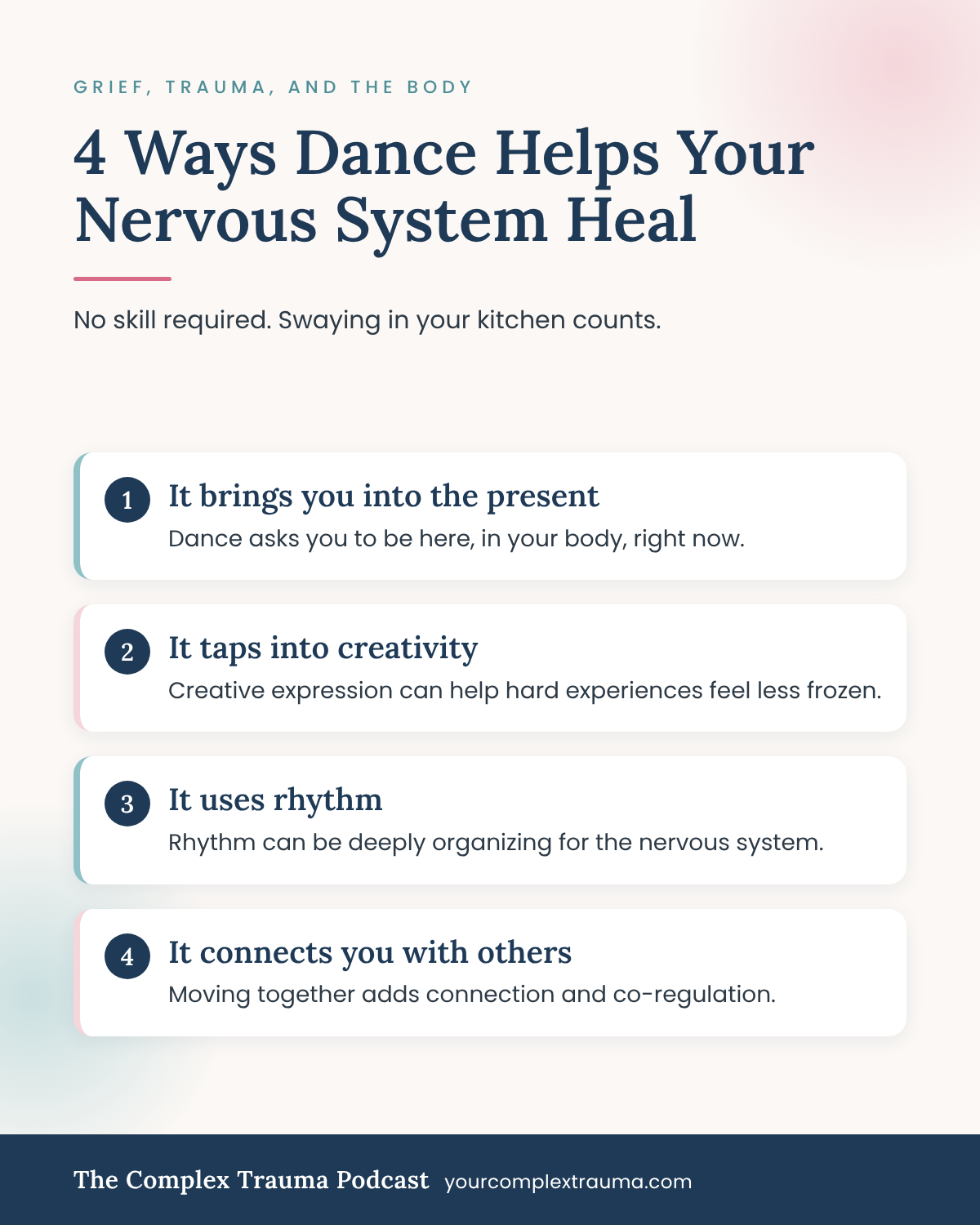
It brings you into the present. You can't do a power move while you're rehearsing tomorrow's argument in your head. Dance asks you to be here, in your body, right now. That kind of presence can give an overactive mind a break.
It taps into creativity. Creative expression uses parts of us that aren't busy analyzing and judging. For some people, that creative space is where hard experiences start to feel less frozen and more workable.
It uses rhythm. Rhythm can be deeply organizing for the nervous system. There's a reason people across cultures have danced, drummed, and rocked through hard times for as long as we've existed.
It often happens with other people. Moving together, whether that's a dance crew, a class, or your kids in the kitchen, adds connection to the mix. That brings us to one of my favorite parts of the conversation.
Why having a crew matters for healing
Near the end, I told them how much it must mean to do life with a group of people who have known you this long. I imagined it was amazing and hard at the same time. One of them said that having these people is what being rich means to him. Looking back, he said, they feel more like family than friends.
That landed for me because so much healing happens in connection. When you have safe enough people to come back to, your nervous system gets to borrow some of their steadiness. That's co-regulation, and it's one of the ways we learn, slowly, that we don't have to carry everything alone. Your crew doesn't have to be a dance crew. It can be a friend, a partner, a group, or a therapist who feels like a soft place to land.
What if dancing feels impossible right now?
You don't have to start dancing to heal. For some people, especially early in trauma recovery, intense movement or even paying attention to the body can feel overwhelming. That's okay, and it's important information. If something feels like too much, your no is a no.
If you're curious, you can start much smaller than a dance floor. You might let yourself sway to a song you love, walk while you listen to music, stretch in the morning, or gently shake out your hands after a stressful call. You get to choose the pace. Small, repeated moments of feeling okay in your body tend to matter more than one big breakthrough.
A note on screens and kids
We also talked a lot about AI and technology. All four of them are parents, and one of them said that for kids today, technology is their dopamine. When they were growing up, dancing in the garage was what made them feel good. Nobody told them to do it. They just wanted to move.
None of them think we can or should get rid of technology. Their message was simpler than that. Help your kids find something they love that isn't a screen, whether it's dance, sports, art, or something else entirely, and don't force it on them. A kid who has a place to express themselves has something to lean on when life gets hard.
Listen to the full conversation
You can hear the whole conversation in my bonus episode of The Complex Trauma Podcast, AI, Mental Health, and Finding Your Crew with Super Cr3w. We talk about breaking as therapy, grief, panic, parenting in the age of AI, and what it means to find your people. To catch Robots vs. Ninjas the next time it's on stage, follow Super Cr3w on Instagram and the show Robots and Ninjas.
Your body has been carrying you through a lot. Maybe it gets to move a little more freely now.
Take good care of yourself. 🧡
Sarah Herstich, LCSW, is a Certified EMDR Therapist, EMDRIA-Approved Consultant, and Somatic Experiencing Practitioner, and the host of The Complex Trauma Podcast.
Frequently Asked Questions
Is dance therapy the same as dancing for fun?
No. Dance/movement therapy is a specific clinical field practiced by trained and credentialed therapists. Dancing for fun, in a class, or in your living room can still be supportive and regulating, but it isn't a substitute for trauma treatment when you need it.
Can movement bring up trauma?
Sometimes it can. Paying attention to the body can stir up sensations, emotions, or memories, especially for people with complex trauma. Going slowly, keeping your eyes open, staying connected to your surroundings, and stopping when you need to can help. Working with a trauma-informed therapist can also make this kind of exploration feel safer.
Why would someone have panic attacks after a loss?
Grief is a huge experience for the nervous system, and for some people it can show up as panic, racing thoughts, or physical symptoms that seem to come out of nowhere. If this is happening to you, it doesn't mean something is wrong with you. It can be a sign your body is carrying more than it can process alone, and it's worth reaching out for support.
Do I have to be a good dancer for this to help?
Not at all. What matters is how movement feels in your body, not how it looks. Swaying in your kitchen counts.
Who is Super Cr3w?
Super Cr3w is a b-boy (breaking) crew that formed in 2000 from three crews: Battle Monkeys, Full Force, and Knucklehead Zoo. They won season two of MTV's America's Best Dance Crew in 2008 and created the family show Robots vs. Ninjas, which ran at On The Record at Park MGM in Las Vegas.